
WTF1
A big misstep by the world's premier road racing series

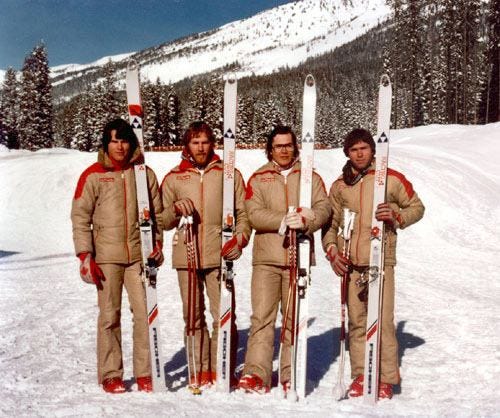
I credit the Canadian Broadcasting Corporation (CBC) with furthering my interest in a couple of sports. In the late 1970s and early 1980s, their coverage of the ski racing achievements of Steve Podborski, Ken Read, Dave Irwin, and Dave Murray, the foursome who most represent the era of the “Crazy Canucks,” was one of the inspirations I used to nurture my passion for alpine skiing. Serge Lang, the French journalist who co-founded the World Cup ski racing circuit in 1966, coined the “Crazy Canucks” term in 1976 to describe the on-the-edge racing style of the Canadian team. Their successes—Ken Read was the first man not from Europe to win a World Cup downhill race in 1975, and Steve Podborski was the first non-European to win the World Cup downhill season title in 1982—meant that all the World Cup downhill races were must-watch TV during those years.
Coincident with the success of the ski team was the arrival on the Formula One racing circuit of a diminutive French Canadian, one Gilles Villeneuve. Unlike modern F1 stars, who all got their start in kart racing, Villeneuve raced snowmobiles before pivoting to cars. How Canadian. He was first noticed in 1976 while competing in the North American Formula Atlantic series. To promote the series, race organizers arranged for several Formula One drivers to compete in a race at Trois-Rivieres, Quebec. Among them was James Hunt, who was just a few weeks shy of winning his first Formula One championship. Villeneuve trounced all of them, and Hunt returned to McLaren headquarters in England full of praise for the young Canadian.
Over the next five years, most of it with the legendary Scuderia Ferrari team, Villeneuve competed with a rare combination of daring, relentless pace, and stunning car control. Though he never won the Formula One championship—he finished second in 1979 to teammate Jody Scheckter after respecting team orders not to challenge Scheckter for the race win at Monza—his driving skills put him in the company of greats like Senna, Prost, and Schumacher. In the final race of 1979 at Watkins Glen, with Scheckter’s championship secured, Gilles was fastest in a wet Friday practice by nine, yes nine seconds, and drove to the win on Sunday. With Gilles making headlines as reliably as the Crazy Canucks, the CBC televised every race, and I watched every one I could. I’ve been a fan ever since. Sadly, Villeneuve's F1 career was cut short when he crashed and was killed in 1982 during qualifying for the Belgian Grand Prix. His former teammate Scheckter gave the eulogy, describing him as “the most genuine man I have ever known,” and “the fastest racing driver in the history of motor racing.”


Focus on safety
Downhill ski racing has changed since the heydays of the Crazy Canucks. The tracks are much smoother than they used to be, with a more consistent surface. This is achieved by injecting the snow on the course with water, and then tilling the surface with a grooming machine to create a hard, uniform surface that remains intact from the first racer to the last. Extensive fencing and netting designed to dissipate impact energy line the courses from top to bottom. Until 1985, hay bales, which often froze solid because of their moisture content, were sometimes the only protective margins for racers exceeding 80 or 90 miles per hour.
The equipment has changed as well, though not dramatically. In 1982, a typical pair of downhill racing skis was stiff, heavy, and used a sandwich construction with a wood core for liveliness and a couple of layers of metal to reduce vibration at high speeds. The skis were long, typically 223 cm, with very shallow sidecuts that yielded a natural turning radius of around 100 meters. In 2026, downhill racing skis remain stiff, heavy, and use a sandwich construction with a wood core and metal layers. They are still about 220 cm long, but they have more sidecut to facilitate smooth, carved turns at high speed. The F.I.S., which governs international ski racing, stipulates that modern downhill skis must have a natural turning radius of at least 50 meters.
Modern safety measures and course design have greatly reduced the horrific, cartwheeling crashes that sometimes befell downhill racers in the 1970s and 1980s, Lindsey Vonn’s recent accident notwithstanding. The races are still riveting. The athletes take risks and push to the limits of their abilities. There is nothing about the courses or their equipment that prevents them from pushing the boundaries of human performance, going as fast as possible down a turny, undulating two-mile strip of ice. Watch this edit of Giovanni Franzoni winning the mac-daddy of all World Cup downhills, the Hahnnenkamm, and tell me if you think he’s holding back.
Formula One racing has also become much safer over the decades. Both car design and track design have made great contributions to driver safety. In the cars, larger dimensions, carbon monocoque survival cells, halos to protect drivers’ heads, head and neck restraints, Kevlar-reinforced fuel cells, and better helmets have allowed modern drivers to walk away from crashes that would have surely been fatal in the 1960s, 70s, and 80s. After one of the sport’s greatest champions, Brazilian Ayrton Senna, was killed in his home race in 1994, the FIA (Fédération Internationale de l’Automobile) created the Institute for Motor Sport Safety. They studied existing tracks and made many changes. High-speed corners were slowed with chicanes or reprofiled. Larger run-off areas were specified, whether asphalt or gravel. Track barriers and pit protocols were improved, and rapid medical intervention was made available at every corner of every track. In the early days, some of the tracks wandered through the countryside far from any assistance or medical personnel. In 1966, at Spa-Francorchamps in Belgium, Jackie Stewart crashed in the rain at 165 mph. His car came to rest in a farmer’s outbuilding, and he sat there, trapped in the wreckage, with ruptured fuel tanks and the fuel pump still running, for twenty-five minutes until a pair of fellow drivers freed him with a tool they borrowed from a spectator. After that, Jackie became a lifelong campaigner for F1 safety. He focused on car design, medical response teams, and better barriers. It took decades of slow change, but in the past thirty years, only one Formula One driver has died behind the wheel. This is in sharp contrast to the number of drivers killed in the ‘60s, ‘70s, and ‘80s.
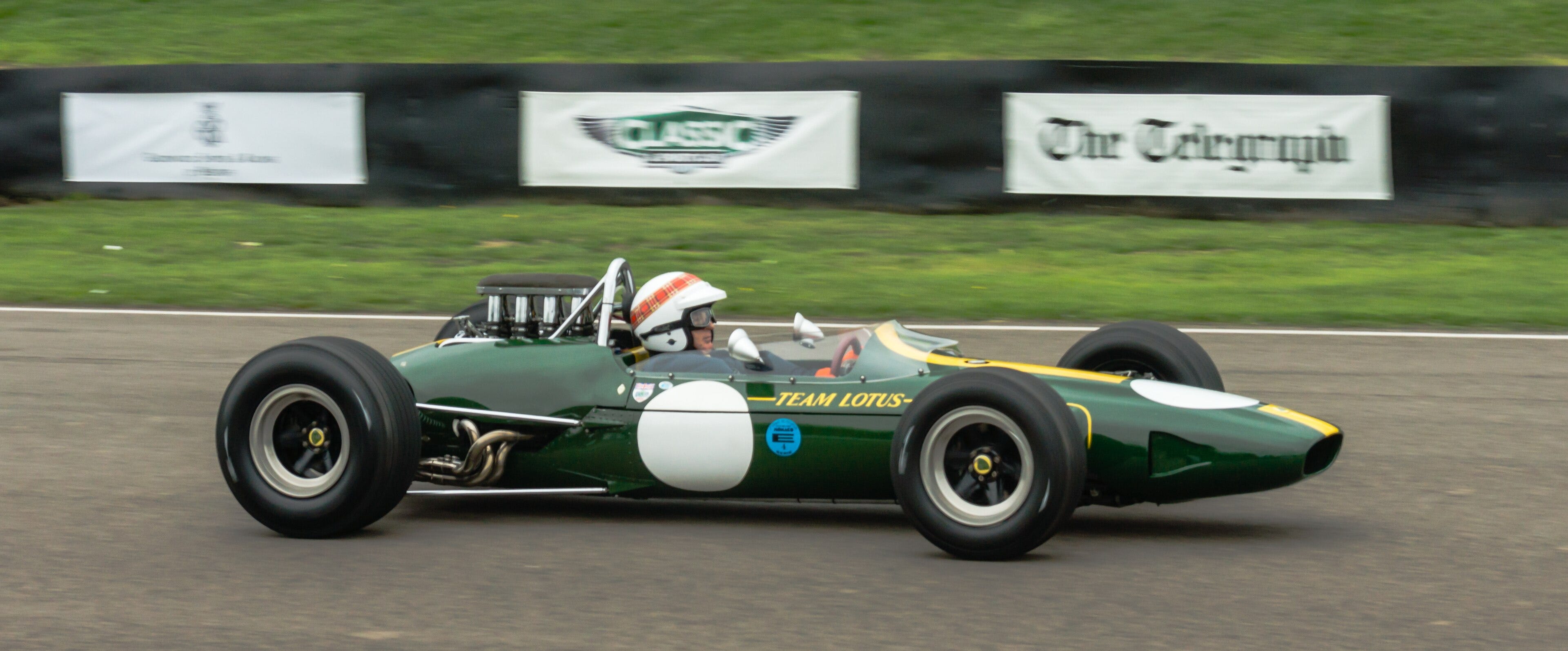
As with downhill ski racing, Formula One remained an intense, dangerous spectacle even as the cars and tracks changed to protect the gladiators who strap themselves into tiny cockpits and push the boundaries of braking, acceleration, and the racing line. No matter the era, from Jim Clark in a tiny, green, bullet-shaped Lotus 33 in 1965, to Max Verstappen in a comparatively enormous Red Bull 19 in 2023, drivers won races and championships by pushing themselves and their machines to the limits of their capabilities.
Changing Specifications
Over the decades, the FIA has modified the allowable specifications of Formula One cars in response to technological innovation, safety concerns, and racing action. In 1965, Jim Clark’s Lotus 33 was a lightweight (450 kg) mechanical jewel with a naturally aspirated 1.5-liter engine, the largest allowed. It had no wings or aerodynamic flourishes designed to increase downforce and cornering grip. With some retail sports cars sporting significantly more power than F1 race cars, the FIA boosted the allowable engine displacement for the 1966 season. 3.0 liters was the new limit for naturally aspirated engines. If forced induction (supercharging, turbocharging) was used, the limit was 1.5 liters. This change elevated the power and speed of F1 cars to levels not much different from modern race cars. The dramatic increase in pace without commensurate changes to car and track safety led to the deadly nature of Formula One racing. The threat would linger for the next thirty years.
In the 1980s, it became obvious that turbocharged 1.5-liter engines could make much more power than 3.0-liter atmospheric engines like the legendary Ford Cosworth V8. In 1986, at the end of this era, some cars were sporting 1,400 to 1,500 horsepower in qualifying trim, and somewhere near 1,000 horsepower in race trim. After a short, late 80s experiment with increased displacement (up to 3.5 liters naturally aspirated) and limits on turbocharging boost, the turbo engines were banned in 1989. The next quarter-century would see the development of what many consider the greatest Formula One racing engines ever built.
Until the mid-1980s, a mechanical limitation limited the maximum rpm, and thus the power, of internal combustion engines. At very high rpm, say around 12,000, the inertia of engine valves can overwhelm the ability of steel valve springs to follow the cam lobe profile and close the valve at the proper time. When this happens, the valves are said to “float." The result can be lost power and efficiency, or worse, catastrophic contact between pistons and valves. Traditional springs can be made strong enough to eliminate the float, but then the operation of the heavier springs begins to rob more power than they add. In 1986, Renault introduced pneumatic valve springs that use small cylinders of compressed gas, usually nitrogen, to allow engine valves to open and close properly at very high rpm, even exceeding 20,000.
Beginning in about 1990 and continuing until 2005, the power developed by naturally aspirated Formula One engines, first 3.5 liters and then 3.0 liters, increased from around 600 horsepower to nearly 1,000 horsepower. Pneumatic valve springs, which enabled engines to spin reliably at 15,000 to 20,000 rpm, were the technology that sparked the change. To this day, the 3.0-liter V10 engines that were used in Formula One in the early 2000s are venerated for their high-rpm wail and prodigious power.
In 2006, in an effort to slow the cars down a bit, the FIA mandated that Formula One engine manufacturers lop two cylinders off their 1,000-horsepower 3.0-liter V10s. V8s of 2.4-liter displacement were the new standard. The smaller-displacement engines produced 750 to 800 horsepower, but advances in aerodynamics and tire technology kept lap times very close to the V10 monsters.
Like many organizations around the world, the FIA has proven susceptible to messaging around climate change and sustainability. Following the lead of states and countries, it has pledged to achieve a state of “net-zero emissions” by 2030. Exactly how this can be attained when a single year of Formula One racing involves twenty-four events across twenty-one countries and five continents is a mystery to me. The teams use transport trucks, ships, and airplanes to ferry cars, people, garages, and NASA-like control rooms all over the world, sometimes jumping continents from weekend to weekend. The logistics team that organized the D-Day invasion would be impressed.
In the cars, the first intrusion of the sustainability ethos occurred at the end of the V8 era between 2009 and 2013. To maintain a connection with hybrid engine technology that was becoming more common in consumer vehicles, Formula One introduced KERS, an acronym for Kinetic Energy Recovery System. KERS integrated a small battery and an 80-horsepower electric motor with the internal combustion V8. Regenerative braking kept the battery charged, and the extra 80 horsepower could be deployed for 6.7 seconds per lap by pressing a button on the steering yoke. Typically, drivers would use the extra energy to pass a car in front or keep a car behind. KERS was optional, and only a few manufacturers used the system in 2009. Others declined due to packaging and weight considerations. An agreement among the teams led to the system's removal in 2010, but it returned in 2011, and most teams adopted it.
The start of the 2014 season brought significant changes to Formula One engines. Determined to polish their green credentials, the FIA adopted an entirely new formula that rendered the term “engine” obsolete. “Power units” comprising an internal combustion engine (ICE) and two motor-generator units (electric motors capable of generating and deploying electrical power) would propel the new cars. The ICE configuration was specified as a 1.6-liter, turbocharged V6. There were no boost limits for the turbochargers, but fuel flow and rpm were capped at levels that allowed these engines to make about 850 horsepower in their final stages of development. Allowable fuel for a race was capped at 100 kg. The naturally aspirated cars in 2013 used about 150 kg of fuel per race. The motor-generator units were named MGU-K and MGU-H. The MGU-K generated energy during braking and provided up to 160 additional horsepower to propel the car. The MGU-H harvested energy from the heat of the exhaust to charge the battery and could also be used to spin up the turbocharger to prevent turbo-lag. The MGU-H pushed the thermal efficiency of the cars to 50% or greater. The engines in modern passenger vehicles typically have thermal efficiencies between 20% and 40%.
Unlike the previous cars, deploying the electrical energy did not require drivers to push a button. Instead, the drivers could select different power unit maps that optimized for different outcomes, like outright speed or fuel saving. Then they would drive with the throttle pedal, and the control unit in the car would manage the blend of ICE and electrical power. It was quite seamless.
Energy harvest from the MGU-K was limited to two megajoules (MJ) per lap, and deployment limited to four MJ per lap, which was about the usable capacity (1.1 kW hours) of the lithium iron battery that stored the energy. Harvesting from the MGU-H was unlimited. The battery capacity was good for about thirty seconds of full electrical power (160 hp) per lap.
Formula One stayed with the hybrid power units for eleven seasons. They proved to be powerful and reliable. The Mercedes team nailed the engine redesign from the jump, along with other chassis and aerodynamic changes, and dominated the first seven years of the hybrid era that began in 2014. Lewis Hamilton won six world drivers’ championships in a Mercedes, and Nico Rosberg won one, also in a Mercedes. In 2021, Max Verstappen, driving a Red Bull with a Honda power unit, finally broke the Mercedes domination.
2022 saw another raft of changes, but the power units stayed the same. The new regulations required a wind tunnel, not an engine lab. Beginning in the early 1970s, race cars used aerodynamics to generate downforce, increasing their grip on the road, especially in high-speed corners. Wing surfaces at the front and rear did most of the work. The problem with wings is that they disturb the air as they pass through it, making the wings of following cars less effective. If you watch a Formula 1 race, you will hear the commentators talking about “clean air” and “dirty air.” For years, dirty air has given leading cars an advantage, making it hard to pass, and turning F1 races into processions with limited overtakes and wheel-to-wheel racing that is exciting to watch. To fix it, the 2022 regulations allowed the teams to use sophisticated floor designs that would pull the cars down to the track and reduce the problem of dirty air.
A famous maxim from the political economist Thomas Sowell is that “there are no solutions, there are only tradeoffs.” The ground effect era, as the 2022 to 2025 regulations came to be known, might have briefly cleaned up the air behind the cars, but it brought a new set of problems. To be effective, the cars had to be run very low to the ground, which made them very stiff and uncomfortable for the drivers. The cars also proved to be extremely sensitive to changes in their setup. Get it wrong, and they would porpoise or bounce at high speed, or not generate the downforce required for fast corners. The dirty air problem may have improved a little at first, but teams soon figured out how to generate “complex outwash,” which made following just as difficult as before. The cars were big and heavy, and the ground effect aerodynamics caused massive, thick spray in wet conditions.
What was similar across all eras of Formula One, from 1947 to 2025, was the importance of the driver. Whether piloting a sleek, 200-horsepower Lotus in the mid-1960s or a huge, 1,000-horsepower Red Bull hybrid in 2025, the drivers who, through prowess and bravery, were best able to push the limits of grip and the racing line were the ones who achieved the most success and hoisted the trophy as World Champion. To be sure, great drivers in poor cars struggled to compete, but the best drivers in good cars won races, and the best drivers in great cars won championships and made history. You may feel nostalgia for the shriek of the three-liter V10s, or the mania of an Ayrton Senna qualifying lap in 1989. Still, all 75-plus years of Formula One racing featured drivers pushing their machines to the limit, until 2026.
Too much electricity!
One of the many nuggets of knowledge I have acquired from Substack pages like environMENTAL and Energy Bad Boys is that the electrical grids that power our societies become vulnerable when the proportion of electrical energy supplied by intermittent sources (solar, wind) gets too high. The grids operate at stable frequencies maintained by the inertia of monstrous, spinning, thermal generators. If you remove enough of that rotational inertia, say 40 to 50 percent, and try to replace it with solar and wind installations, grids become more susceptible to frequency fluctuations that can cause cascading shutdowns. Think of the grid failures in Spain and Portugal in early 2025.
Formula One’s new power unit formula for 2026 specifies a very different mix of ICE and electrical power. In 2025, the ratio of ICE to electrical power was 85 to 15. The internal combustion engines made around 850 horsepower, with another 160 horsepower from the MGU-K. In 2026, the new ratio is 53 to 47, or 530 horsepower from the ICE, and 470 from the MGU-K. The electric motor (MGU-K) is three times more powerful than it was in 2025. In practical terms, the 2025 hybrids were powered by internal combustion engines that could be turned up a bit depending on whether the system was deploying or harvesting electrical energy. In 2026, the near 50/50 balance between ICE and electric power, combined with the same battery capacity as before, amounts to a power unit that, for the first time in the history of Formula One, does not consistently reward driver prowess and bravery. This mix of firm and intermittent power, which requires a constant back and forth between deployment and harvesting, doesn’t cause cars to shut down, like electrical grids, but it does cause them to speed up and slow down, sometimes dramatically, in ways that drivers don’t always control. It turns out that supplying 50 percent of peak power from an intermittent source is as bad for car racing as it is for electrical grids.
The FIA’s reasons for the change to the 50/50 hybrids include alignment with global trends toward the electrification of transport and their own net-zero goals. New corporate entrants like Ford, Audi, and Cadillac predicated their involvement on the new hybrid specifications. Sustainable, synthetic fuels “sourced from municipal waste, non-food biomass, or carbon capture technologies, with the production process powered by renewables,” are another part of the net-zero and sustainability effort. It is worth noting that, regardless of the powertrain's hybrid nature, all of the car's motive power comes from the internal combustion engine. No external source charges a large battery to supply power during a race. Instead, the cars use multiple strategies to replenish a small battery with the same capacity (4 MJ) as the 2025 cars. They include regenerative braking, “lift and coast,” which requires the driver to lift off the throttle early, before the traditional braking points, to convert the car’s kinetic energy to energy stored in the battery, and “super clipping.” “Super clipping” occurs when power from the ICE is diverted from the drive wheels to the MGU-K to charge the battery, turning the cars into high-performance, road-going versions of diesel-electric locomotives. Again, all of the power used in the race comes from the ICE; it’s just that some of it is stored up and used later in a constant merry-go-round of harvesting and deployment.
All through 2025, there were rumors that Mercedes was the pre-season favorite for the 2026 season. As a fan of Max Verstappen, who I believe is a generational talent, I hoped this was not true. Max is a Red Bull driver. To date, three races into the 2026 season, the rumors have proved correct. Beginning with their dominance for the first seven years of the hybrid era that began in 2014, and except for the ground-effect cars, Mercedes has proved masterful at engineering the best solutions to the challenges posed by new technical standards. At the first 2026 races in Australia, China, and Japan, the two Mercedes cars finished first and second in two of the three races. In Japan, they finished first and fourth. For the first time in years, I have watched none of these races. This is because the drivers have never mattered less than they do now.
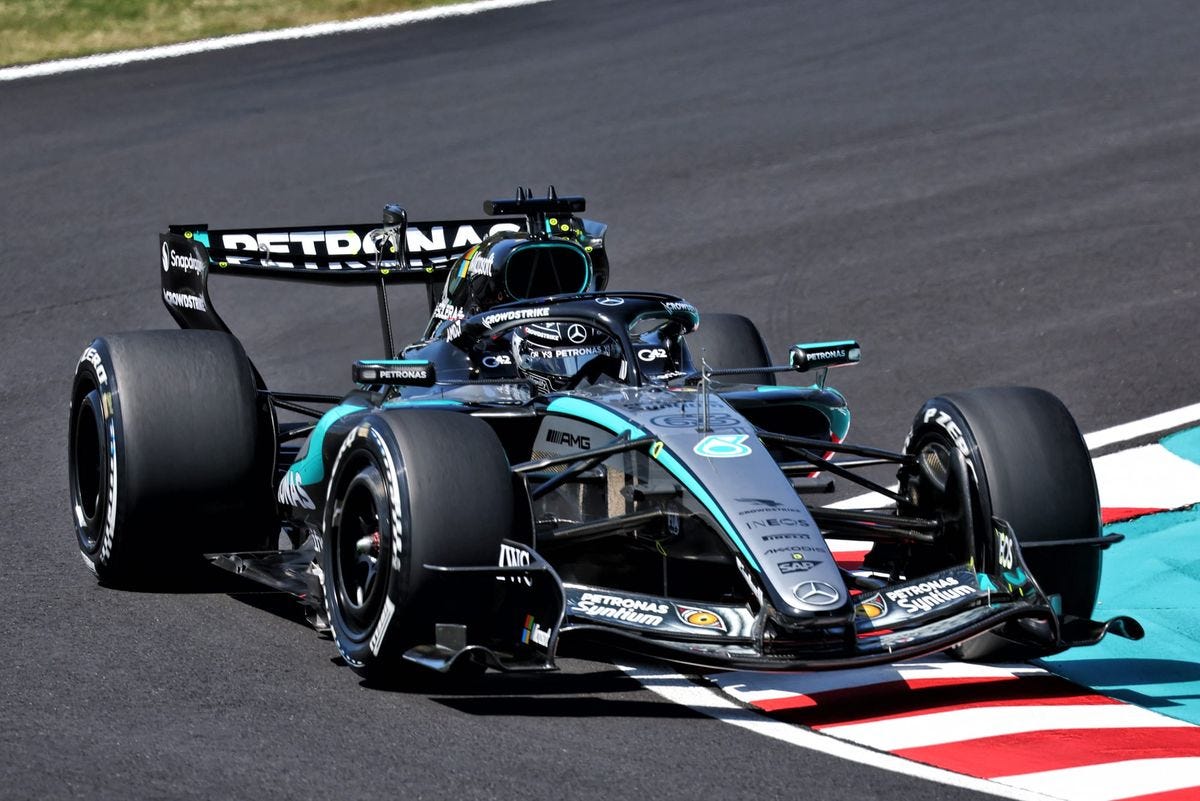
Here are a few driver comments from last weekend’s Japanese Grand Prix, held at one of F1’s legendary tracks, Suzuka.
It hurts your soul seeing your speed dropping so much. 56 kph down the straight. (Lando Norris, McLaren driver and current World Champion)
The more you push, the slower you went. So overall, not good enough for Formula 1. (Carlos Sainz, Williams driver)
Maybe 50% of the team members can drive in Suzuka now I think. High speed corners now are the charging stations for the car. So driving skill is not really needed anymore. (Fernando Alonso, Aston Martin driver, two-time World Champion)
If it were up to me, and we definitely need to look at this. How can we make that one fast, brutal qualifying lap again? How can we reduce the lift and coast? That’s definitely something we need to do. (Toto Wolff, Mercedes Team Principal)
Driving on the limit no longer pays off. That’s very frustrating. It’s one big joke. (Charles Leclerc, Ferrari driver)
What Fernando Alonso means by his statement above is that half of the Aston Martin team, including mechanics, data analysts, chefs, massage therapists, race engineers, and owners, can drive the 2026 cars at competitive speeds on track. He also referred to the racing as the “battery World Championship.” Needless to say, this is not an acceptable situation for drivers who, rightly, view themselves as the best on the planet.
In the first races of 2026, in an attempt to put lipstick on a pig, much has been made of a higher frequency of passing, suggesting that the new power unit and aerodynamic rules have revived the head-to-head battles that inspire drivers and excite the fans. In reality, much of the passing is an artifact of the power unit's highs and lows. A car with a full battery has 1,000 horsepower, a car that’s harvesting has half of that. The car with the full battery is going to make the pass. But then, on the next straight or the next lap, the circumstances are reversed, as the car that used its battery to swoop past begins harvesting energy to replenish it. Now it is the weak one, and the positions swap again, and again. The passing is not an organic outcome of drivers battling. It is a function of the energy management requirements and algorithms of the car. If you want to see one of the greatest wheel-to-wheel battles of all time, follow this link: Gilles Villeneuve vs Rene Arnoux 1979. Villeneuve and Arnoux battled for second place in the French Grand Prix, swapping places and bumping wheels several times during the final two laps.
Passing happens when one car is going faster than another, obviously, but speed differences, or deltas, between cars that are harvesting versus deploying have created on-track dangers of the type that killed Gilles Villeneuve. Villeneuve’s accident occurred during a qualifying lap when he closed quickly on a car in front that was not pushing for a qualifying time. The driver in front saw Villeneuve coming and moved right to give him a racing line on the inside of a left turn. Unfortunately, Villeneuve also moved right and went airborne when he smashed into the back of the slower car. His car disintegrated when it came back to earth. Villeneuve was thrown from the wreckage and killed.
At last weekend’s Japanese Grand Prix, Ollie Bearman (deploying electrical power) closed quickly on Franco Colapinto, who was harvesting energy. Analysis of the telemetry data puts the closing speed between 25 and 30 miles per hour. That doesn’t sound extreme, but think of two cars on the interstate, one at 90 mph and one at 60 mph. It’s a big difference. Colapinto spotted Bearman late and moved left to play defense, perhaps not realizing how quickly Bearman was coming. Bearman moved left to avoid Colapinto and spun off track at 185 mph, then slammed into a barrier at high speed. The impact force was estimated at 50 Gs. Thanks to the safety features of modern cars and tracks, Bearman walked away from the car with a slight limp and is fine. Fernando Alonso, currently the oldest driver on the circuit, warned of crashes like Bearman’s. In the days before the race at Suzuka, he described how the 2026 regulations and the speed deltas they create have turned passing into an avoidance maneuver rather than a tactical move.
After the first race of 2026, the Chinese Grand Prix, the BBC published a race summary.
Beyond that, it means that some elements of driver skill are being removed.
Some of the sport’s most demanding corners, which in the past would have been the most extreme tests of a driver’s skill and bravery, are no longer taken at the limit of grip because it is more effective to recover energy through them instead.
Among the corners drivers mentioned in this context in China were the Esses at Suzuka — considered by many the most challenging piece of race track on the planet …
Check out this bit of telemetry from Suzuka, the track mentioned in the quote above. The data in the orange ellipse indicates the speed through the esses of Max Verstappen’s 2025 qualifying lap in blue, and Kimi Antonelli’s 2026 qualifying lap. Both drivers qualified first on the grid. In 2026, Max entered the esses at just over 250 km/h. In 2025, Kimi entered the section traveling 20 km/h slower to preserve energy for the faster sections of track that follow.
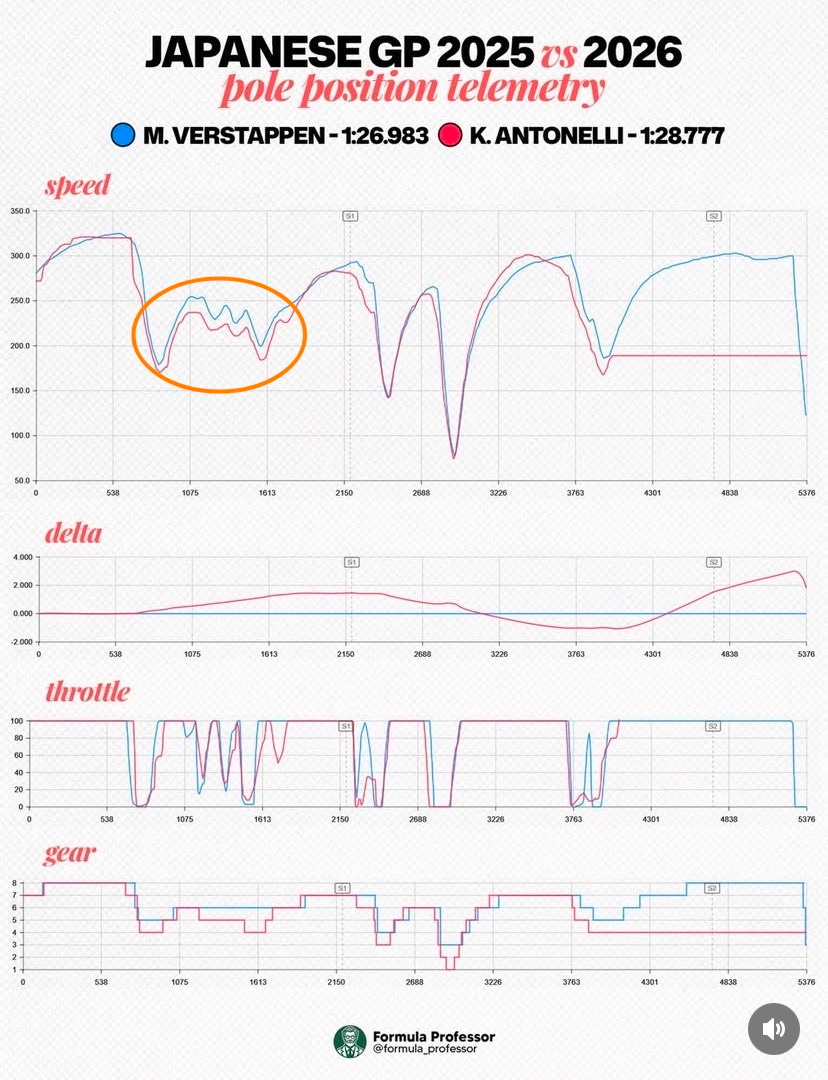
The current ruleset has transformed Formula One from a driver’s sport to a game of energy-management algorithms, some of which are controlled by the driver. Many are not. The game is to keep the battery levels high enough to deploy that energy where it makes the most difference, on long, high-speed straightaways. Practically, it means drivers trundling through difficult sections of track at a fraction of their abilities so they can unleash a 1,000-horsepower blast down a straightaway. You don’t need Max Verstappen, Lewis Hamilton, or Ayrton Senna for that. Making matters worse for North American fans is the broadcast deal F1 signed with Apple TV, which has the exclusive rights that ESPN had last year. ESPN is widely available as part of cable plans and streaming services like YouTube TV. Apple TV requires a separate subscription, which may shrink a fan base that was on a growth streak.
In the context of what is happening in the world today, none of this matters. But F1 is another of those human endeavors that showcase the heights of skill, daring, science, and engineering that human beings can attain. The current rules challenge the science and engineering fields, but limit the contributions of skill and daring on the track. The Formula One season is about to take an unplanned break with the cancellation of races in Bahrain and Saudi Arabia. Technical committees will be meeting to address the concerns voiced by teams and fans. I think they will make it better. But if they want to make it the best, the most watchable, the premier motorsport series on the planet, they should go back to ICE power, or mostly ICE power. The FIA already has a Formula E series for fully electric cars. They don’t need two.
Like (🖤) this post or receive a ten-second stop-and-go penalty.
Before you go:
Please click the 🖤 button, comment, share, and subscribe!
Nice color on Alpine skiing and F1 evolution. I’ve never followed F1 closely, mostly because it’s on a wider array of time zones. I have followed NASCAR top series for years. A few years ago they rolled out an electric prototype at the Chicago Street course, the fan pushback was enormous, it went back in the locker and hasn’t been talked about since. F1 needs to remember its roots, and provide fans the thrill they tune in for or it will eventually be a zero emissions series for real. The green/net zero movement never makes sense, and this is just another example of green lighting gone bad.
Great article, you nicely captured the precise issue that F1 fans like me are struggling with: the dilution of the driver element. Thanks!