
Summer Heat

The most carefree, idyllic summer of my life occurred in 1980, when I was fifteen. My family spent several weeks living on an island on Lac La Ronge. We lived in tents and a log cabin that we built two summers earlier. The island and the cabin served as a base of operations for a new cabin we were building on a different island a short distance away—our third cabin project in as many summers. We didn’t do it alone. The three cabins were for three families: us, the Enviks, and the Kuhlings. The Enviks were my parents’ best friends. Their two boys were close to my age, one older, one younger, and I had known them all my life. The Enviks introduced us to the Kuhling family in the mid-70s, and their four children, three girls and one boy, spanned an age range similar to my siblings and me.
We built the Kuhling cabin first, out of natural logs we cut a few miles away and moved to the site with a skid-steer driven over the frozen lake. In year two, we built the Envik cabin with milled logs. The Casper family drew the short straw, so our cabin was built last, also with milled logs that we hauled to the site on the lake ice. Though on a different island, our cabin site was only about one mile from the Kuhling cabin, so we chose to stay there. The cabin was small; the adults slept inside, and the kids slept in tents. But there was an indoor kitchen, a dining table, real beds (for the grown-ups), couches, and a permanent latrine, so a solid step above the tents, outdoor kitchens, and primitive latrines of the previous summers.
It was a coming-of-age summer, tinged with the thrill of romance and its inevitable counterparts, loss and heartbreak. Among the kids, four of us were old enough to start to have feelings for each other, and though we lived and worked with our parents every day, we were also incredibly free. I knew my way around boats, and I knew the geography of our huge lake and its hundreds of islands almost as well as my father. On one of our few days off, Blaine Envik and I tripped thirty miles across Lac La Ronge and portaged into a tiny lake stocked with rainbow trout. In the evenings, we poached beer from our parents’ stockpiles and sat on an outcrop, warm stone two billion years old, rough with crunchy lichen, while the sun ramped slowly toward the horizon.
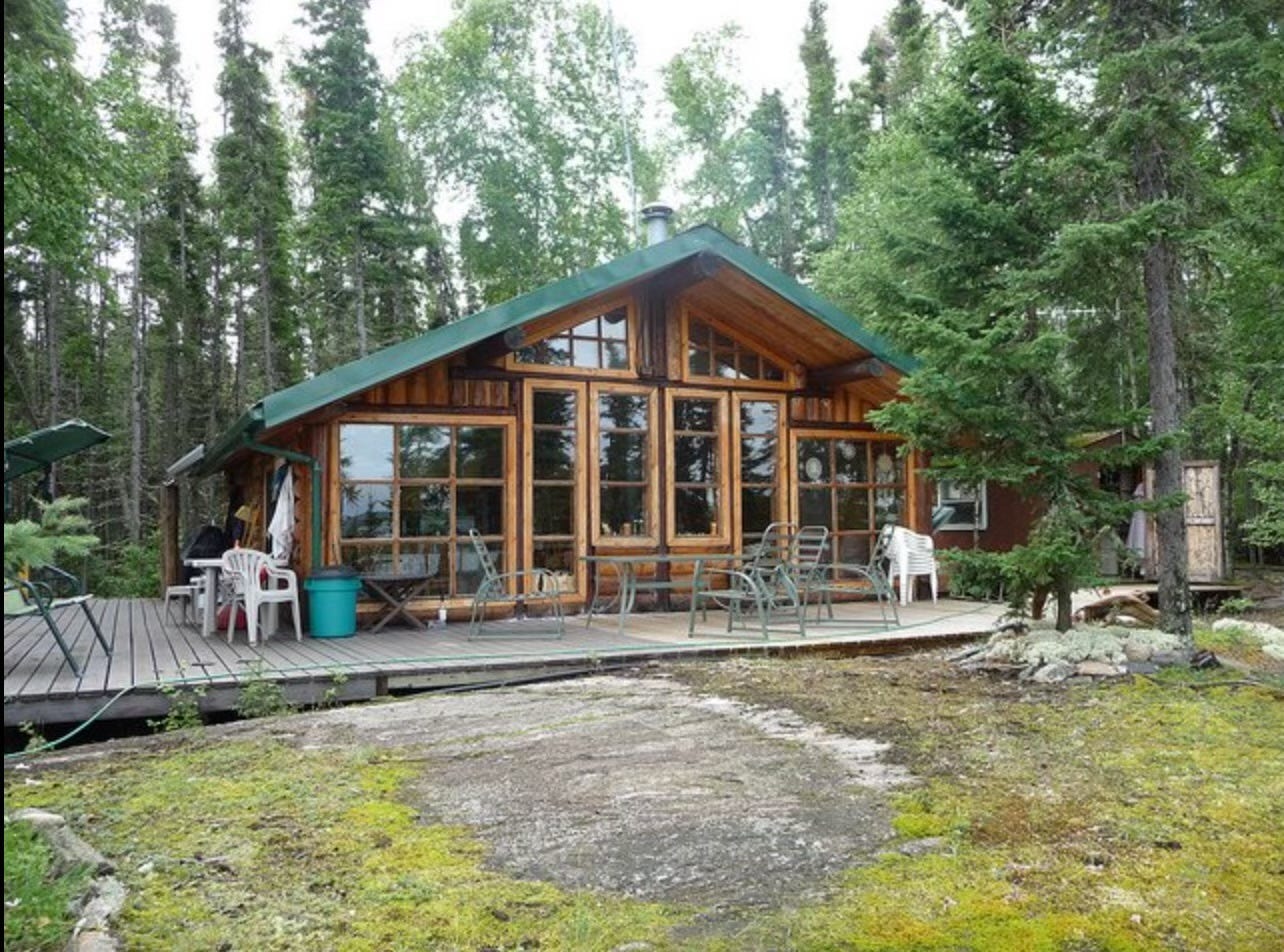
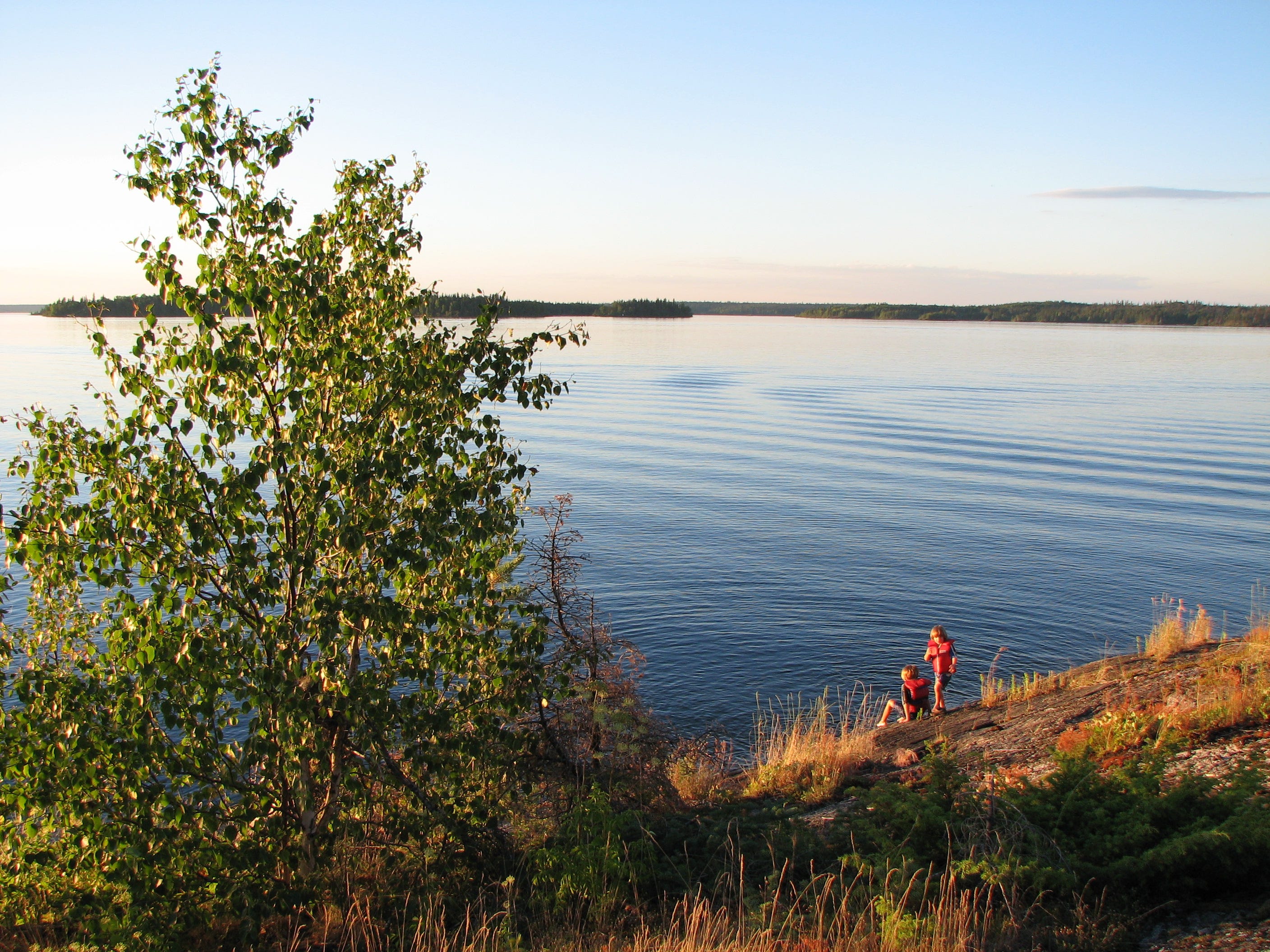
The weather was fantastic. It was a hot, dry summer. And calm. Lac La Ronge felt like the doldrums that trap sailing ships near the equator—windless, hot, the surface of the water rolling gently and glistening like a gigantic mirror. Sometimes, the daytime heat lifted the moist air above the lake into towering thunderheads—gray anvils that spit forked lightning and spawned quick, heavy showers. Lightning and hot, dry summers are a bad combination. There were many forest fires that year. But unlike this year, when thousands of people had to evacuate the town of La Ronge and its satellite communities, the fires of 1980 were more remote and posed no direct threat to the town or the cabins owned by us and our friends. The only impact I remember was the smoky air. The Kuhling cabin was nestled in a grove of mature spruce and pine trees, and our yellow and orange tents were pitched on thick layers of green moss in between the towering trunks. In the mornings, with the sun still low, we emerged from our tents cautiously, like ground squirrels poking their heads out of their burrows and looking for danger. We stepped into a forest primeval: cool, shaded, and quiet, with clear beads of dew clinging to every leaf and every blade of grass, and the added effect of wood smoke trailing ghostly between the trees. Depending on the hour, some of the smoke might have come from the kitchen, where the adults were stoking the wood stove to make coffee, but most was from the forest fires that burned in the distance. You caught its acrid odor before you noticed it hanging in the canopy like a gray fog. On days when it was thick, visibility on the lake that normally extended to tens of miles was reduced to a mile or two.
That is how I experienced forest fires during my decade of growing up in La Ronge. There were times when fire affected travel on Highway 2 heading south to Prince Albert, and other times, like the summer of 1980 when smoke from distant fires affected the air quality, but I never experienced a forest fire as a direct threat.
The Pisew fire in northern Saskatchewan started on May 21 near Besnard Lake, about thirty miles northwest of La Ronge. Besnard Lake is famous for its walleye fishing, and it occupies a similar geographic position to Lac La Ronge, at the edge of the Canadian Shield. It has been speculated that Pisew started as a holdover fire from a previous season, though that is not definitive. Holdover fires occur when moss and other organic material smolder underground and undetected after a forest fire has been extinguished on the surface. All through the winter, like charcoal in a Weber kettle with all the vents closed, the nascent fire waits for drier fuel and a puff of air to bring it back to life. The early months of 2025 were notably dry and windy, more than sufficient to aid and abet any ignition mechanism and foster the rapid growth that followed.
With west winds pushing the fire toward the communities of La Ronge, Air Ronge, the Lac La Ronge Indian Band (LLRIB), and other satellite communities like Wadin Bay, Sucker River, Nemeiben Lake, and Stanley Mission, residents watched nervously for ten days. The situation became untenable at the first of June, and 7,500 residents from the listed communities were ordered to evacuate. People packed up pets, medications, important papers, and a few changes of clothes, and joined a long convoy crawling south through flames and smoke along Highway 2. I’m sure that most, in the last moments before they climbed into the driver’s seat to leave their homes and livelihoods, looked around and mouthed a prayer that they would return shortly and find everything as they left it. Living on the Gulf Coast, it’s a practice I’m familiar with. In the quarter-century we have owned our house in south Louisiana, we have left it many times in the face of approaching hurricanes, usually just across town to my mother-in-law’s house, but once to Houston. Flooding and damage from falling trees are not just threats, but realities endured during tropical cyclones and other severe weather. If the winds are forecast to be hurricane-strength, we usually spend the night at my in-laws’ house, and we always say a prayer before we drive away.

After burning for more than a month across 460,000 acres, the Pisew fire remains uncontained. Thankfully, after a ten-day evacuation, the threat to the town and surrounding communities was judged to have diminished to the point where residents could return. The firefighters and other personnel who stayed behind to protect the town did well. The vast majority returned to find their homes and businesses intact. Sadly, there were exceptions, including a few houses in the Eagle Point subdivision, several cabins along the twin peninsulas that flank McGibbon Bay, and two businesses on La Ronge Avenue.
People are often quite stoic in the face of loss. “It’s just things,” they’ll say. “We’re all alive. That’s what matters.” And they’re correct. Most things are just things. But some are more. Photographs evoke memories: of a child born, of an idyllic summer. When our house flooded in the summer of 2016, the hardest day was the day we discovered the chest that contained a treasure trove of memorabilia from my wife’s childhood. She’s a very organized person, and she kept report cards, yearbooks, photographs, letters, dolls, and other mementos from her past. Before the flood, she would open it periodically, say once every year or two, and go through portions of it page by page, piece by piece, smiling, telling the back stories, holding each thing carefully with the sensitive tips of her fingers as if touching them stirred the memory as much as seeing them. For some reason, as the waters rose around the house and we passed from room to room, elevating things we wanted to save, the chest escaped our view. Almost all the contents were lost.
And while homes, cabins, and their contents are mourned mainly by the people who owned them, the loss of unique civic structures can affect everybody. Of the two businesses lost in La Ronge, one was a general store called Robertson’s Trading. If you’re a visitor to Paris, you go to the Louvre. If you’re in London, you go to Westminster Abbey. Until the end of 2023, when the business officially closed after 56 years of operation, you stopped at Robertson’s Trading if you visited La Ronge.
Robertson’s Trading started in 1967 when Alex Robertson moved his young family from Prince Albert to La Ronge and bought a tiny business called La Ronge Grocery. Alex was an experienced fur trader who learned his vocation as a buyer for the Hudson Bay Company. In a few short years, Alex, his wife Phyllis, and their four children built the grocery into a successful general store and fur-buying operation. Indigenous trappers from across the north brought their furs to town and shopped them to multiple buyers. With a rare ability to spot either flaws or quality that others could not see, combined with impeccable fairness and integrity, Alex often won out. Alex’s day-to-day business exposed him to indigenous craftwork done by local artisans. He bought when he could, keeping some pieces and selling others. Over time, the space around his trading desk at the back of the store took on the character of a museum. The walls were covered with furs, beaded jackets, trophy fish, and moose antlers. I didn’t feel I knew him well, but Alex always seemed to know something about the happenings in my life whenever I visited the store.
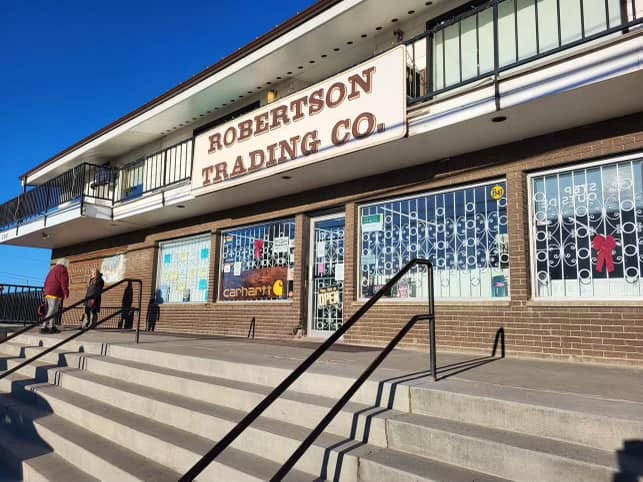
As Alex aged, his son Scott took over the business. When I worked for the Department of Energy, Mines, and Resources in the summer of 1984, my job was to keep the geological field parties at work in the north supplied with food and equipment. When I took my weekly orders to the store, I left them with Scott. Nearly forty years later, at the end of 2023, with the demands of the store as formidable as ever, Scott made the difficult decision to close the business so that he and his wife might have more freedom in their lives. Over the last year and a half, though shuttered, the store opened periodically to sell specialty products made by their talented butcher, and Scott nurtured a vision where the crafts and artwork curated by his father and himself would form the core of a museum that celebrated the work and art of the Indigenous people that created it. Tragically, Robertson’s Trading was one of the two businesses lost to the Pisew Fire. The trading desk and its iconic surroundings: all was lost.

Although we tend to think of humanity as the proximate, if not the direct cause of destructive wildfires, Mother Nature has been starting and spreading flames since the beginning of time. From dry prairie to northern taiga, and from the chaparral hills of southern California to the ancient forests of old England, fire has always been an important factor in the evolution of landscapes. The tragedy that ensues when man’s creations, which are now in the way, are consumed by wildfire does not necessarily imply that the Great Mother Gaia is imploring us to change our ways. Had Robertson’s Trading existed 300 years ago, when, presumably, Mother Nature was not so disappointed in humanity, a wildfire in a dry spring, whipped and stoked by winds amplified by the fire itself, would have merrily and swiftly burned it to the ground.
My years as a child and young adult were blissfully free of direct threats from wildfires. The past 25 years in northern Saskatchewan, and seemingly across northern Canada, have been different. Wildfires have devastated several large communities. Slave Lake, Alberta, Fort McMurray, Alberta, Lytton, B.C., and Jasper, Alberta are just a short list of towns and cities severely damaged by wildfires in the last fifteen years. La Ronge, though not devastated in the same way as those other communities, has been threatened three times since 1999. Two of the threats, in 2015 and this year, required mass evacuations. In 2015, some folks were away from their homes for a month.
In places like California, at least part of the reason for the human and infrastructure cost of wildfires like the L.A. fires in January of this year is the growth of cities and settlements into high-risk areas like the dry chaparral hills above Malibu. The growth factor doesn’t apply in northern Canada. Northern villages and towns have always been surrounded by millions of acres of flammable boreal forest. Ironically, the aggressive response to forest fires in North America may contribute to the intensity of recent fires, as fire suppression allows the fuel load to increase year after year. In their incessant efforts to advance a narrative, most media sources point to man-made climate change as the culprit responsible for the uptick in destructive fires.
In my essay, Many Happy Returns, I referenced the work of Roger Pielke Jr. He is an excellent source for balanced data and analysis on all things climate. The fourth installment of his now six-part series on Weather Attribution Alchemy shows how the vast library of peer-reviewed research papers allows anyone to assemble plausible-sounding links between societal-scale combustion of hydrocarbon fuels and the latest horrible “thing that just happened.” Thus, fire weather, which just means hot, dry, and windy, is said to be more likely to occur as a result of anthropogenic climate change. The IPCC, which considers the totality of the literature and does not cherry-pick to make a point, says the link cannot be confirmed. Consider the table of CIDs (Climate Impact Drivers) below, from IPCC’s sixth assessment report (AR6), and check the row labeled “Fire weather.”

Another of Roger Pielke Jr.’s essays highlights the findings of a recent paper published in Nature Communications. The unexpected conclusion of the research is that historically, across diverse ecosystems in North America, fire was much more widespread than in recent years. This is another confirmation of my axiom that when it comes to climate, there is a precedent for everything said to be unprecedented.
Our study of 1851 tree-ring fire-scar sites and contemporary fire perimeters across the United States and Canada reveals a substantial, persistent fire deficit from 1984–2022 in many forest and woodland ecosystems, despite recent increases in burning. Contemporary fire occurrence is still far below historical (1600–1880) levels at NAFSN [North American tree-ring Fire-Scar Network] sites despite multiple large and ‘record-breaking’ recent fire years, such as 2020 in the western United States. Individual years with particularly widespread fire during the 1984–2022 period were not unprecedented in comparison with the active fire regimes of the historical period across most of the study region. Historically, fires in particularly active fire years were spatially more widespread and ubiquitous compared to fires burning during active contemporary years.
A 2000 paper published in the journal “Atmosphere-Ocean” titled “Temperature and precipitation trends in Canada during the 20th century” had this to say about climatic trends.
… climate has been becoming gradually wetter and warmer in southern Canada throughout the entire century, and in all of Canada during the latter half of the century.
For scale, the level of warming observed over the century was centered on 1.0°C, with a range from 0.5 to 1.5°C. The precipitation increase ranged from 5% to 35%. So, modestly warmer and modestly wetter over a century. I’m going to go out on a limb and conclude, from this study and my empirical experience, that the likelihood of fire weather, in Canada as a whole, hardly changed across the span of the 20th century. Since northern Saskatchewan is a part of Canada, I give it the same assessment.
Environment and Climate Change Canada is a good source for more granular data focused on the last 50 years.
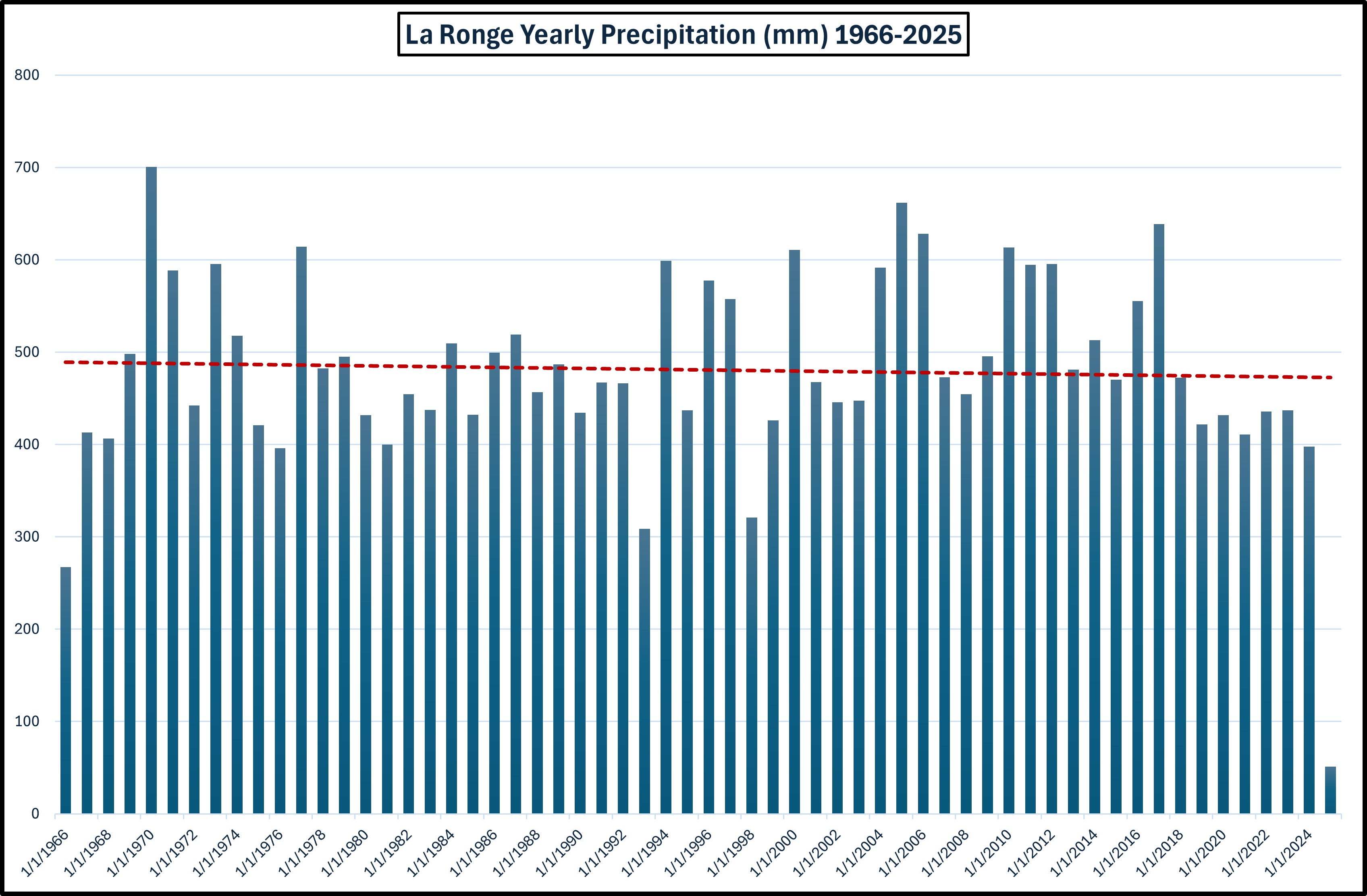
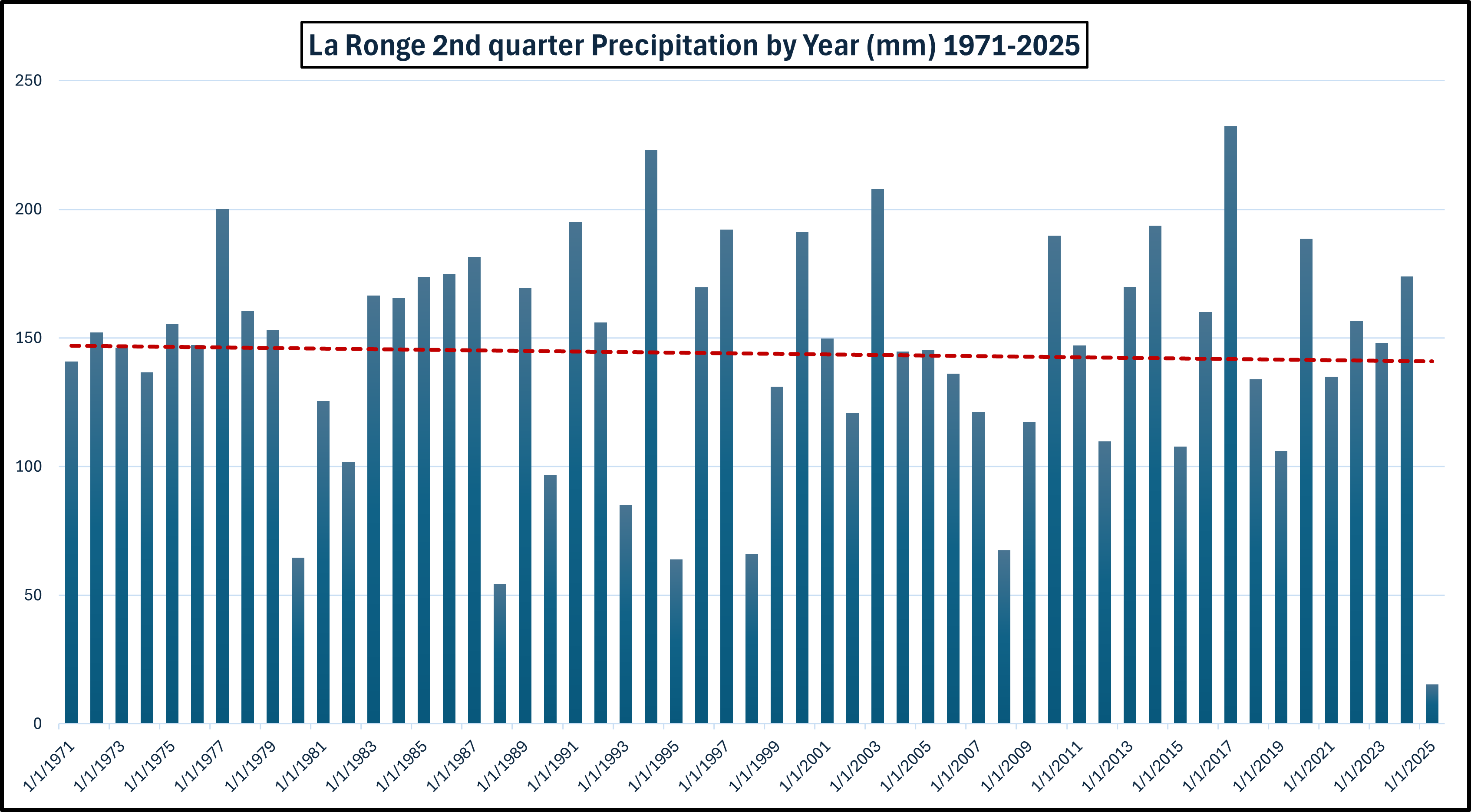
Yearly precipitation in La Ronge averages just under 500 mm (about 20 inches). The graph of yearly precipitation shows a very slight downward trend, which is slightly affected by the very low amount recorded to date in 2025. Precipitation in the second quarter of each year averages about 150 mm and is typically exceeded only by third-quarter precipitation. Presumably, it is second-quarter rainfall or lack thereof that sets the stage for wildfire risk in the late spring and summer. Once again, the trend is slightly downward and influenced by the anomalously low value in 2025 (less than an inch). Notably, the second quarters of both 1999 and 2015, both years when La Ronge was threatened by wildfire, were below average, though not dramatically. The spring of 1999 saw about 130 mm of precipitation, while the spring of 2015 recorded 110 mm. The spring of 1980, precursor to our smoky summer of cabin building, was very dry, with only about 65 mm of precipitation.
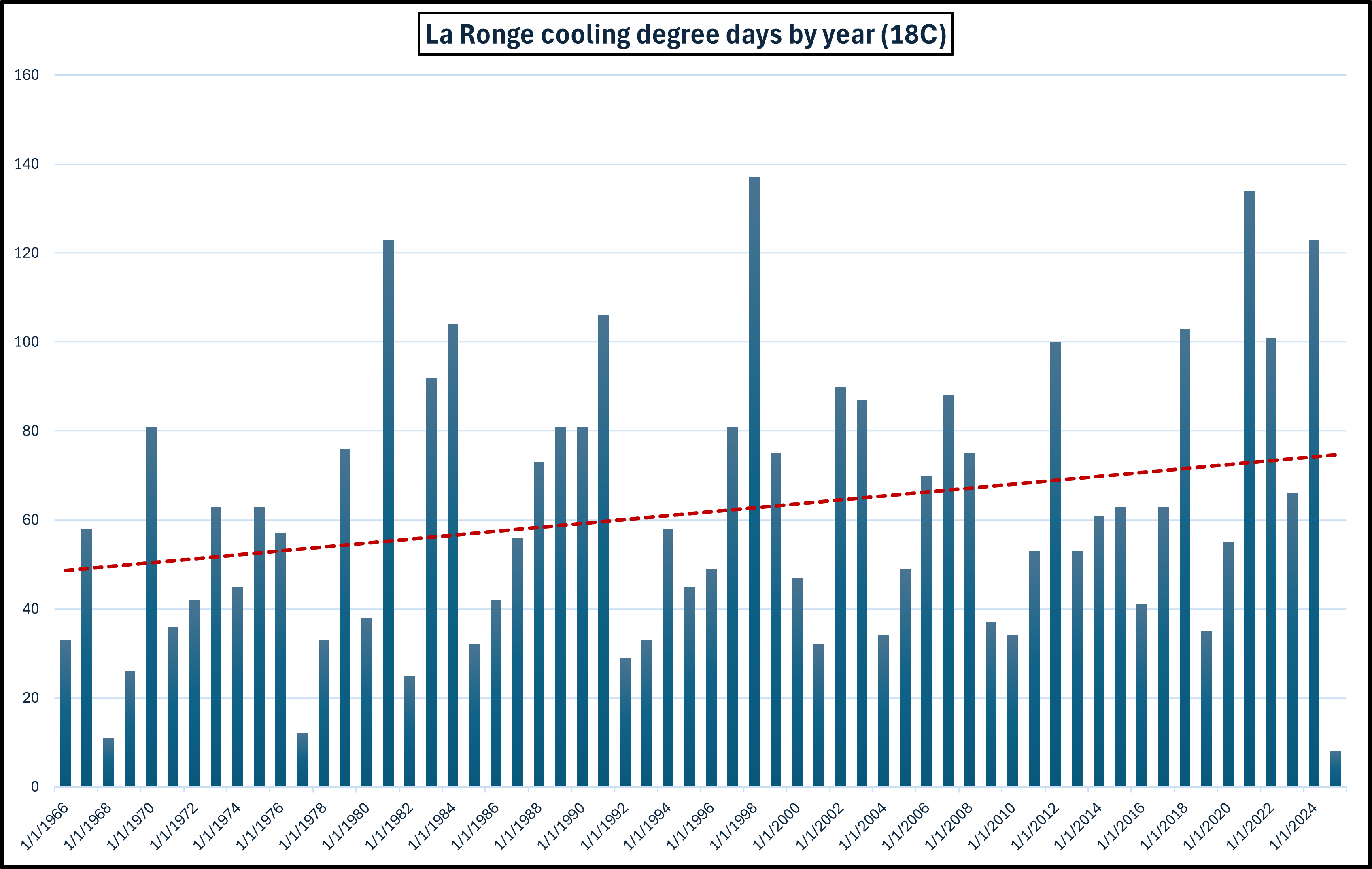
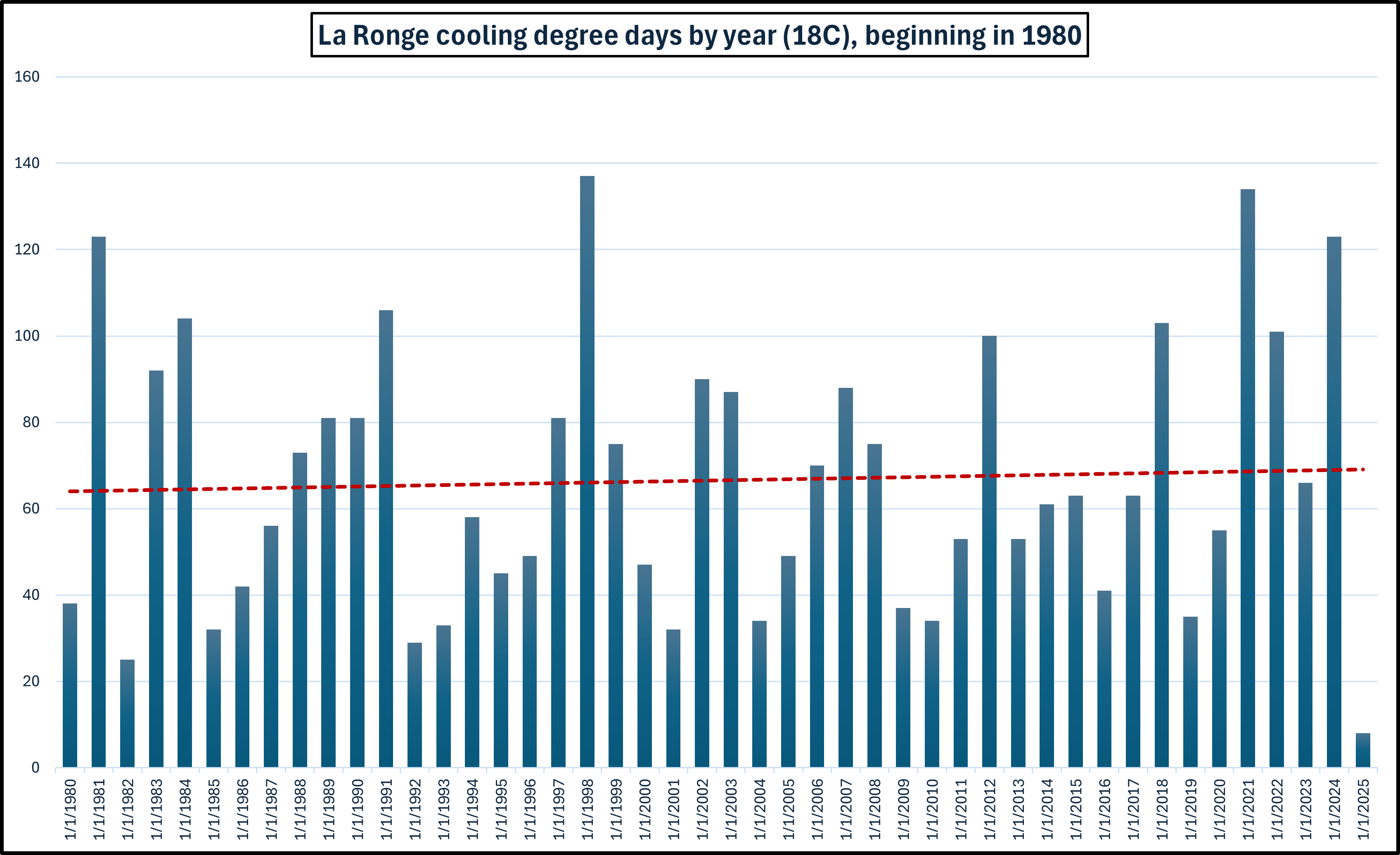
Cooling-degree days occur when the daily average of the minimum and maximum temperatures exceeds 18 degrees Celsius, indicating a possible need for air conditioning to cool dwellings and businesses. The first graph of cooling-degree days in La Ronge, which has data back to 1966, shows a pronounced upward trend, indicating a warming climate. However, the 1960s and 1970s were noticeably cooler than other decades in the 20th century. The chart of cooling degree days that begins in 1980 trends only slightly upward. Not much has changed in the last 45 years.
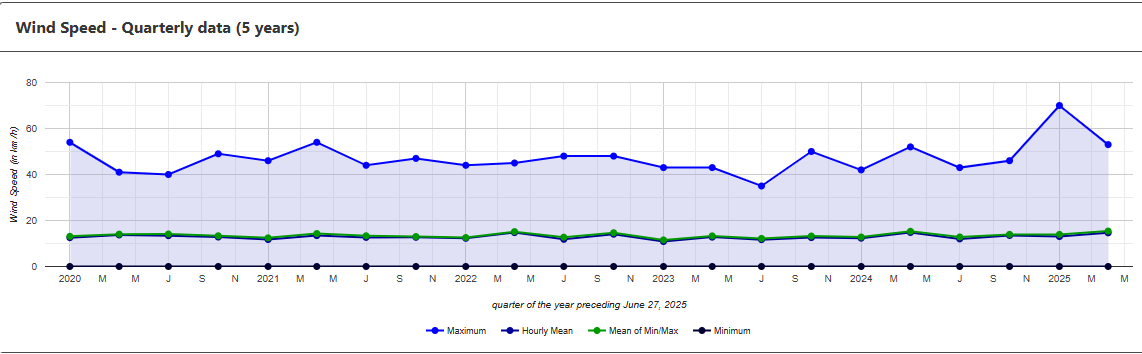
Wind speed is also an important component of fire risk. Higher wind speeds accelerate the drying of flammable material, and higher winds stoke and spread anything that ignites, meaning fires get out of control more quickly. The graph of wind speed only covers the last five years, but longer time frames show a similar story. Maximum and average wind speeds have not materially changed in decades. The one anomaly on the graph is a noticeable uptick in maximum wind speed and a small uptick in mean wind speed for the first and second quarters of 2025. For the second quarter, I wonder if a portion of this anomaly is due to the Pisew fire itself, as large volumes of heated, rising air create low-pressure areas that generate local winds as cooler, surrounding air rushes in to balance the pressure.
The conclusion I draw from all this is that dangerous wildfires can occur during climatic conditions that are unremarkable, as in 1999 or 2015, and during anomalous conditions, such as the very dry, quite windy spring of 2025. As I wrote in my essay Many Happy Returns: “The risk of the weather doing something bad that threatens your life and your home is always small and non-zero.” And this isn’t going to change. If, God forbid, humans disappeared from the earth, industry fell silent, and entropy, held at bay by our efforts to build, manufacture, and maintain, began to grind our works into the elements from which they were wrought, bolts of lightning would still start wildfires in dry forests. Pressure waves would still slide off the west coast of Africa, begin to rotate on their trip across the Atlantic, gain energy from the warm waters of the Caribbean Sea, and lash the Gulf Coast with double-digit rain totals and hurricane-force winds. Net-zero policies, which demand that humans forego their comfort and prosperity, or their dreams of prosperity, will do nothing to change this. Also, they haven’t worked. Trillions of dollars spent over the last forty years to advance the cause of electric vehicles, and wind and solar installations have reduced global primary energy supplied by hydrocarbon fuels by just a few percentage points, all while the absolute consumption of fossil fuels has increased nearly 350% because of greater overall energy demand. 1
Humanity is facilitating energy addition, which is what progress requires. If we are to lift billions of people out of poverty and privation, which is a much nobler goal than net zero emissions, we’ll need much more. Scott Tinker, state geologist for Texas and the chairman of Switch Energy Alliance, has a 50/50/50 vision. He wants to lift the world’s poor to a modern living standard, which he describes in terms of energy use and income: 50 MWh per year and $50K per year. And he wants to do it in 50 years, thus 50/50/50. In 2025, world primary energy consumption is 600 exajoules per year. He estimates that 50/50/50 will eventually require 1,800 exajoules per year, triple the current consumption.
If we’re not about to impoverish ourselves to fix the weather, and it would be foolish to attempt it, what can be done to reduce wildfire risk in northern Canada? Although it is somewhat dispiriting, the honest answer might be not much, though forest management, which includes fire, could make a difference. Some fires are started by humans, either accidentally or intentionally. Natural causes will not disappear, but education and messaging might reduce accidents, and harsh penalties (really harsh) might reduce arson. And it is possible to fight back.
In the aftermath of the L.A. fires, a Wall Street Journal article listed the tools and strategies that individuals and communities could employ to protect their homes and other properties from fire. The list included rooftop sprinklers, sealed vents and gutters, personal hydrants, fire-resistant building materials, landscaping strategies, diesel pumps that pull water from swimming pools, fire-resistant gels, firefighter training, and neighborhood watch strategies. The yearly risk of wildfire in northern Saskatchewan is not as high as it is in the hills above Malibu, and retrofitting homes and businesses with the tools and materials to repel fire might be prohibitively expensive for many northern residents. However, at least one key substance, water, is in ample supply. I’m aware of three groups of two or three individuals who did heroic work saving cabins by boating from site to site and using gas-powered pumps and an infinite supply of lake water to douse cabins and surrounding vegetation with thousands of gallons of water. I’m not sure if they snuck back in after the evacuation order, or stayed behind to protect the properties that they, and their friends, had built and maintained for decades, but their dedication and resolve saved much. Another friend joked that she altered the weather patterns near her house because she pumped so much water onto the home and property before evacuating. The house, despite being in a very vulnerable spot, survived.
The world has always been dangerous. Fires, hurricanes, blizzards, tornadoes, floods, volcanic eruptions, earthquakes, and tsunamis are a part of life on our beautiful blue ball. Nothing in the foreseeable future is going to change the risk profile of these dangerous events in a material fashion. Energy, prosperity, technology, planning, and courage help us to meet those challenges. Let’s not lay down our arms in the hope that Mother Nature will look kindly and spare us her furies.
“🖤” this post and have an idyllic summer.
Before you go:
Please click the 🖤 button, comment, share, and subscribe!
Spot on analysis! Lowering our standard of living by trying to implement Net Zero policies is pure insanity. You’re so right! Without the aid of modern machinery and technology all of which are possible with some type of derivative of hydrocarbons these natural disasters would be exponentially worse. Keep putting the truth and common sense information out there and eventually enough people will begin to understand the reality. Summer camping for months was so much fun! Greatly enjoyed your stories and the lessons from them.
Damn you built some nice cabins!
Thanks for putting some comparative data in for the SK bush. It’s amazing how much publicly available data is there for all to see but the narrative is what people remember.
You’re doing great work on Substack. We always eagerly await your posts. Keep it up!