
Waffle House Diplomacy

“Is the Waffle House universally awesome? It is indeed, marvelous, an irony-free zone where everything is beautiful and nothing hurts... A place of safety and nourishment. It never closes, it is always faithful, always there for you.” Anthony Bourdain
A citizen of a North American country, not Mexico or the United States, recently asked me a question. We were driving down Johnston Street toward the world-class health club we are blessed to have in our city. The club name is “Red Lerille’s Health and Racquet Club.” We call it Red’s. It is named after its founder, recently passed, who opened in a small building on Johnston Street in 1963. Two years later, Red built a big new club on Doucet Road. Today, more than 60 years later, the business remains at the Doucet location.
I was eager to show off the scale and amenities of our fitness jewel to my guest. The question caught me off guard. Quietly, from the passenger seat, I heard, “What is the state of race relations in Lafayette?” The question was such a discordant departure from my thoughts that I did not know how to answer. Is anyone, other than academic, political, and media race hustlers, still talking about these things?
“Well,” I began, trying to think of something to say. Eventually, I realized that my inability to find an answer was the answer I was looking for. “Honestly, it’s not really a thing. To the degree that people want, or choose, or can afford, we all share schools, restaurants, health clubs, and churches. I’m sure there are people out there who are racist in one way or another, but that’s nothing unique in the world.”
By the time I answered, we were almost to Red’s parking lot, so the conversation ended, and we moved on to more pleasant topics, like the new ladies’ wing recently opened at the club.
Our son graduated from college ten days ago. On the night of his convocation, my wife and I had an experience that reminded me of the race question. First, a bit of background.
If you have been a longtime subscriber to Trevor’s Substack or read the byline there, you may have gathered that I love alpine skiing. When our boys were born in the early 2000s, I took a four-year hiatus from ski trips while we worked through diaper duties and toddler tantrums. The plan was always to return, and in 2005, we started the era of the family ski trip.
Family ski trips are expensive. Start adding up airfare, lift tickets, equipment rental, accommodation, and food, and you’re spending multi-thousands in a hurry. To reduce travel costs, we often made the four-hour drive to Houston Intercontinental and flew from there rather than Lafayette Regional. The outbound trips were energized by anticipation. We powered through to a hotel by the airport, ate supper at one of those giant, neon, Tex-Mex destinations that line the freeways in Houston, and woke up early the next morning, raring to get to Colorado.
The trips home were a little more grueling. Even if we staged the return by getting to Denver the evening before the flight back to Texas, the west-to-east time zone change meant mid- or late-afternoon arrivals in Houston. By the time we retrieved our bags and our car, the sun was setting behind us as we joined the endless stream of traffic on Interstate 10. The boys were always hungry, but it was family policy to put at least forty percent of the trip in the bank before stopping. Forty percent was Beaumont, and the restaurant that became our regular family stop on the last leg of a Colorado ski trip was the Waffle House on the west side of the city.
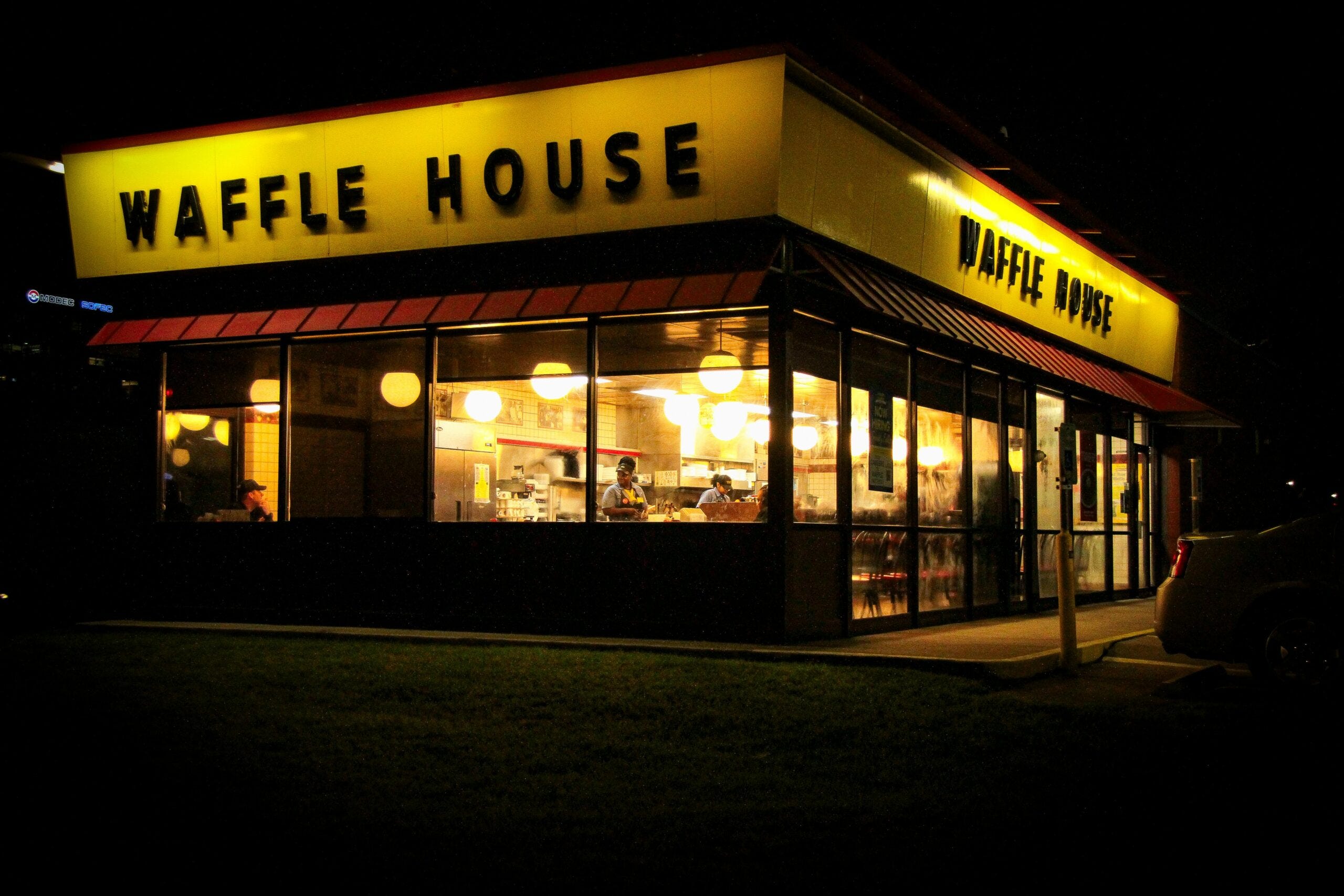
I’m not sure how we chose it the first time. Many others would have opted for something truly fast, like McDonald’s or Wendy’s, but my wife has a strong aversion to that type of food, so it was off the table. The Waffle House decision was likely precipitated by the late hour. There is a time in the middle of the night, when, unless you’re Spanish and accustomed to mid-day siestas and late-night dinners, it makes more sense to peruse a breakfast menu than a dinner menu. On the night in question, that hour had arrived. It was a good choice. The boys loved ordering pecan waffles and pancakes at a time of night when they would normally be sleeping, the waitresses were kind and referred to us as “baby” and “sugar,” and I got enough coffee and calories in me to stay alert and safely close out our journey. The Waffle House became our regular stop. With both boys grown, family ski trips are not the yearly occurrence they once were, but Waffle House restaurants remain a popular choice for road trip dining in our family.
In 2026, the LSU College of Engineering convocation ceremony started at 6:30 p.m. More than 600 undergraduates had their names called and walked across the stage to receive their diplomas. They all paused for photos with the Dean and the Head of their department. Master’s and PhD students boosted the number to more than 900. It was a long ceremony.
After taking photos outside the venue, we said good night to our son and his friends and walked to our car for the one-hour drive back to Lafayette. We had a graduation party planned for the next day. Thomas and friends would drive over the next morning.
As we merged onto Interstate 10 and started up the big bridge over the Mississippi River, I asked my wife if she was hungry. “Kind of,” she answered. Our last meal was an early-afternoon lunch. The Lobdell exit on the west side of the bridge features a number of hotels and restaurants for travelers. I peered at the signs that list the amenities as we approached the exit. One of them featured a familiar logo.
“Waffle House,” I said. “How about that?”
She thought for a second and answered, “Sure.”
At night, a Waffle House restaurant, seen from the road, exudes a familiar, welcoming vibe. The yellow sign at the top of a tall pole, and the compact, three-layered buildings—bricks, then glass, and a yellow surround at the top—are instantly recognizable. The windows are uninterrupted down two sides. Behind the glass, lighted globes hang from the ceiling, and the light has a buttery warmth that beckons to tired travelers and others. They are the modern embodiment of “The Prancing Pony,” the travelers’ inn where Frodo and his companions stayed before leaving the Shire on their great quest in “The Lord of the Rings.”
On graduation night, the air was warm and humid. The glass doors were cloudy with condensation. The door had not closed behind us before one of the waitresses called out, “Welcome in. How y’all doin’?”
The restaurant was quite busy. At the bar facing the doors, two or three men sat on stools—truck drivers maybe, or shift workers from the nearby plants grabbing a bite on their way home. Occupying the tables to the right and left were a group of young people, some couples, and a family of four, the two children the same age as ours, the first time we stopped in Beaumont. The only table available was the one in the front corner furthest from the door. As we made our way toward it, two other waitresses called out, “Welcome. How y’all doin’?”
We answered each time. “Good, thanks. How are y’all?”
It varies from store to store, but the staff at this Waffle House were all Black people when we were there. The patrons were a mix of Black and White. Three waitresses were serving and busing tables; another woman wore a security vest but helped to bus tables as well. The male cook was tall and slender, with long, blonde, beaded braids or dreads that hung past his shoulders. One of the waitresses quickly brought us glasses of water and asked if we wanted anything else to drink. We both answered, “Coffee.”
While she left to get cups of coffee, and we examined the menu (breakfast side, of course), a large group began to filter through the door, three or four at a time. They were a 50/50 mix of adults and young boys. All the boys were about ten years old and wore baseball caps with a team name, “Wow Factor.” The adults sported t-shirts and polos with the same name and logo. As they huddled inside the door and searched for places to sit, their conversation and a few random items of clothing, like an Ole Miss baseball cap, identified them as part of a youth baseball team from Mississippi in town for a weekend tournament. They had come straight from the diamond after their last game; their faces were flushed and shiny from sun and humidity. I heard one of the adults say that their next game was at eight a.m., less than twelve hours away. They needed sustenance.
Three tables would have seated the Wow Factor entourage. When they walked in the door, there were none. To make sure they didn’t have to leave and find another place to eat dinner, the whole restaurant swung into action. The men seated at the bar moved in a way that left the four remaining stools all together. The guests at the two booths adjacent to ours were nearly finished, so they expedited their bill-paying to free up space. The security lady was halfway through a late dinner, but she jumped up to help clear and set up the newly vacant tables. Irene and I offered to trade our booth for a pair of barstools, but were told graciously that everyone was happy. There was no need.
With virtually every seat taken, the cook was locked in on the grill, and the waitresses were in constant motion in the cramped space. With the big crowd, it took a little longer to get our food than is typical for a Waffle House. No one complained or fussed.
The man in the Ole Miss hat was heavy-set. He sat on a bar stool next to his son. He was thirsty after a day at the ball park, and downed his first glass of Coke Zero rapidly. When a waitress passed by, he asked for a refill.
“Sure baby,” she answered. And then forgot as more pressing tasks occupied her mind. Eventually, he asked a different waitress as she passed by. This one picked up his glass immediately and refilled it with Coke Zero. Minutes later, the full glass jarred the memory of the first waitress. She stopped to apologize.
“I’m so sorry. I was supposed to get you a Coke Zero refill, and I forgot.”
He waved it off politely. “It’s no problem, ma’am. Y’all are busy. I’m good.”
I tell this rather long story because it is a live-action answer to the question posed at the beginning of this piece: “What is the state of race relations in Lafayette? Or Lobdell, just west of the Mississippi River?”
Though I don’t like to generalize, I suspect that Waffle House diners skew toward rural and working-class folks. A key moment in Hilary Rodham Clinton’s failed 2016 bid to become President of the United States occurred when she described half of Donald Trump’s supporters as a basket of deplorables, calling them racist, sexist, homophobic, xenophobic, and Islamophobic. In that wealthy, out-of-touch world, I’m sure that “basket of deplorables” and “Waffle House patrons” carry similar connotations. Given those perceived shortcomings, how is it that we Waffle House patrons got on so well with the Waffle House staff? Why did historical injustice and modern grievance not bring a darkness to our clean, well-lighted place?
The brilliant American economist and political philosopher, Thomas Sowell, has stated that of all the 45 books he has written, “A Conflict of Visions” is his favorite. In it, he theorizes that the origins of political conflict are based on two different conceptions of humanity. In one, the unconstrained vision, the heights of reason and morality attained by the most enlightened members of society serve as guides and goals for society at large. The nature of man is malleable, and the right behaviors can be taught and learned. Efforts to compel desired actions through the design of laws and incentives are rejected or discounted as treatment of symptoms rather than the root cause.
In contrast, the constrained vision sees humanity as tragic and flawed, always and forever. Human nature is immutable, and attempts to change it are doomed to fail. The challenge of the constrained vision is how to bend self-interest to benefit society at large. In “The Wealth of Nations,” Adam Smith showed how the incentives of free markets could produce moral and social benefits to society despite the self-interested nature of the humans who participated in them.
The Constitution of the United States, with its elaborate set of checks and balances, is clearly built on the foundations of the constrained vision. No one is to be entirely trusted with the power of government.
The two visions, constrained and unconstrained, provide a useful lens for analysis of the Lobdell Waffle House. Were we all nice to each other because we have, over time, applied dispassionate reasoning and logic to discover that everyone should be judged not by the color of their skin but by the content of their character? Or was the courtesy and kindness just a thin veneer of congeniality compelled by self-interest, with baser instincts lurking beneath the surface? Given the propensity of dogma to break down in the face of reality, which is more likely shades of gray than black or white, I’ll suggest a bit of both.
The reflexive racism of the mid-20th century has been out of fashion for 60 years. It is no longer a big deal for White and Black people to share space — at school, at work, at church, in restaurants and health clubs. In that sense, we have moved closer to the unconstrained ideal. It’s also possible that the Black waitress knows that courtesy and professionalism generate bigger tips, even if she hardly ever feels like being polite and professional to the clients she serves. Or that the heavy gent in the Ole Miss hat uses racial pejoratives in different company, but not in the Waffle House because he really wants a pecan waffle and he knows he won’t get one if he starts using language other than “ma’am.” Incentives are powerful things. They can drive both good and bad behaviors.
Does it really matter why we’re nice to each other? The list of atrocities perpetrated by men against men for the sin of being different in some way is a merciful fraction of what it used to be, and not ALL of that is down to checks and balances. Progress toward perfection may be glacial, but there is progress. And while we continue to work, for decades and centuries to come, on those flaws of human nature, it has been shown that laws and incentives, wisely designed, are capable of restraining our demons.
The nation’s 250th birthday is approaching. We face many challenges, not least of them the various animosities that continue to manifest between Jews, Muslims, Blacks, Whites, Progressives, Conservatives, rich, and poor. Sadly, we are still talking about these things, human nature being immutable, and all. And as national identities have fallen out of fashion, the voices seem to be getting louder. But for every racial flashpoint and every attempt to shoot up a synagogue, there are a thousand scenes like Saturday night at the Lobdell Waffle House—people of different backgrounds, circumstances, and colors treating each other with kindness and respect. That’s worth celebrating.
Like (🖤) this piece and win a free pecan waffle.
Before you go:
Please click the 🖤 button, comment, share, and subscribe!
When I was a field engineer in the early 1980s and was on the road (away from Metairie, LA, my home office), I would work out at Red Lerille’s Health and Racquet Club. Incredible facility. I was a runner and a weight lifter at that time and their services were top notch. As long as the store management of a Waffle House is intact, it is always a great place to get solid protein.
So spot on in sooooo many ways! I always look forward to your writing, it really hits home. As an added tid bit, our little town has 2 Waffle House locations, on I-75 exit 186 and 187. Both have a great staff and are always pleasant to the customers. Occasionally we can make it for breakfast but it’s been a go to for “Date Night “ for 24 years. Scattered, smothered, topped, and chunked….. I’ll get that in right away honey….. thank you ma’am🤠