

As we get older, we don't lose friends. We just find out who the real ones are…. Unknown
It has come to my attention that my older sister Deanie, affectionately known as “The Troll,” has been writing short stories about her childhood in the tiny prairie village of Portreeve, Saskatchewan. I’ve enjoyed reading them, but I’m a bit disappointed in the supporting roles played by her two younger brothers, one of whom is me. The other is Cal, the youngest.
I understand why we don’t feature prominently in her stories. She’s five years older than I am, so we didn’t have much in common until Cal and I were in high school and college. Still, she didn’t even mention our names. But for a few passing references to “my younger brothers,” you wouldn’t know she had any siblings at all.
I’m here to tell one of my stories and balance the scales a bit. I’ll start with our names. Cal and I are both named after early-Twentieth century American Presidents. Cal is short for Calvin, and I’m Ted, short for Theodore. Canadian Prime Ministers of that era were named William, Richard, Arthur, and Robert, all of them perfectly fine names. Why my parents chose to name us after American leaders is a mystery, though my father emigrated across the Medicine Line from Minnesota as a boy. I guess that American heritage lingered for a bit. My sister, as far as I can tell, is not named after anybody.
The one-room schoolhouse in Portreeve is a prominent feature in Deanie’s writing. Cal and I started our schooling there, as she did, and we went away to attend high school in the city, as she did. Education was important to my parents. They wanted us to go to university and felt the best way to ensure that outcome was to put us in the company of others with the same goals. We definitely weren’t the only kids from Portreeve who pursued higher education, but mom and dad felt they needed to put their thumb on the scales.
Deanie boarded with a family in Swift Current for her high school years and enrolled at the University of Saskatchewan after her graduation. Because they loved us more, Mom and Dad moved with Cal and me to Saskatoon so we could attend Walter Murray Collegiate. It was a shock. Every class was filled with more students than ever graced the one-room schoolhouse in Portreeve. The school population was many multiples greater than all of Portreeve. Crowded hallways, where knots of teenagers who had known each other all their lives lingered by their lockers and sized us up as we weaved toward algebra or English class, were intimidating at first, but we quickly learned that our small town education and social skills were sufficient for us to make friends and impress teachers. By the time I started eleventh grade, I was standing by the lockers with guys and girls, watching the hall for new faces. And I saw one.
Cal and I both favored our father’s Norwegian heritage. We had sandy hair and blue eyes. The guy I watched, whom I had never seen before, was our opposite. He had dark, wavy hair that was long enough to touch his t-shirt in the back. He had olive skin and hooded, dark eyes that made him look as if he were frowning. A dark mustache covered his upper lip, and he wore jeans with the cuffs turned up so you could see the buckles of scuffed black engineer boots. It was the first day of school, and our group was large and boisterous as we reconnected after the long summer break. We took up a lot of space. The unknown boy detoured around us. As he passed, I saw that he was tall, probably over six feet. There were several pretty girls in our circle, but he never looked at any of us as he passed.
After lunch that same day, I plopped into my usual desk near the door in Mr. Sofko’s algebra class. I was looking down at the graffiti scratched into the desktop when I saw and heard the black engineer's boots clomp past me. The desk behind me scraped on the floor, and I felt the floor shudder as a large body plopped into a chair. Curious, I sat up and scanned the room nonchalantly, as if I was looking for someone. I swiveled counterclockwise until I was looking at the back of the room, then turned a little more to examine the row of desks behind me. When my gaze found the desk behind me, I found two dark eyes staring straight into mine. His face was creased into a smirk that suggested he knew what I was doing. He spoke up while our eyes were still locked.
“What’re you lookin’ at?” he asked.
I mumbled a one-word answer, “nothin’,” as I turned away. My face was hot from embarrassment as I waited for Mr. Sofko to start his class.
On that first day of school, as teachers called roll and asked questions in the classroom, I learned the new kid’s name was Brian. Our English teacher, Mrs. Roberts, in an effort to help us gain proficiency in both the spoken and written word, asked each of us to introduce ourselves and comment on our summer jobs, interests, or plans for the upcoming school year. Since most of us were familiar with each other, there were plenty of good-natured jibes thrown back and forth. The teacher frowned at some, laughed at others, but mostly let us joke freely, as long as the speaker was allowed to say their piece. There were a couple of new kids, and the teacher kept a tighter rein while they spoke.
When Brian stood up from his desk to introduce himself, his long torso unfolded to his full height. The classroom was quiet and warm. Mrs. Roberts had opened a couple of windows to let fresh air circulate. The screech of a magpie and a murmur of traffic slipped in with the warm air of late summer.
Unlike some of my classmates, even the ones we knew well, Brian did not look down at his desk and mumble his dialogue. His chin was lifted, and he looked right and left, making eye contact with the students around him.
“My name is Brian George. I didn’t have a job this past summer because I was helping my family move to Saskatoon. Um, we used to live in Prince Albert. I wasn’t born there, but I lived there most of my life. I like cars, I guess, but I don’t have one.” He paused and frowned while he thought of a way to conclude his short speech. When the words came to him, he smiled suddenly, and I was amazed at the warmth he projected around the room.
“So, if anyone has a car they’re looking to get rid of, for cheap, or even better, for free, please come talk to me after class.”
That brought a chuckle from the other students, including me. Mrs. Roberts raised her eyebrows into a wry expression. “Thank you, Brian,” she said.
Though at first we didn’t have much in common beyond an interest in cars, Brian and I shared almost every instructional hour, and we became friends. I admired his sense of humor, his unwillingness to tolerate bullies or bullying, and his courage. Traits like that, while admirable, are also the sort of characteristics that inspire other, less savory individuals to test your limits. Brian’s looks and dress were a preference, not a statement, but others didn’t see it that way. It didn’t take long for the “tough kids” in school to begin teasing him about having long hair, two first names, or being unable to afford a car. When this happened, Brian always had a wittier, better response than the mocking thrown his way, and the result was usually Brian and another boy chest-to-chest, with the other kid eventually backing off and mumbling threats about what would happen off school grounds.
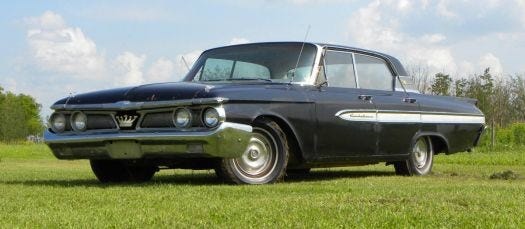
The 1960s cruising culture immortalized in films like “American Graffiti” was not limited to Southern California. In Saskatoon, 8th Street East was a neon highway of drive-in restaurants, gas stations, banks, coffee shops, and grocery stores. On Friday and Saturday nights, we piled into cars and cruised up and down between Preston and Broadway Avenues. The year I met Brian, my brother Cal had just acquired his first car, a 1961 Monarch, which was a brand built by Ford for Canada alone. The Monarchs were essentially Mercury models with unique trim, grilles, and taillights to differentiate them from their Mercury relatives. Cal’s Monarch belonged to Dad for five years before he passed it on. Brian lived close to us, and by late fall, we were giving him rides to and from school almost every day, and he was cruising with us on the weekends. I sensed my parents were unsure of him at first, as he always looked a little like a bad boy, but he was unfailingly polite and respectful to them, and they never said anything to Cal or me about the friends we chose.
One of the great advantages of Brian’s outward persona was that he appeared older than he was. We were not yet seventeen, but he could pass for twenty, which made it much easier to acquire beer. There were a couple of sketchy hotel bars on the other side of the river, and you could buy ice-cold twelve-packs from their “off-sale” counters. We would pool our money, send Brian in alone, and wait in the car. The off-sale entrance was usually a battered steel door on a side street, and when he flung the door open, case in hand, he would hold it over his head like a trophy and flash us the big smile that transformed his face. That trip across the river was how most of our cruising nights began.
All of Brian’s simmering conflicts at school came suddenly to a head on a Friday in early November. It was a cold night. There was no snow on the ground, but low, grey clouds hid the sun all day. At night, as we cruised in Cal’s Monarch, small snowflakes swirled in the cones of light cast by the streetlamps. Cal was driving, and I was riding shotgun. The back seat of the Monarch was wide and flat. Brian and two other friends sat back there, each of them with an open beer tucked between their thighs.
We were at a stoplight, earnestly discussing whether the one-size-too-small wool sweater Lynn Galbraith wore to school that day was a strategy or an accident. As was common in discussions of that sort, Brian was imparting some wisdom to the rest of us.
“When it comes to girls, there are no accidents,” he said. “Everything is calculated, done for a reason. In this case, the reason was to make sure everyone noticed her, guys and girls alike. Guys to get them interested, girls to get them jealous.”
Our friend Dave was sitting on the driver’s side of the back seat. He said, “Well, it worked. I think I found ten reasons to walk by her locker today.” We were nodding our heads in agreement when Cal said, “Oh, crap,” and flinched away from his side window. A fraction of a second later, we all flinched when something smacked against the metal roof of the car. The noise inside was deafening, and it happened again before we could say or do anything. Somebody screamed outside the car, and we lifted our heads to see what was happening.
I squinted to see through the frosted glass on Cal’s side of the car. Somebody was on the street beside the car, and he was swinging something in the air like a whip. “What is he doing?” I asked. In a different situation, we might have just driven away, but there were cars all around us at the stoplight. Another scream, and then the lunatic outside the car moved into the clearer view afforded by the windshield. I recognized him from school, though I didn’t know his name. He screamed again, streams of white condensation appearing with each word, peering through the windshield.
“That’s a belt in his hand,” said Cal. “And I think he’s saying, ‘I want George.’”
I turned my head to look at Brian. He rolled his eyes and shook his head. “Let me out. I’ll take care of this.”
Cal replied, “Hang on,” and inched the car forward, trying to will the light to change. It didn’t, and the crazy guy came around to my side of the car, whipping the flat of his belt against the hood and roof, yelling, “I want George!”
Cal’s initial shock was turning to anger. The Monarch was not a fancy new car he had saved up for, but it was his, and he didn’t appreciate the abuse it was taking. Finally, the light turned green, and Cal inched forward again, but it took some time for the cars in front of us to get moving. The whipping and screaming continued. The brake lights on the car in front of us winked off, and Cal said, “Finally.” We started to move, and I felt a cold blast of air as Dave quickly rolled down his window.
“What are you …” I started, as the car slid past our attacker, who had finally stopped lashing the roof, and was waiting for his car to move up to him. With the speed of a cobra strike, Dave’s hand shot out of the window and grabbed the belt just as the car accelerated. He tore it from the guy’s hand and pulled it in the window, shouting “Hah!”
Dave’s sleight of hand had us bouncing in our seats, craning our necks to see the shock and outrage on the face of the stoplight assailant. We were a few blocks down the street, approaching the intersection of Cumberland Avenue, when I saw Cal glance at his side mirror and say, “Uh oh.”
We turned our heads again to see the headlights of an old truck closing fast behind us.
Dave said dryly, “I think he would like us to return his belt,” as the truck whipped into the left lane and zoomed up beside us. The passenger window was down, and we could see three guys in the truck. The one next to the window was the kid who had been in the street. He was still screaming, his face contorted by rage and the constant stream of obscenities he was throwing our way.
“That fucker is crazy,” said Brian.
“No kidding,” I answered. “Who is he and what did you do to him?”
“I think his name is Charles Finley, and I didn’t do anything to him, really. He was trying to get on my nerves the other day, and I told him he was a goat fucker. Then the vice-principal was coming across the parking lot toward us, so I just walked away. I hadn’t thought about it since, but it seems fair to say he has.”
“Ya think?”
The intersection of Cumberland Avenue was fast approaching. Cal said, “I’m going to turn right on Cumberland while he’s still in the left lane. Maybe we can lose him, and I can pull over and see what he did to my car.”
Dave spoke up from the back seat. “You know there are five of us, right. I only see three in that truck. I say pull over and whatever happens happens.”
We were considering our options, trying to ignore the lunatic screaming at us, when Cal flinched again. He jerked the wheel to the right as the truck swerved into our lane, trying to force us off the road. Cal went as far right as he could without hitting the curb, then stomped on the brakes to let the truck go by. He almost made it. There was a screech of rending metal as the rear fender and bumper of the truck sideswiped the front fender of the Monarch.
“God damn!” Cal yelled. The truck was ahead of us now, and slowing down, trying to get us to stop. There was a supermarket parking lot to the right, and Cal turned into it. The truck took the next entrance and turned back toward us. We were opening the doors and starting to get out when the truck screeched to a stop in front of us. Its headlights were blinding, but as I stepped out of the car and squinted, I saw the passenger door fly open, and the beltless wonder jump down onto the asphalt. He ran between the two vehicles to my side of the car, and I squared up as he stomped toward me. Dave and our other friend, Lionel, were still getting out of the back seat, and Brian was sliding toward the passenger side.
Again, Finley screamed, “Where’s George? as he approached. I stood my ground, and he used both hands to shove me in the chest.
Brian was still half in the car, and I heard him say, “Hang on, goat fucker.”
The shove had pushed me back a step, but I stayed in his path, and Finley came at me again. This time, I was ready. As his hands came toward my chest for the second time, I pushed off my right foot and swung my right fist at his face as hard as I could.
Anyone who has played a sport like baseball, hockey, soccer, or golf understands the feeling of pure contact. It happens when a swing is perfectly timed and coordinated. The center mass of the ball or puck meets precisely with the center mass of the bat, or club head, or the top of your foot. You hardly feel it, but the ball leaps from the contact, traveling faster, farther, and straighter than you thought possible. I never trained or had any experience as a pugilist, but for some reason, when I swung my fist at Charles Finley’s face, I did everything right. The flat of my fist caught him square on the left cheek with an audible smack. His head spun to the right, and he started to fall. I stepped back to get out of his way, and he crumpled to the ground in front of me. His head nearly rested on my shoes.
“Damn, E.” Brian often called me E, as it was the first letter of my last name. He had made it out of the car and was standing behind me. “Remind me to take you seriously if we ever get in a fight.” I glanced down at Finley, then through the headlights at his two friends, who stood by the doors of the truck, but showed no interest in pushing events further. Cal, who had examined the damage to his car, had other ideas. He marched toward the driver, who began to climb back into the cab of the truck.
“Hey,” he called. “Get back here!” I could see Cal gathering himself to run when flashing red lights and the whine of a police siren made him freeze.
The police cruiser that pulled up beside us was a big, black-and-white Chrysler. The red light strobed across our faces while the officers opened the doors and stepped out. One officer stood back while the other, his hand on a billy club hanging from his belt, walked up to us. He looked down at Finley, then at me.
“You boys been fighting?” he asked, continuing the long tradition of police officers stating the obvious.
“Well, not really,” I started. He raised his eyebrows and knelt beside Finley, who had managed to push himself up to a kneeling position.
“You okay, son?
Every time the red strobe lit Finley’s face, I could see that his left cheek was already swollen and discolored.
The policeman held his hand in front of Finley’s face and asked, “How many fingers?”
“Two.” The policeman nodded.
“How about now?”
“Four,” Finley answered.
“All right. I think you’re okay. Now,” he said, standing up to his full height and facing me. “How about you explain how all this happened?”
“It’s pretty easy, sir. This guy attacked our car when we were stopped at a stoplight. We drove away when the light turned green, but they chased us in the truck.” I looked up at the headlights facing ours. “And then they sideswiped us. If you go around to the other side of the car, you’ll see where they tried to run us off the road. We pulled in here to get away; they followed us and wanted to fight.”
The policeman frowned. “Why did they do all this?”
“I think this guy,” I looked down at Finley, “was mad at one of my friends.”
“Which one?”
“Me, sir,” answered Brian. He stepped up beside me.
Before the officer continued his questioning, another car pulled up to the scene. “Who’s that?” the policeman asked. I shook my head.
But when the door opened, I did know. It was Bill Brown, another high school friend. He started toward us, but was stopped by the other officer. Bill was talking animatedly. I saw him point at the truck driver as he spoke. The two of them started walking toward us. When they were close, the officer began speaking to his partner.
“This one,” he meant Bill, “was a couple of cars back from these boys and says he saw the whole thing in the street. Said that boy,” he looked down at Charles, “jumped out at a stoplight, and was whipping his belt all over the car. Then, when they drove away, the truck followed and sideswiped them before they pulled into the parking lot here.”
“What about what happened in the parking lot?”
“Well, that he didn’t see. Said they drove by and then doubled back to help their friends.” The officer looked down at Charles, who was still a bit groggy, and at me, unscathed. “Seems pretty clear though.”
“Okay. You go talk to the other two. I’ll take a look at the car.”
Nothing came of it, for us at least. We heard that the truck was impounded. We had to go to the police station the following morning to see if any other questions needed answers, but there was nothing. Insurance covered the repairs to Cal’s car, and though our parents frowned at the story we told them, they didn’t punish us further. The best thing I got from the night was a reputation. My friends told anyone who would listen about the knockout in the parking lot. I didn’t mind it, and Brian called me his tough-guy friend for a long time after that.
Though we were all Saskatchewan boys, our rural upbringing and ongoing farm duties made Cal and me a bit exotic to our urban friends. We lived in Saskatoon all winter, but spent summers at the farm near Portreeve, and traveled back and forth in the spring and fall for seeding, harvest, and hunting. Our father was a keen hunter who introduced us to his passion when we were very young. Both Cal and I had taken trophy whitetail bucks before we were ten years old. Dad taught us to shoot rifles and shotguns, how to process game, and was rigid about gun safety. Our long experience allowed us to tell endless stories to our high school friends. They had all seen and heard the Canada geese that paused their great migrations on the stubble fields around the city, fattening themselves for the long journey to Texas or Louisiana, but most had never been hunkered down in a pit blind behind a decoy spread at dawn, heart pounding, with hundreds of geese overhead, their honks and cries so loud you weren’t sure you would hear when your father yelled, “NOW!”
Nor had they hiked into the northern edge of the Great Sandhills when the promise of the coming day was just a reddish glow on the eastern horizon. Or, once safely hidden in the sage and sand, used field glasses to scan the alfalfa fields to the north, looking for the whitetail deer that fed in the alfalfa at night, and retreated to hidden beds in the Sandhills with the coming of day.
We had lots of funny anecdotes about farm life as well—trucks and tractors getting stuck in prairie gumbo that balled up between tires and fenders like heavy cement, Shetland ponies that used to try to scrape us off their backs by walking under tree branches and stable doors, great-horned owls that would fold their wings and hurtle like cannonballs through a vent opening into the hayloft of our giant, wooden barn, where they raised their young. Our friends appreciated all of it, as we listened raptly to their stories of hijinks at the drive-in theater. The difference was that we were able to experience all the things they told us about because we lived in Saskatoon for nine months of the year. Brian, in particular, was insistent that we reciprocate and take him to the farm for a weekend, preferably during hunting season. No one had ever taken him hunting, and he wanted to try it. Hunting season was almost over at the time of our parking lot altercation. We had to wait a year.
A wet September in our 12th-grade year delayed the harvest. By the time we were clear to invite friends down for a weekend, it was mid-November, and the big flocks of geese that roosted on the South Saskatchewan River near the farm had largely moved on to warmer fields in the Dakotas and southward. Whitetail deer season was open, and there were coveys of sharptail grouse and Hungarian partridge sheltering in the hedgerows and coulees of the hills that bracketed the river. Ringneck pheasants, introduced to southern Saskatchewan in the 1930s, were another, rarer game bird that lived in the river hills.
The road trip to the farm was memorable in itself. Cal and I had made the drive many times, but I had never done it with a group of friends. Mom and Dad had gone ahead on Thursday morning so that Dad could do some farm work, and Mom could warm the house and prepare a meal for the young guests I was bringing. Cal stayed with a friend in Saskatoon for the weekend. Brian, Dave, and Lionel brought their gear to school that day, and we left from the parking lot minutes after the bell rang to end the day. We all had permission to miss school on Friday. My car was full of gas, and by four pm, we were at the outskirts of the city, headed southwest on Highway 7.
The sky was gray overhead, threatening snow, but the asphalt was dry, and we made good time as we were a day ahead of the long lines of cars that snaked out of the city on Friday afternoons. An hour later, with the sky beginning to darken, we made it to Rosetown, the halfway point of our trip. As I slowed for the lower speed limits in the town, I asked the questions I had already asked a couple of times.
“One more time. Everyone has a white-tailed deer license, right?”
Dave and Lionel spoke in unison from the back seat. “Yes, Theodore.”
I glanced to my right to look at Brian. He rolled his eyes upward as he looked back. Then he nodded.
“And everyone has a game bird license, right?”
“Yes, Theodore.”
I didn’t bother to look at Brian a second time.
“And what kind of birds can you not shoot with just a game bird license, not that we’re likely to see any.”
“Ducks and geese, Theodore.”
“You know E,” Brian said, changing the subject. “I’m getting a little thirsty. I bet we could find an off-sale counter in this town.”
Ten minutes later, we were back on the road with a cold six-pack. I was driving, so I limited my intake to one. The others shared the remaining five. It was dark when I turned off Highway 7 at Brock, heading south toward Eston and the South Saskatchewan River.
Saskatoon is known as the City of Bridges. In the mid-1960s, there were five bridges over the South Saskatchewan River. Today, there are eight. Unfortunately, all the bridge money in Saskatchewan seems to have been spent in Saskatoon. There aren’t many bridges over the South Saskatchewan once you’re outside the city. To compensate, the province runs several small, cable-guided ferries to help travelers avoid long detours. In the winter, once the ice is thick enough, people drive over the ice at the ferry crossings.
I had seen skeins of ice forming at the riverbanks in Saskatoon, but the freeze-up had not begun in earnest. The Lancer ferry is the closest one to the farm, and as we approached the north side of the river, I told the boys to note the change from flat, cultivated fields lined with orderly stubble rows to the virgin, short-grass prairie that covered hills and steep coulees with a coarse gray wool. Stabbing headlights and the glow of the dashboard in the warm cabin made the car feel like a sanctuary, a spaceship hurtling through the black void of space.
The ferry was across the river when we stopped at the landing. I turned off the headlights, and we stepped out of the car to stretch our legs. The air was cold, and a westerly breeze rippled the dark water. I crossed my arms and shivered. “Look up,” I said. “Check out the Milky Way.”
They all tilted their heads and stared. Brian spoke first. “Damn. I’ve looked at the stars before, but I’ve never seen them like this. Not even when we would go camping at Candle Lake.”
“Dry air,” I said. “The humidity is really low in this part of the province. Not always good for farming, but great for seeing stars.” The motor that winched the ferry across the river was getting louder. “Let’s get back in the car,” I added. “I’m freezing.”
On the south side of the river, as we climbed out of the valley, I pointed out that we would be hunting in the river hills west of the road. Ten minutes later, I turned into our farmyard. The drive was lined with rows of pine trees that angled southeast and southwest. At the end of the drive, there was a yardlight to the left. On the right was the two-story farmhouse with the east-facing dormer.
The house had brown wooden siding that faded into the darkness, but the kitchen was brightly lit, and the curtains were drawn back. I could see my mother standing at the stove, and my father sitting in a chair at the table. As the car came to a stop, I saw him stand up slowly, pushing on the edge of the table to help overcome arthritis and back trouble. We were lifting bags out of the trunk when he opened the door and asked if we needed help.
“We got it, Dad,” I answered. He held the door while the four of us clomped up the stairs and crowded into the space between the door and the kitchen table. My mother stood with her back to the stove, slender and smiling to see us safely in her kitchen. We set our bags down and took off our shoes. I hugged mom and turned to my friends. “You remember Brian, Dave, Lionel?”
“Of course,” she answered. “Why don’t you show the boys to the rooms upstairs and then come down for supper. The casserole’s ready. I’m just waiting for some carrots to steam.”
When he finished eating, Brian set his cutlery on his plate and pushed his chair back from the table. My mother always sat at the end of the table nearest the sink and the stove, and he looked in her direction. With a warm smile on his face, he said, “Mrs. E, that was delicious.”
Mom was busy chewing a mouthful of carrots when Brian spoke up. She took a few seconds to finish and compose herself. She would never do anything as uncouth as chew and talk at the same time.
“Thank you, Brian. There’s more if you’re still hungry.”
“Oh, no ma’am. I’m quite full.”
“Well, not so full to miss out on a piece of pie, I hope. I made a Saskatoon berry pie today, and there’s vanilla ice cream to go with it.”
“Oh, I will definitely have some of that.” I was sitting next to Brian, and he turned to look at me. “Hurry up, E. Did you not hear there’s Saskatoon berry pie?”
While we finished the remnants on our plates, Mom stood up from the table and put her plate and cutlery next to the sink. Brian followed her lead and then went to the other end of the table to get my father’s dishes.
“Are you finished, Mr. E?” Brian was one of those guys who was always looking for ways to help. Dad nodded and mumbled his consent. He listened more than he talked, and the boys never knew quite what to make of him. His face could crinkle into a lovely smile that started at the corners of his blue eyes, but he maintained an inscrutable look for much of the time, which kept the boys guessing. The rigors of homestead farming in the early twentieth century had taken their toll on his body. The flat planes of his Nordic face had drawn inward, and issues with his legs and back had given him a stoop, but he still projected the physical force he had once possessed.
After he had been at our house in Saskatoon one time, Brian said, “I don’t think your dad likes me.”
“Why do you say that?”
“He doesn’t talk to me very much, and he never smiles at me.”
I laughed. “He’s the same with me. Trust me. If he didn’t like you, you’d know about it.” I thought about what I’d said and corrected my statement. “Well, I’d know about it. And I don’t.”
The pie was delicious. Brian and the boys went on and on about it, saying it was the best pie they’d ever had. Mom blushed from the praise, and Dad graced us with a hint of a smile. Saskatoon berries (Amelanchier alnifolia) are native to the coulees that frame the South Saskatchewan River north of the farm, and it was a tradition for farm families, including ours, to embark on picking expeditions in the early summer when the fruit was ripe. Though they are similar in size to blueberries, they are more closely related to apples and imbued with a purple hue distinct from the indigo color of blueberries. Their taste is also compared to blueberries, but there’s something different—hints of cherry or almond that derive from the tiny seeds.
The best part of a hunting day is a bright kitchen before dawn, with coffee brewing and filling the air with its delicious, roasted aroma. Since we were staying with my parents in the middle of nowhere, there was no partying the night before, and we took turns washing our faces in the basin at the end of the hall by mom and dad’s tiny bedroom. Everyone was excited.
Dad was up with us. He didn’t hunt like he used to, but he volunteered to drive the truck and be our taxi for the day.
After coffee and toast, Dad looked around the room to make sure we all wore the bright colors that were required for big game hunters.
“You’ve got hats too?” he asked.
“Yes, sir,” they all replied.
“And licenses?”
“We checked it all on the way down, Dad. We’re good.”
He nodded. “Let’s load up then. Don’t forget the lunch.”
On the drive to the river hills, when we passed two-pheasant corner, a whitetail doe bounded up out of the ditch and through the headlight beams of Dad’s green Mercury truck. We were crammed into the cab, heater blasting.
“Look at that!” said Lionel. He was the smallest of our group, and was pushed up against Dad’s heavy, canvas work coat that smelled of dry soil, musty feathers, and motor oil. He turned his head and looked up at Dad. “Do you think that’s a good sign?”
Dad answered in his usual dry, matter-of-fact manner. “Nope. We’re going up into the hills. I don’t think that deer’s going to follow us.”
Lionel said, “Oh,” and turned back toward the windshield.
Twenty minutes later, after we had opened and closed a few gates and bumped down some double track surrounded by mounds of prickly pear cactus, Dad brought the truck to a stop and turned the engine and lights off. The sun was just below the horizon, and the eastern sky was an orange dome. The land around us was shadowed like a charcoal sketch: lighter at the tops of hills where the gray dawn found short grass that was silver and tan, darker in the shallow draws that were the beginnings of steep coulees that drained toward the river.
Dad and Brian were the two largest bodies in the truck and sat next to the doors. Dad opened his, and Brian followed. The metal hinges creaked. We had stopped near the entrance to one of the big coulees, and a cold wind flowed up and out of the river valley. White plumes of condensation surrounded our heads as we exhaled into the cold morning.
Having grown up with my father’s strict policies on gun safety, I was nervous about my friends’ behavior as we began to reach into the bed of the truck and uncase the rifles we would carry on our hunt. Everyone, except for Lionel, had managed to borrow a hunting rifle from a parent or uncle, and we had gone to a gun range outside Saskatoon the weekend before. At the range, before we fired a shot, I taught them the rules I learned from my father, chief among them, “always control the muzzle of your firearm,” and “keep it pointed in a safe direction at all times.” Then we took turns loading, unloading, aiming, and firing to make sure the rifles were sighted properly and the boys were comfortable with the process, the recoil, and the noise.
Dad stood at the side of the truck while we loaded magazines, his face shadowed by a canvas cap. To my relief, the boys did everything by the book. They didn’t joke around, kept their muzzles pointed at the ground, checked safety catches, and generally behaved with a quiet efficiency that brought to mind an expeditionary force preparing to storm a beach or sneak behind enemy lines. When we were ready to go, Dad came around the back of the truck and gathered us up.
“Okay,” he said. “The four of you are going to walk this coulee, slowly. Two of you will walk on the right side, and two on the left. On each side, there will be a person down low on the hillside, and one higher. No one gets ahead or behind. If that happens, whoever is ahead stops to wait until the others catch up.”
I glanced around at my friends’ faces. They were all wide-eyed, listening to Dad.
“Walk slowly,” he continued. “Take a few steps. Watch. Listen. The most likely thing is there’s a deer, or several deer, bedded up near the bottom of the coulee. They’ll hear you coming and decide to run to safety. Do not try to shoot a moving target. Nine times out of ten, they’ll run a little way and then stop to look back at what disturbed them. That’ll be your chance. As long as you’re not shooting across the coulee, where your friends are, take it if it’s not too far.”
“Sir,” Lionel said. Dad looked down. “How far is too far?”
Lionel was carrying a lovely little BSA .243 that belonged to my brother. It had a small stock and an aperture sight that was very accurate if you knew how to use it. Luckily, Brian’s weapon, a WWII-era Lee-Enfield in .303 caliber, also had an aperture at the rear of the rifle, and Lionel was able to practice with it the weekend before. Dad looked around and spotted a fenceline in the distance.
“See that fence?”
Lionel nodded.
“That’s about 200 yards. If you had a rest, I’d say take the shot. Shooting from a standing position, like you’ll be doing, that’s probably too far. Keep it inside of that.”
“Yes sir.”
With that, we set out. We had about a mile to go before the coulee we were in intersected another. Dad told us to climb out on the east side once we reached the intersection, and he would pick us up. From there, he would take us to the start of a different coulee, and we would start again.
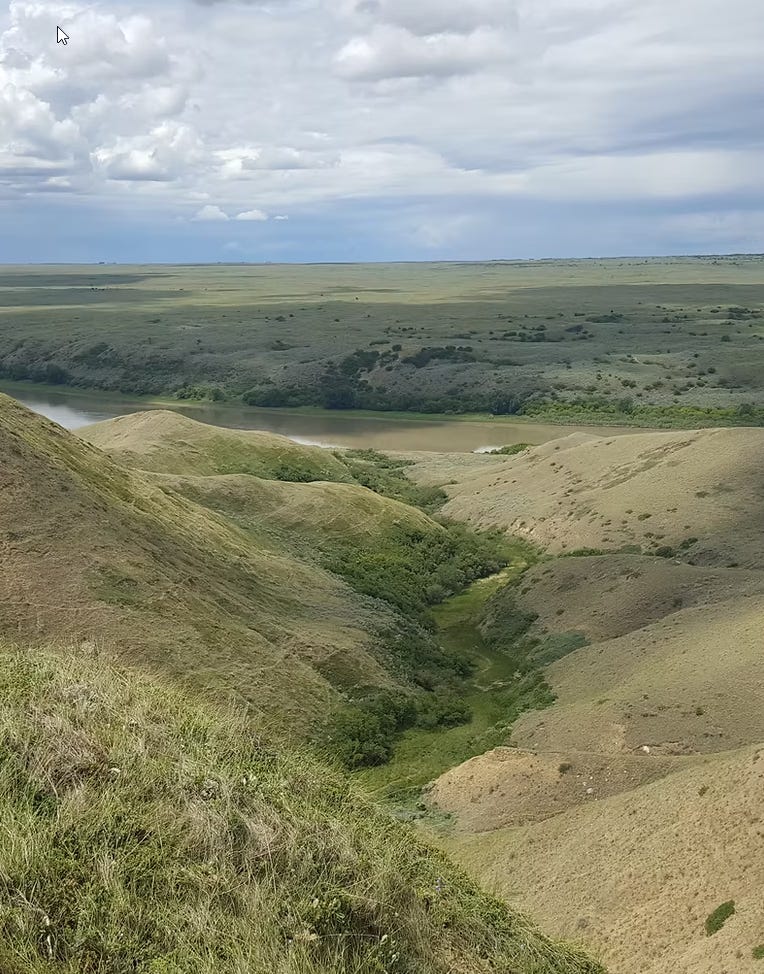
By lunchtime, we had probably hiked five miles in four different coulees without seeing a whitetail. Dave, while waiting for the rest of us to join him at a coulee rim where Dad was going to pick us up, had taken the opportunity to sit down and rest his legs. He didn’t scan the ground very well and settled into a small clump of cactus. Brian was complaining about lugging his wartime Enfield, which weighed nearly ten pounds, up and down the sides of steep coulees, and Lionel, whom we all viewed as the weak link in the chain in situations like the fight on 8th Street, surprised us all by rabbiting up and down the steep hills without effort. He smirked and said, “I told all of you to come and try out for the cross-country team with me, and none of you listened.”
Mom had packed us a lunch of ham and cheese sandwiches, and Dad parked the truck where we could see a bend in the river. A sand bar, tan against the dark ribbon of water, traced the inside of the curve. After checking for cactus, we sat on the ground on the downwind side of the truck. With the wind blocked, we could feel some warmth from the weak sun. The sky above us was pale blue. High cirrus clouds painted it with a few white streaks, and we closed our eyes and turned our faces upward as we chewed. The best part of the lunch was the narrow wedges of Saskatoon berry pie that Mom had wrapped in plastic. We ate them with our hands, and washed them down with canteens of the mineral-tasting water from the well in Portreeve.
The morning passed without incident, and the boys were beginning to relax around Dad. The first coulee we would hike after lunch was just a quarter mile from our lunch spot, so once we finished eating, we loaded the rifles and prepared to start hunting. Dad joined in some of our lunch conversation, but did so from the cab of the truck, where he sat alone. At one point, Brian was recapping the events that led to the 8th Street incident, and accidentally used the term “goat fucker.”
“Oops,” he said almost immediately. He looked toward my father with a guilty expression. “Sorry about the language, Mr. E.”
Dad narrowed his eyes, which Brian took as a rebuke, but as he looked away from us to take another bite of his sandwich, I saw him smile.
Rejuvenated by the sandwich and the pie, we were in good spirits as we loaded the rifles and prepared to hike toward a draw that was a quarter mile from the lunch spot. Dad stood by the truck and observed.
“Ready,” I called out.
“Ready,” the boys answered.
I started to walk. Dave and Lionel fell in beside me. Brian was staring at something in the river valley, and I waited for him to join us. When he turned, he forgot about the muzzle of his old rifle, and the barrel swung through an arc, chest high. As it moved past Dad, I saw two things. Dad flinched, hardly noticeable, but evidence of his discomfort with a rifle pointed at his chest. And Brian’s eyes opened wide. He knew what he had done.
Brian tried to speak first, but Dad cut him off. “Don’t point that fucking thing at me,” he boomed.
“Mr. E,” Brian stammered. “I am so sorry. I just forgot. It’ll never happen again, I promise.”
I stood frozen, staring at the scene. It was probably only the second time in my life that I heard my father use the “f” word. I didn’t know what would happen next, but Dad dropped his head and stared at the ground for a moment. When he lifted his gaze, he took a few steps toward Brian and stood in front of him.
Dad pointed at the old Lee-Enfield. “Have you ever seen what this rifle, or any of these rifles out here, will do to a living thing?”
“No sir.”
“It’ll kill it, just as dead as that stone lying on the ground there. Do you want to live the rest of your life knowing you killed one of your friends, or me?”
“No sir.”
“Then you'd better be a damn sight more careful with that rifle.”
“Yes sir.”
And with that, it was over. Dad walked back to the truck. Brian stood still until I caught his eye and gave a jerk of my head, telling him to come along. The four of us started walking toward the coulee. No one spoke.
The rest of the day passed without incident and without deer. Late in the afternoon, as the sun started its descent to the horizon in the west, Lionel called out from the other side of the coulee. We all stopped and looked toward each other, trying to figure out what was happening.
Lionel was on the east side of the coulee, near the bottom. I was across from him on the west side. Brian was above me; Dave was above Lionel. In the bottom of the coulee, between Lionel and me, gnarled thickets of wolf willow sheltered muddy flats impacted by the hoofmarks of cattle.
“What is it? I called to Lionel. He pointed diagonally across our path. I looked in that direction, and there on the coulee rim, silhouetted against the purple sky, was a nice whitetail buck and two does. The buck was broadside with its head turned to look at us. The rectangle of his body and his crown of antlers were black against the backdrop. He seemed larger than life, magnified, but I knew he was a long way off.
“Should I shoot?” Lionel asked.
“Not with the .243,” I said. Dave’s rifle was a 30.06 with a scope, and I called to him. “Dave. If you can get down on one knee and use the other as a rest, like we practiced, you can try it. Hold at the top of his back, right behind the shoulder.” I guessed the distance at 300 yards.
“You better hurry,” I added. “They won’t stick around.”
Dave dropped to one knee and worked the bolt of the rifle, moving a round from the magazine to the chamber. With his left elbow on his left knee, he settled in behind the scope. While he aimed, I turned my attention to the deer and waited for the rifle report. At the range the weekend before, I had taught the boys to exhale partway, pause, then squeeze the trigger, and I found myself following that same routine while I waited. The deer were motionless; there was no sound but the gentle hiss of the wind in the grass. Eventually, I drew in a breath and turned my head toward Dave. He was still down on one knee, but he had taken the rifle off his shoulder and was looking across the coulee at the rest of us. I held up my hands as if to ask, “What’s wrong?”
He shrugged and said, “Too far,” just loud enough for me to hear. I frowned and thought about taking the shot myself, but when I looked back at the rim of the coulee, they were gone.
Dad picked us up ten minutes later. He said he’d seen a nice buck and two does come out of the coulee we were in, and wondered if we’d seen them. I said that we had, and that Dave had a chance to shoot.
“Well,” he said. “Why didn’t you?”
“It was pretty far, sir. I knelt and tried to use my knee as a rest, but I was shaking a lot, and I didn’t want to make a bad shot.”
We were crammed onto the front seat of the truck as we bumped slowly down a double track toward a better road. Dad glanced to the right and seemed to look at the boys arranged next to him with some new respect.
“Well, young man, that was probably a good decision. Shame you didn’t get a better chance at that buck, but better that than you wounding him and us spending the next few hours trying to find him in the dark.”
“Yes, sir.”
Mom had another nice dinner waiting for us when we got back to the farm—ham, mashed potatoes, vegetables from the garden, and more Saskatoon berry pie. In comparison to the night before, Dad was a different man. He talked and told stories throughout the dinner, including ones like the time he was kneeling, inspecting a large male badger he thought he had killed. And then it opened its eyes.
“Believe me,” he said, laughing while he talked. “A live, thirty-pound male badger is not something you want to be up close and personal with.”
As I lay in bed that night listening to Brian’s gentle snores from the other corner of the south bedroom, I wondered why Dad’s demeanor toward my friends had changed so much. My best guess was that Brian’s transgression—pointing the rifle at him, however innocently—had given him the chance to put a scare in them, which he felt they needed. Satisfied with my thesis, I fell into a deep sleep and did not wake until just before dawn.
The boys wanted to try some different types of hunting, so Saturday was for the birds. Dave had managed to borrow an old, side-by-side double shotgun from the same uncle who lent him the 30.06. Brian and Lionel borrowed from Dad and me. I gave Lionel a 20-gauge pump shotgun that was perfect for grouse and partridge, and Brian, who was the biggest and tallest among us, borrowed Dad’s heavy old Winchester Model 12.
We hadn’t spent any time with shotguns at the range the weekend before, so we took some time after breakfast to review their operation, and then shot some clay targets in the field behind the house. After a few tries and some discussion of gun movement and lead, everyone was breaking targets with reasonable consistency. Dad stayed home, but lent us the Mercury truck for the day. Before we drove out of the yard, he strolled over from the small, red-painted shop next to the fuel tanks that dispensed diesel and “purple gas” for the tractors and farm vehicles. I rolled down the driver’s window as he approached. His inscrutable, stern face was back.
“You boys be careful,” he said. “At close range, those shotguns are just as dangerous as a rifle, if not more so. They’ll put a big hole in you.”
I nodded, and the boys said: “Yes, sir.” He banged his hand on the roof and stepped back. “Good luck,” he called, as we rolled out of the yard.
We went back to the river hills. While deer hunting the previous day, we had flushed half a dozen coveys of Sharptails—prairie chickens in the local vernacular—and a couple of coveys of Hungarian partridge. Ditches and hedges on the way to the hills were additional spots that often held game birds.
As we climbed into the hills toward the steep coulees, I stopped the truck several times so we could walk a hedgerow or the margins of a dried-up slough where the natural vegetation provided more cover than the short prairie grass. Not all the spots held birds, but some did, and after a few stops, we had four Sharptails and a partridge cooling in the bed of the truck. Brian, in particular, was pleased with himself. He felt a little handicapped shooting Dad’s big Model 12 with the full choke, but felt sure he had connected with at least one of the Sharptails, and claimed it as his first ever bird on the wing. After that, he could hardly wait to get to the next spot.
As we returned to the truck after an unsuccessful stroll around an old homestead, Brian expressed his preference for flatter terrain over coulees.
“Seeing as how I always get stuck carrying the weapon that weighs as much as a cannon, I’ve gotta say I like this kind of walking better than those steep-ass hills from yesterday.”
I was looking down, racking shells out of the magazine, listening to similar sounds from the other side of the truck. “Break’s over, I’m afraid. See that cattle gate across the road up there?” I lifted my head to show them where I meant. “The top of the hill after that gate is where the first coulee starts. All this has just been a warmup.”
Brian groaned. Space was limited in the cab of the truck, so I slid my shotgun into a soft case and put it in the bed of the truck. Dave, who had been riding next to the passenger door, did the same. Lionel and Dave didn’t have cases for their guns, so they brought them into the cab, muzzles pointed down at the floor. We had been through the routine a half-dozen times without issue—stop, get out, load up, walk, unload, get in, drive to the next spot—so I started the truck and drove to the gate without worry. The person next to the passenger door was the gate opener, and Dave hopped out to lift the wire loop that held the gate in place. After a minute, I could see he was struggling with something. I set the emergency brake and climbed out of the cab to help.
The gate was pulled taut across the opening, and Dave was unable to stretch it enough to lift the wire over the post at the end of the gate. I put my two hands against the gatepost and prepared to lean into it. Right when I applied the pressure, there was a loud explosion behind us. Dave and I both flinched like we’d been shot, ducking our heads and whirling in the direction of the blast.
Behind the windshield of the truck, I could see nothing but a grey cloud. Certain that a gun had gone off, I ran to Dave’s side of the truck. I was sure that one of my friends was dead or gravely wounded. I was yelling, “Brian! Lionel!” into the cloud when Brian’s face appeared, coated with grey dust. He fell out of the truck, coughing and choking. Seconds later, Lionel followed, heaving and hacking on the cloud of dust.
After a minute, when it was obvious they weren’t hurt beyond some ringing eardrums, I asked, “What the hell happened?” though the acrid smell of gunsmoke gave it away.
Brian looked at me, then looked down. “My gun went off.”
In all my years of hunting with my brother, father, and other men and boys from around Portreeve, I had never witnessed such a serious safety breach, and I was mad that we were going to have to explain it to my Dad. “How?” I asked. “Didn’t you unload before we got in the truck? Have you not been unloading at all this whole morning?”
“I was. But just before we got in the truck the last time, I leaned the shotgun up against the bumper so I could tie my boot. By the time I finished, you were all getting in, and I heard the bit about getting through the gate and getting right back out, so I made sure the safety was on and just got in the truck. I made sure the barrel stayed pointed at the floor.”
“Yeah, well thank God for that. How did it go off then, if the safety was on?”
“I don’t know. When Dave got out of the truck, I shifted a bit on the seat, and the gun moved. I guess the trigger guard was pressed into the seat, and it got turned off.”
“Then what?”
“When I saw you were about to get the gate open. I shifted back to the middle and pulled it toward me. My finger wasn’t on the trigger. It must have caught on something.”
I shook my head and turned toward Lionel. “You’re okay, right?”
He nodded. “Still a little deaf though.”
“What about the truck?” Dave asked.
“I don’t know,” I said. The concussion dust had settled, and I reached into the truck and took out Dad’s shotgun. I racked the remaining two shells out of it and handed it to Dave. Then I leaned in for Lionel’s 20 gauge. I peered into the chamber and worked the slide to make sure it was empty.
When I inspected the passenger footwell, I found a neat, 12-bore-sized hole through the rubber mat and the steel pan. Under the truck, the opening was framed by small ribbons of metal. After punching through the floor, the string of pellets angled toward the front wheel, but missed it to the rear. There were some small indents in the fender where a few pellets hit, but the hole was the only real damage.
After I finished the inspection, I said, “At least we can drive it home.”
Brian, Dave, and Lionel stared at the ground and said nothing.
“What?” I asked. “You want to keep hunting?”
None of them would come out and say it, but I could tell they wanted to keep going.
“Fine. But you,” I pointed at Brian, “can never make that mistake again, ever. Do you know how lucky we are that all we have is a hole in the floor of a truck?”
“I know,” he said.
I turned to the other two. “You can’t make those mistakes either.”
They nodded.
“Ever!”
I turned back to Brian. “When we get back to the farm, you’ve got to tell Dad what happened.”
“I know.”
We hunted for a couple more hours, but the birds that were holed up in the coulees the day before had moved. We flushed one nice covey of Sharptails, and Lionel made a good shot on a bird that both Brian and I missed.
“Nice shot,” I yelled, and Lionel grinned like a fool.
We didn’t talk much on the way back to the farm. A steady influx of dust through the hole in the floor served as a constant reminder of the uncomfortable explanation that was about to happen. Dave put his foot on the rubber mat and pressed down to cut off the flow, but the dust was so fine it seemed to find its way in regardless. By the time we pulled in the yard, our mouths were dry and gritty from chewing on the powdery air. When I stopped the truck in front of the house, I glanced at Brian to see if he needed any encouragement. What I saw made me laugh, and Brian looked back, confused.
“What?” he asked.
“I’m sorry. It’s just that you look like a sad clown.”
With that description, Dave and Lionel leaned forward so they could look back at Brian, and they laughed too.
A tear of laughter scribed a dirty streak down Dave’s cheek, and Brian leaned over to look at himself in the rearview mirror. “Oh my God,” he said.
After the explosion in the truck, Brian wiped the dust away from his eyes and mouth, but didn’t do anything about the rest of his face. The markings gave him a classic clown face—white around the eyes and mouth, dirt everywhere else. The dusty drive added to the effect.
“Oh man,” said Lionel. “I’m not sure who’s gonna die during this confession. You, ‘cause you shot a hole in his truck, or Mr. E from laughter when he sees your face.”
Brian shot back. “Yours isn’t much better!” And it was true. Lionel’s face had the same pattern as Brian’s, just not as defined.
For a few moments, all we did was sit in the truck and laugh. It would die down, and then one of us would glance at Brian’s face, and it would start all over. We laughed until our ribs hurt. We were happy to be with friends, relieved that no one was hurt, and slowly working up the nerve to face my father. Finally, Brian said, “All right. Let me do this.”
I could see Dad sitting at the kitchen table, looking through some papers. He looked up when I opened the door. Dave and Lionel were sitting on the steps and untying their boot laces.
“Well. Any luck?”
“A bit,” I answered. “We found quite a few birds on the way to the hills, but not many in the coulees where we saw them yesterday. We have half a dozen chickens and one partridge.”
“Not bad. The boys do okay with the wingshooting?”
“Pretty good, actually. I think everyone shot at least one bird.” He nodded and looked back at the papers.
“Dad,” I said. He looked up again, questioning.
“Brian has something he needs to tell you. Outside.”
Dad frowned at me, wondering why the mystery, but pushed up out of the chair and clomped toward the door. The arthritis that hurt his back and legs had left him with a heavy-footed gait, like he didn’t know the floor was there until his lifted foot made contact with it. Brian was waiting by the passenger door of the truck. He had wiped his face with the tail of his shirt, so the clown effect wasn’t as pronounced. Dave and Lionel moved into the kitchen, and I stood in the doorway, listening from a distance.
I didn’t hear everything Brian said. He spoke softly, but with his head up. He pantomimed the events and lifted the mat to show Dad the hole in the truck. He took responsibility for the primary transgression, which was the sin of getting in the truck with a fully loaded, cocked weapon, and when he finished, Dad once again delivered a firm, short rebuke.
“Well, you’re damned lucky you didn’t blow your head off.”
And that was the end of it. Brian offered to pay for repairs to the truck, but we were on a farm, and farmers never pay for repairs they can do themselves. The next day, Dad hammered the metal ribbons back into the hole where they originated and welded the small gaps that remained. No one ever worried about the small dents in the fender, and we drove the truck for many more years.
We were quieter on the drive back to Saskatoon. The off-sale counters were closed on Sunday, and even though the sun was shining, the day was cold. It was the only time the four of us hunted together. As we stared out the windows at endless stubble and summerfallow, breadbasket of the world at the onset of winter, each of us alone with our thoughts, I had a strange, sudden feeling. It was a certainty, a knowing that the four of us would never spend another weekend like the one just ending. The drive, the meals with my parents, Dad’s stern looks, Brian complaining about the hills and the weight of his rifle or shotgun, Lionel showing off his cross-country fitness, Brian’s unsafe gun handling, and the short lectures that followed them, none of it would happen that way ever again. We were graduating in May of the following year, and we all had different plans. I planned to attend the College of Engineering at the University of Saskatchewan. Dave said he was going to become an accountant, like his father, and Lionel, who was smarter than all of us, wasn’t sure, but he was leaning toward majoring in math at a college back east. McGill, or something like that. His parents had moved the family west to Saskatchewan when he was a young boy, and they wanted him to receive some of that Laurentian culture they felt they’d left behind. Brian was thinking about trade school—electrician maybe, or plumbing. Everything was changing, as it must, and we were all a little sad about it. I know I was.
Of all the people in our foursome, Brian seemed the least likely to become my lifelong friend, but that’s what happened. Once we started college, I ran into Dave on occasion, usually as we crisscrossed on the footpaths connecting different buildings on campus. As upperclassmen, our classes were more specialized, and I spent all day in the Engineering building while he was at the business college. Our paths crossed less, and then not at all. He moved to Calgary after graduation and made a life there. Lionel moved back east and became a professor at one of the eastern universities. His parents were very proud.
Brian went to trade school and became an electrician. I studied agricultural engineering and worked for the department for a few years after I graduated. While we were furthering our education, Brian bought a rifle and learned to use it properly. He became a trusted hunting partner who joined me on Alberta elk hunts, but he never returned to chase deer in the river hills. Whenever we were together, he always made me laugh.
When Cal graduated from the College of Agriculture, the two of us began to take over the farm from Dad. By the late 1970s, both of us were back on the farm, full-time, with wives and young families of our own. Brian moved to a town in northern Saskatchewan and opened an electrical business. For some reason, neither of us was willing to let time and distance dissolve our friendship. Years would pass, the phone would ring, and if I were the one to answer, he would say, “Hey there, goat fucker.”
I’m retired now. Two of Cal’s sons bought my farm, so the land first broken by my grandfather in 1910 is now tilled, seeded, and harvested by a fourth generation. I always thought I would stay there until the end of my days, but life throws curve balls and wild pitches. I’m back in Saskatoon and in love with an old high school girlfriend. We own a nice house near the University, not far from 8th Street. Like I said, wild pitches. Brian sold his business in the north and also moved back to Saskatoon. We don’t go out cruising on Friday nights, but we do get together for coffee or a beer once every couple of months. The state of the world gives us plenty to talk about, but at some point, we always come back to our high school years. Maybe one of these weekends we’ll drive down to the farm and go for a hike in the river hills. No rifles or shotguns this time.
If enough time passes, old memories start to feel like dreams. You know they happened, but they don’t seem real. Two things help to lift the milky veil that time drapes over them. We can write them down, or we can find an old friend to corroborate. I’m lucky. I’ve got both.
Like (🖤) this story and advance the cause of gun safety everywhere.
Before you go:
Please click the 🖤 button, comment, share, and subscribe!
Trevor’s Substack is a reader-supported publication. To receive new posts and support my work, consider becoming a free or paid subscriber.
I really enjoyed this story. Took me back to my youth, hunting with my dad, uncles, siblings and cousins. Unforgettable times!
Puts me right there, in the coulee with them.....
....right in your grandmother's kitchen, eating Saskatoonberry pie with them...
...right in the cramped cab of the Mercury pickup with 'em.
You're just like the best small batch bourbons. Do NOT stop writing these stories ... they are too damn good.