
Oh, Canada

When I first moved to the United States from Canada, I had that slightly superior attitude that people from smaller countries typically have about America. During my first year, I often chatted with a friend who moved from Calgary to Houston at the same time I moved from Calgary to Lafayette. Together, we shared observations about our new hosts that seemed to justify the quirk in our personalities. It wasn’t that people teased us about our accents. Well, not a lot. The oil and gas business is worldwide, and people are used to working with people who sound different. And as far as accents go, Canadians are not much different than Minnesotans, and easier to understand than a bloke from Aberdeen or Manchester. No, it was our substitution of terms like “holiday” for the broader term “vacation,” and the apparent unwillingness of our American listeners to use context to deduce our meaning.
“Wait,” they would say, eyes narrowed. “Do you mean you’re going on a vacation?”
“Well, yes. But, you know, same thing.”
To our American friends, it wasn’t the same, and their apparent need to correct us was one of the details my friend and I used to bolster our superior attitudes. The big guys have always had it this way — Exxon, the New York Yankees, and McKinsey Consulting. Everyone loves to hate the biggest, the richest, and the most powerful. In time, I began to appreciate the greatness of America—its energy and dynamism, the “hey y’all” boisterousness that was a foil to my natural introversion, and the unlikely constellation of the founders and their noble documents, the Declaration and the Constitution. I became a citizen on July 4th, 2010, in the grand entrance hall of the WWII museum in New Orleans. It’s one of the proudest days of my life.
There was a time when Canada had more compelling reasons to view itself as a worthy member of the G7, the leading industrialized nations. My best friend growing up was from a military family, and he often told anecdotes, relayed by his older brothers, of superior Canadian performance, even above their American counterparts, at military exercises attended by NATO countries. Atomic Energy of Canada developed CANDU nuclear reactors in the 1950s and 1960s, and began producing electrical power at Pickering, Ontario, in 1971. The technology was further commercialized and exported, and CANDU reactors are currently operating in Argentina, China, India, Romania, and South Korea. The country’s resource and agricultural endowments are world-class, and Canada fared well during the 2008/2009 financial crisis because the banking industry remained conservative and avoided the temptation to package risky mortgages into the securities that crippled U.S. banks. It took toughness to forge the second-largest country in the world (by area) from a harsh climate.
Though GDP per capita is far from a perfect measure of well-being in different countries, it does say something about policy and governance. There’s no doubt that since 2015, which coincides with the election of Justin Trudeau as Prime Minister of Canada, this metric is telling a different story about Canada than it has in the past. The Globe and Mail recently published an article illustrating that Canada’s GDP per capita is lower than Alabama's, which consistently ranks near the bottom of US states when judged by that standard. In the last ten years, Canada has become a weaker country on the world stage. It couldn’t have come at a worse time. Worried that the United States might find itself in a similar, weakened position, primarily in relation to China, President Trump has embarked on a dizzying reset of the post-war order that promoted trade, stability, and security through institutions like the United Nations (UN), International Monetary Fund (IMF), and NATO. As the United States' second- or third-largest trading partner, its next-door neighbor, and its largest supplier of crude oil, Canada is being forced to reckon with the mercurial instincts and prickly negotiating style of a New York real estate magnate-turned-world leader, and the path is rocky. How did Canada find itself in this position?
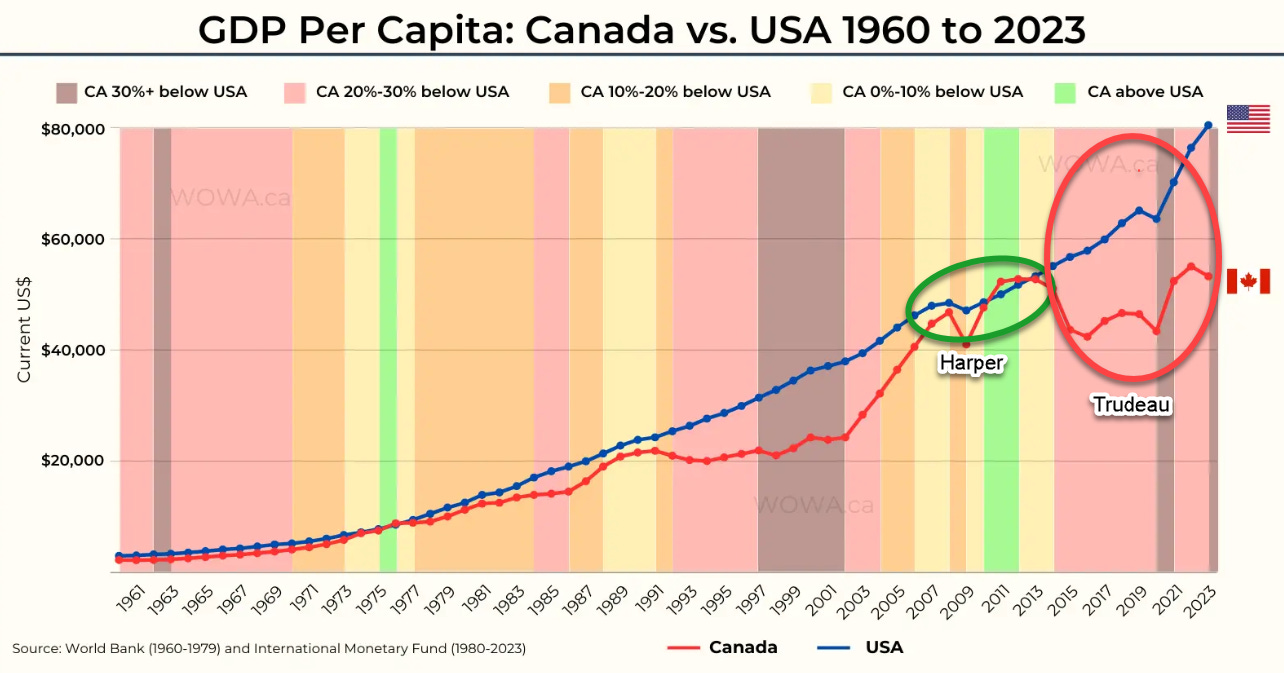
The main reason for Canada’s stumbles is the election of Justin Trudeau, who never met a WEF-sponsored policy recommendation he didn’t like. He subjected the country to a full suite of progressive shibboleths—a dramatic expansion of immigration, commitment to DEI principles, net-zero regulations, meaningless land acknowledgements, neglect of the military, the macabre spectre of MAID (medical assistance in dying), national hand-wringing over truth and reconciliation, the elevation of documents like UNDRIP (United Nations Declaration of the Rights of Indigenous Peoples) over the laws passed by the people’s representatives in provincial and national Parliaments, COVID-era dalliance with the Emergencies Act to quell protests against vaccine mandates, and a dramatic increase in the role and scope of the federal government in the economy and society as a whole.
Adherence to the principles and policies described above was supposed to elevate Canada’s standing in the world and position it for prosperity and influence in the 21st century. Like England on the other side of the Atlantic, Canada would lead by example and forge a new, clean, green, collective, inclusive way of living that others would emulate because they would eventually see the rightness of the path. The problem is that when you try to lead others down a path of decline, no one will follow for very long, and eventually, when you have weakened yourself sufficiently, others begin to take advantage of you. This is where Canada finds itself in 2026.
In the United States, influential people are sometimes referred to as Washington, academic, or financial elites. In Canada, similar groups are lumped together as Laurentian elites. The term refers to political, business, academic, and media leaders based along the St. Lawrence River in Central Canada. The cities of Toronto, Ottawa, and Montreal are the epicenters.
The Century Initiative (CI) is a charitable group that originated in Laurentian circles. Their primary goal is “promoting a prosperous, resilient, and globally influential Canada for generations to come.” To that end, the group envisions a Canada with 100 million people by the year 2100. With birth rates far below replacement level, the only way to get there is through immigration. CI is careful to note that they support immigration levels consistent with historical norms (about 1% of the population annually) to ensure the country’s infrastructure, housing supply, and essential services are not overwhelmed. Justin Trudeau did not get the memo. Beginning in 2018, immigration levels jumped to about 1.5% of the population, fell briefly during the COVID era, then quickly accelerated to over 3%. Rents spiked predictably, for natural-born citizens and newcomers both.
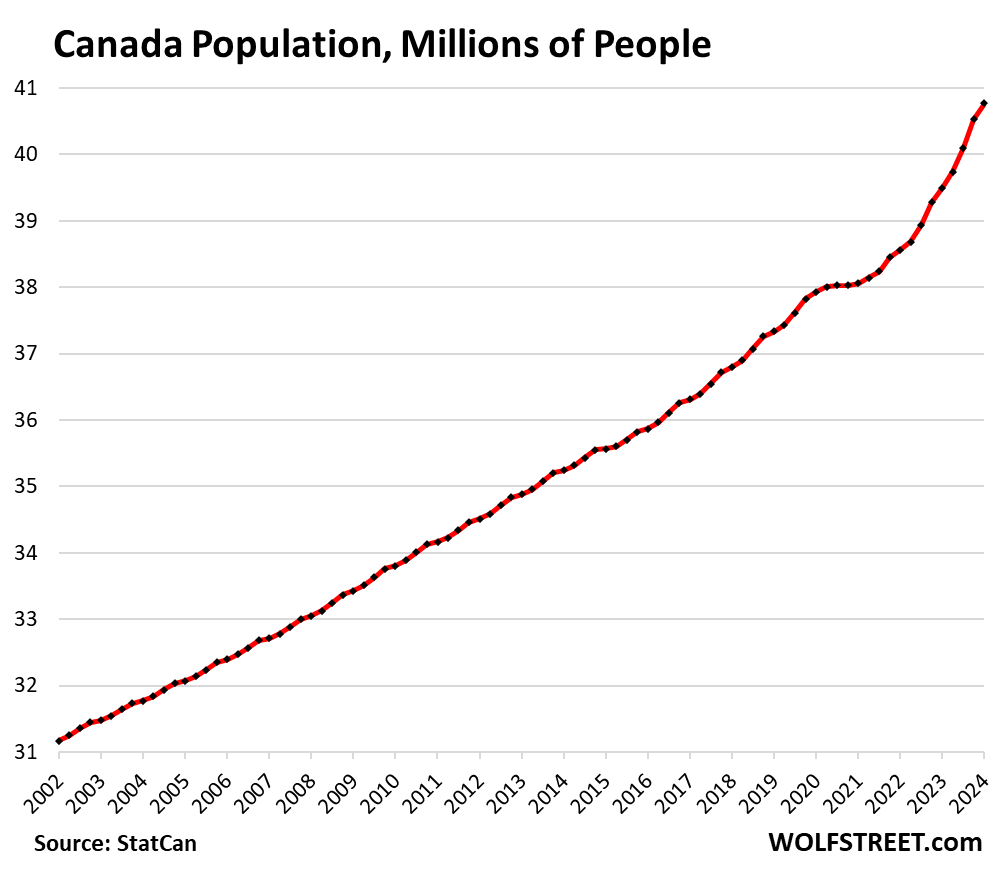
Research has indicated that significant societal transformations can occur when the foreign-born share of the population rises above 10%. In Canada, the 2021 census documented 8.36 million people as either permanent immigrants or non-permanent residents. That number was 23% of the population. As you can see in the graph above, population growth has accelerated since 2021, with nearly 100% of that growth from immigration. Some quick math demonstrates that the foreign-born population is now around 25%. There will be consequences, and not all of them will be wanted.
In the absence of a radical turnaround in Canada’s birthrate, immigration is a necessity if the country wishes to grow. But it needs to be done smartly. Justin Trudeau’s combination of high-volume immigration, far in excess of historical norms, in combination with an unfavorable business environment, has increased GDP in an absolute sense, but decreased each person’s share of that GDP. Everyone is a little worse off.
The Progressive philosophy of government begins with the belief that unrestrained market economies lead to systemic inequality and injustice. The solution is restraint, so Progressive governments tax, regulate, and redistribute to reduce inequality, ensure justice, and reduce poverty. Whether or not Progressive policies actually achieve any of these goals is a matter of widely disparate opinion.
Justin Trudeau’s Liberal administration greatly expanded the role and scope of the federal government in Canada’s economy and in society as a whole. Federal employment increased by 39% on his watch. All those new employees were hired to do the taxing, regulating, and redistributing that his government believed was necessary for Canada to be a fairer, greener, and more equitable host for its citizens and to serve as an example of enlightened Progressive governance for the world.
The results were not what was wanted. With the increased regulatory burden, business investment and confidence collapsed. Over ten years, growth in GDP per capita corrected for inflation increased at a glacial 0.3% per year, the worst growth rate since the Great Depression. Investment in industrial infrastructure—factories, warehouses, machinery—actually declined 0.5% per year during Trudeau’s decade. The appointment of Stephen Guilbeault, a climate activist turned M.P., as Minister of Environment and Climate Change in 2021 reinforced the country’s net-zero pledges, with corresponding negative knock-on effects in important industries like the oil and gas sector and homebuilding. Lessons that were not learned by the Trudeau administration, but were visible to those who cared to see, were that larger government crowds out private investment, leading to stagnation, debt, and separatist sentiment in Western provinces that resent asymmetrical transfer payments and transportation bottlenecks that limit development of natural resources.
Canada lost the plot culturally as well. In addition to the uncertainties inherent in the cultural influence of millions of new immigrants, the country has been shaming itself for past sins. Canada’s Truth and Reconciliation Commission conducted its work from 2008 to 2015, during the tenure of Prime Minister Stephen Harper. The Commission’s mandate was to inform all of Canada about what happened in the 19th and 20th-century residential school system that was set up for indigenous children. In 2015, when the Commission issued its final report, it concluded that the residential schools, which were funded by the Canadian government and operated by Christian churches—Roman Catholic, Anglican, Methodist, and others—were a form of cultural genocide. In 2021, researchers who documented 215 subsurface “anomalies” at the site of a former residential school in Kamloops, B.C., raised the spectre of actual genocide by implying that the anomalies were the unmarked graves of children who had died at the school. To date, there has been no excavation work to confirm or refute the accusations or the blowback of skepticism that accompanied them. The language used by the commission—former students of the schools are referred to as survivors, invoking the imagery of the Holocaust—combined with testimony documenting physical, emotional, and sexual abuse, spurred understandable tension and anger.
After Justin Trudeau’s victory in 2015, it became fashionable to acknowledge that this or that meeting, public event, or sporting contest was taking place on land traditionally inhabited by, or stolen from, the Haudenosaunee Confederacy, the Inuit, or the Woodland Cree. In 2017, Stephen Marche wrote an essay for The New Yorker about the phenomenon. More recently, in December 2025, David Frum penned a piece for The Atlantic titled “Good Intentions Gone Bad: How Canada’s “reconciliation” with its Indigenous people went wrong.”
Acknowledgment is beginning to emerge as a kind of accidental pledge of allegiance for Canada—a statement made before any undertaking with a national purpose. (From the Stephen Marche essay.)
The statements are meaningless. No one who makes these acknowledgements intends to cede the unceded land they stand on. Marche noted the hypocrisy in his essay and proposed something different at the end.
I acknowledge that the Wendat, Anishinabek Nation, the Haudenosaunee Confederacy, and the Mississaugas of the New Credit First Nations lived here before us and keep living here now, as we live here and keep living here. (From the Stephen Marche essay.)
That sounds better. It acknowledges both the indigenous presence and the fact that generations descended from English, French, Irish, Ukrainian, and Chinese settlers feel a similar, deep connection to their country.
The United Nations Declaration on the Rights of Indigenous Peoples (UNDRIP) was adopted by the U.N. General Assembly in 2007. Fourteen years later, in 2021, Canada passed the United Nations Declaration on the Rights of Indigenous Peoples Act, which mandates federal consultation with First Nations, Inuit, and Métis to align federal laws with UNDRIP. The province of British Columbia beat the Feds to the punch, passing its own Declaration Act in 2019. In December of 2025, a provincial Court of Appeal upheld the Act, meaning that B.C. laws can be challenged if they are not consistent with the principles of UNDRIP.
Article 26 of UNDRIP contains three statements. The second is as follows.
Indigenous peoples have the right to own, use, develop and control the lands, territories and resources that they possess by reason of traditional ownership or other traditional occupation or use, as well as those which they have otherwise acquired.
Words mean things. If you say over and over that you’re guilty of land theft, you will eventually be taken seriously. The combination of national guilt and UNDRIP has heightened friction, slowing large-scale infrastructure and resource projects vital to the country’s prosperity. A recent case in B.C. illustrates that urban environments may also be affected. Based on oral testimony, old maps, notebooks, and yellowed diaries, a Supreme Court judge affirmed the existence of Aboriginal title to about 750 acres of land along the Fraser River in Richmond. Notably, the judge indicated that Aboriginal title does not extinguish the fee simple title held by private property owners in the lands in question. She writes: "Both interests in land may be valid, and the exercise of the rights that come with those interests should be reconciled." Current holders of the fee simple titles are rightly concerned that they may never be able to sell or refinance their properties. The case will undoubtedly spur additional claims, especially in British Columbia, where the current title system was established without the signing of historic treaties ceding land to settlers, leaving Aboriginal title intact. Frum’s essay concludes with a short paragraph about the Richmond court case and others like it.
This bout of judicial activism justifies itself as reconciliation. In reality, it’s a formula for division, resentment, and backlash. Canada is moving in a dangerous direction when it can least afford such misjudgments and mistakes.
Canada must find a way to resolve these old claims and injustices in the face of new realities.
One of the new realities is the second term of Donald Trump as President of the United States. His willingness to use the commercial strength of the United States market to unilaterally reset the terms of trade with countries around the world, primarily through tariffs, has upset leaders, business owners, and proud citizens. His stream-of-consciousness rhetoric, which leads to on-the-record musings about how great it would be if Canada were the 51st state, heightens that old instinct of cultural superiority. Canada’s cultural response has been to invoke the legend of one of the greatest hockey players of all time, Gordie Howe. Howe was an imposing player, famous for using his elbows to defend his space on the ice. The phrase “elbows up” is a call to nationalism and a common defence of Canadian jobs, products, and values. Actions taken include removing American spirits from provincial liquor stores and a marked decline in Canadian tourists traveling to the United States during the winter months.
At the national level, Prime Minister Mark Carney gave a much-celebrated speech at the World Economic Forum Annual Meeting in Davos in January. He emphasized the rupture in the post-war order precipitated by great power rivals seeking to secure the energy, critical minerals, manufacturing capacity, supply chains, and markets necessary to thrive in the 21st Century. Countries like Canada, that prospered under the umbrella of global institutions like the IMF and NATO, could no longer count on the dividends conferred by the old rules.
To his credit, Carney avoided pleas for the resuscitation of the old order.
We know the old order is not coming back. We shouldn't mourn it. Nostalgia is not a strategy, but we believe that from the fracture, we can build something bigger, better, stronger, more just.
Carney proposed two things: strength at home and “creating a dense web of connections across trade, investment, culture, on which we can draw for future challenges and opportunities.” The “web of connections” he imagined consisted of “middle powers” as a third bloc to counter the economic coercion of hegemons like the United States and China.
But when we only negotiate bilaterally with a hegemon, we negotiate from weakness. We accept what’s offered. We compete with each other to be the most accommodating.
This is not sovereignty. It’s the performance of sovereignty while accepting subordination. In a world of great power rivalry, the countries in between have a choice – compete with each other for favour, or to combine to create a third path with impact.
The middle powers/dense web strategy may work, or it may not. Finding multiple markets for your products is always a good hedge against the loss of a trading partner or two, but the United States buys about 75% of Canada’s exports. A loss of that magnitude is not easily mended, no matter how worldwide your web. The middle powers, as Carney describes Canada and other first-world countries, may have less in common than they think. And Canada is not in a position to play one great power (China) against another. The United States and Canada are next-door neighbors, and their defense and security have been, and will be, intimately tied. Should Canada get too cozy with China, those jibes about the 51st state would get a lot more serious. And last I heard, China is also known as a tough negotiator.
When facing a test of any kind, be it physical, emotional, sporting, business, or academic, it is usually good counsel to take care of the things that you control. If the test is a sporting contest like the final game of an Olympic hockey tournament, the things you can control are physical training, game strategy, line-up combinations, set-play design and practice, and the intensity of your on-ice efforts. This disciplined preparation offers the best chance of victory, though it does not guarantee it. Sometimes you run up against a hot goaltender. Sometimes the puck bounces the wrong way. When that happens, you evaluate whether you could have prepared differently, in a way that was more likely to bring success, make adjustments if necessary, and get back to practice.

To that end, Prime Minister Carney has pledged movement on resource and infrastructure projects. The Memorandum of Understanding (MOU) signed by Canada and the province of Alberta in November 2025 lists projects like a million-barrel-per-day bitumen pipeline to carry heavy oil to the west coast and increase access to Asian markets. A draft “Co-operation Agreement between Alberta and Canada on Environmental and Impact Assessment” is designed to streamline the review and permitting process for major projects. Alberta Premier Danielle Smith said the following about the proposed agreement: “This agreement is a meaningful next step toward faster, more efficient project reviews, and includes the removal of federal oversight of projects that are squarely within the province’s jurisdiction to approve. This will see Alberta projects approved faster, and shovels in the ground sooner.” A week ago, Canada announced an acceleration of its critical minerals strategy, committing up to C$3.6 billion to speed the development of new mines and processing facilities. After three decades with military expenditures below 1.5% of GDP, with some years as low as 1% of GDP, defense spending is forecast to rise to 2% in 2025/2026, with a long-term goal of 5% of GDP by 2035.
All the above are good examples of a country tending to things within its control. But there are still a few worrisome signs. One is the “grand bargain” aspect of the MOU. The first “Whereas” statement in the MOU is “Canada and Alberta remain committed to achieving net zero greenhouse gas emissions by 2050.” Agreements on carbon pricing and methane regulations are yet to be resolved. A “Pathways” CCUS project is a prerequisite for the approval and construction of the bitumen pipeline. Just recently, Canadian Natural Resources Limited (CNRL) deferred a $8.25 billion oilsands mine expansion, citing regulatory uncertainty around carbon pricing and methane regulations. Resistance to further infrastructure development in B.C. may prove formidable.
This (expansion) is being deferred due to lack of finalization of government regulatory policies around carbon pricing, methane, which creates uncertainty and economic burden for a long-term growth investment. (statement from CNRL)
Canada’s future prominence on the world stage and its success in negotiating with the United States and other trade and security partners depend not on its position as a moral brand—polite, green, welcoming, good at hockey and curling—but on its value as a trade and security partner. Over a decade, Justin Trudeau’s leadership emphasized the moral brand and assumed that value would follow. It hasn’t. That old sense of cultural superiority that I brought to the United States over three decades ago (which I long abandoned) is not helpful. Elbows up may be useful if it becomes less about tit for tat gestures and more about real reform to Trudeau-era policies that discouraged investment and capital accumulation. In geopolitics, industrial might is power, economic might is power, and military might is power. In Canada, and everywhere, might outweighs polite. Mark Carney and future prime ministers would do well to remember that.
Two minutes for high-sticking if you don’t like (🖤) this post.
Before you go:
Please click the 🖤 button, comment, share, and subscribe!
"He subjected the country to a full suite of progressive shibboleths—a dramatic expansion of immigration, commitment to DEI principles, net-zero regulations, meaningless land acknowledgements, neglect of the military, the macabre spectre of MAID (medical assistance in dying), national hand-wringing over truth and reconciliation, the elevation of documents like UNDRIP (United Nations Declaration of the Rights of Indigenous Peoples) over the laws passed by the people’s representatives in provincial and national Parliaments, COVID-era dalliance with the Emergencies Act to quell protests against vaccine mandates, and a dramatic increase in the role and scope of the federal government in the economy and society as a whole."
A) Thank you for giving us license to increase the length of our sentences!
B) That list seems incomplete given the train wreck he was ... maybe you left some things out and could have made that sentence longer!
All kidding aside, Trevor, as sad (and angry) as all this makes me for my friends in SK and AB, this is a beautifully written piece that I immediately sent to all of them.
Really well done. We can never get enough of your work! 👏👍
This was a very interesting and informative essay. Although a bit long for my normal tastes, I did learn quite a few things re Canada that I didn’t know or understand.
As a retired oil & gas professional from the U.S., I spent several years in western Canada that on balance I enjoyed immensely. I especially enjoyed the Canadian Rockies of Alberta / BC, where my wife and I honeymooned in the mid ‘80’s. Wonderful part of the world !!
Switching over to current Canadian cultural issues that the author expanded on; a couple of my views are:
1. Immigration: Today’s Canada is not the Canada I knew and loved in the ‘80’s thru 2000. And it hasn’t changed for the better. Like the U.S., Canada must get a grip on recent excessive immigration. Assimilation of different people groups takes time (several generations) and is best done in smaller batches.
2. Restitution / Reconciliation: Once started down this path, it’s nearly impossible to stop and reverse course. In the U.S., various reparation efforts are generally led by small groups of “aggrieved” agitators and outright grifters. Nothing ever good comes from the attendant, never ending law fare. Everyone, everywhere has ancestors that got a raw deal and were treated badly. Rather than tearing others down, today’s generation needs to get over their “hurt feelings” and start working for a better future outcome.
Looking forward to future posts on this newly discovered Substack. (Ha, it was the Olympic hockey photo that brought me in.)