
Kouign's Breakfast

I planned to tell this story in a note. As I wrote, and the story took shape, the words accumulated quickly. Roy Scheider’s famous line from Jaws ran through my head. “We’re going to need a bigger note.”
My wife and I just spent a long weekend in San Francisco to attend my niece’s high school graduation. We had a great time. We stayed at my sister’s lovely, 19th-century apartment in Lower Pacific Heights, and when not attending the graduation ceremony and next-day party, indulged in long walks through Golden Gate Park and up and over the top of Pacific Heights and down to the beach in the Marina District. PSA: the hills are steep. The weather was beautiful the whole time.
Our internal clocks were set to Central Daylight Time, so we were waking up early. On Saturday morning, I was up before everyone else. I made a cup of coffee and read a book for thirty minutes until my wife joined me in the kitchen. I made her a cup of coffee, then announced that I was taking a trip to a nearby bakery to procure some pastries for breakfast.
The corner of Divisadero and California is one block from the apartment. On the corner, fronting California Street, is a shop called b. Patisserie, a French bakery that is the shared vision of chefs Belinda Leong and Michel Suas. The chefs are highly acclaimed. Both have been head pastry chefs at two- and three-star Michelin restaurants. The shop has won a James Beard Award for culinary excellence. I visited it in 2019 and remembered it from our earlier trip.
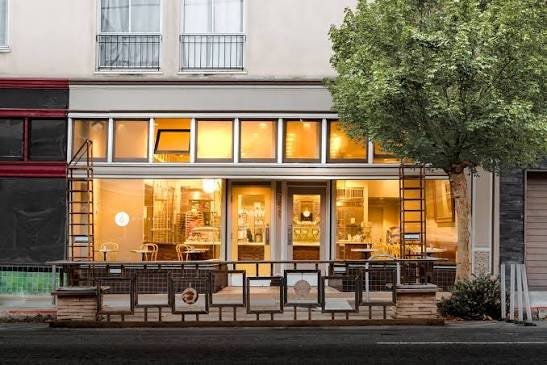
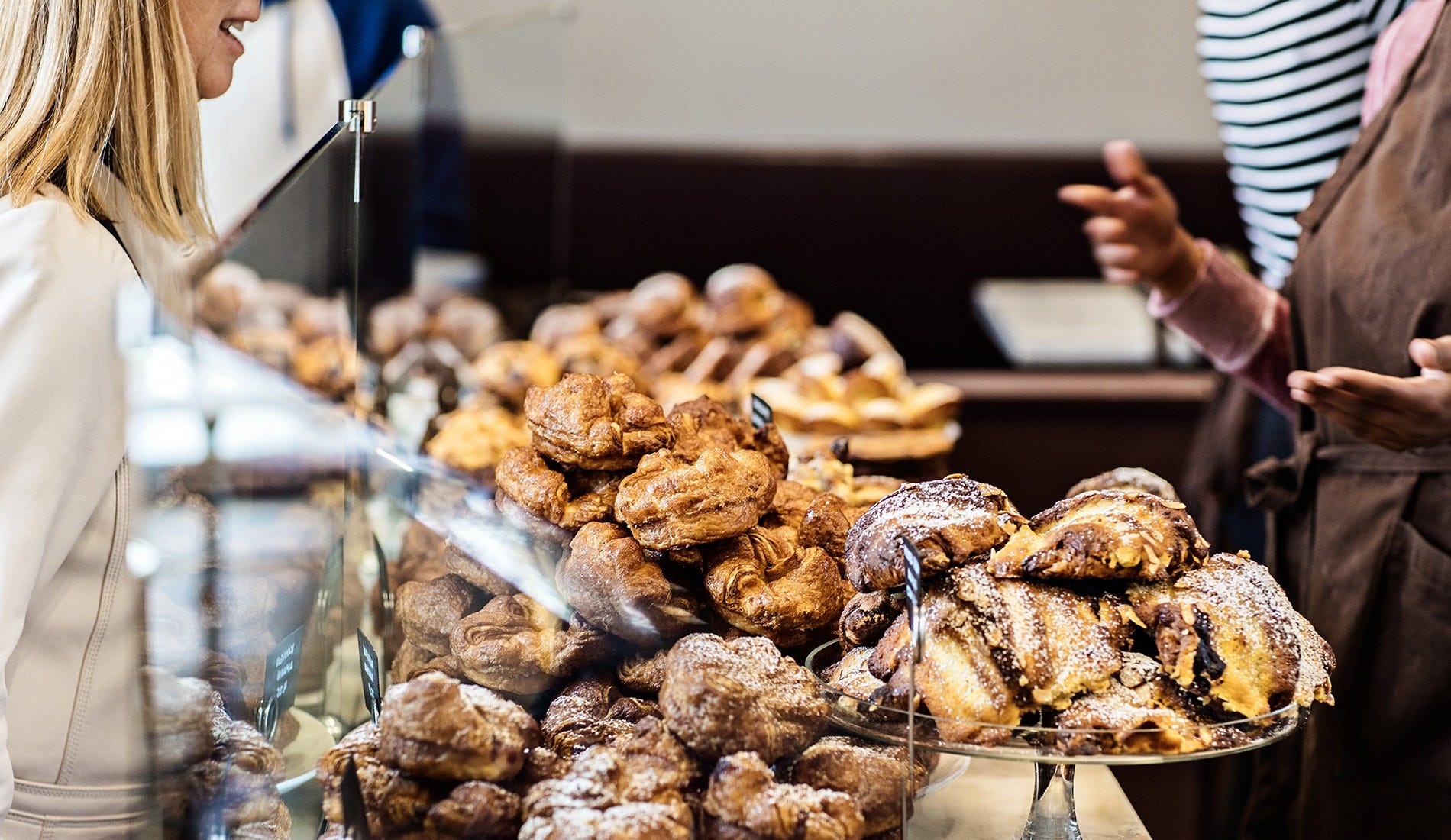
When I arrived, the line extended out the door and down the sidewalk outside the plate-glass windows that front the store. I took my place at the end of the line and peered through the window at the glass cases full of croissant, pain suisse, and kouign amann. Until I visited this bakery in 2019, I had never heard of kouign amann (pronounced kween uh-mahn). It is a pastry from Brittany, France. A baker named Yves-René Scordia invented it in 1860, during a flour shortage. Faced with a shortage of dough, Monsieur Scordia incorporated alternating layers of butter and sugar to stretch his ingredients. The result is a round, layered pastry that melds the buttery, crisp layers of a croissant with the decadent, burnt sugar richness of crème brûlée. They are delicious.
A woman of Indian heritage was standing in front of me; she turned and said, “Good morning.” I was mildly surprised to be addressed so boldly. It seemed slightly out of character for inhabitants of a big city, but it just goes to show that stereotypes never tell the whole story. “Good morning,” I replied.
Continuing to defy expectations, she continued. “It’s such a beautiful day.”
It was shady and cool on the north side of the street. Traffic was light, and a fresh breeze from the ocean mixed with the bakery aromas. “It is,” I answered. “My wife and I are visiting the city. We’ve been here since Thursday, and it’s been gorgeous since the moment we arrived.”
“What brings you here?” she asked.
“My niece’s graduation. My sister lives just around the corner.”
“Oh, very nice. Where have you traveled from?”
“We live in Lafayette, Louisiana.”
“Ooohh.” She nodded as she spoke. Her eyes were narrowed as if she was formulating new questions.
My talkative friend had a deep voice and the slightest accent. It was what you might hear from someone born in India, but resident in the United States for decades, maybe most of her life. I guessed her age to be forty-five or fifty years old. She wore a navy puffer jacket to ward off the chill of the shady side of the street, and her face and hair had a flushed, mussed look that suggested she had just left a yoga class or steam room.
Before she could continue, I asked her a question. “Do you live near here?”
She shook her head. “No. In Marin. Across the bridge.”
“Well, what brings you down here so early on a Saturday? There must be good bakeries in Marin County as well.”
She shrugged. “There are, but I come down once a week to practice (I didn’t hear this part clearly, but I think it was something like yoga/tai chi/meditation) with a Chinese lady here in the city. I’ve been seeing her for years.”
“And then you pick up something tasty for the trip home? Or to take home?”
“Exactly.”
By now, we were halfway down the wall of windows, with as many people in line behind us as in front. Her face took on the thoughtful look again. “What do you do in Louisiana?”
Depending on the surroundings, I sometimes feel tension when I answer this question. If I’m on a six-person chairlift in Colorado with five people I don’t know, and someone asks me this question, I feel a little tension. You never know how folks are going to react. A 30-person line in the center of San Francisco is worse. Everyone could hear our conversation if they chose to pay attention. And we were the only ones talking.
Now, if I were the Chief Euthanizer at the animal shelter, the owner of an African cobalt mine staffed by children, or Nathan Thurm, the sleazy, sweating defense lawyer played by Martin Short on Saturday Night Live, I might have good reason to hedge the truth when disclosing my profession in a crowd. I’m none of those things, but the relentless demonization of oil and gas companies, and by association, the people who work for those companies, means I get lumped in with the aforementioned undesirables in the minds of some. Oddly, some dislike you for producing the very products that enable their lives. Oh well.
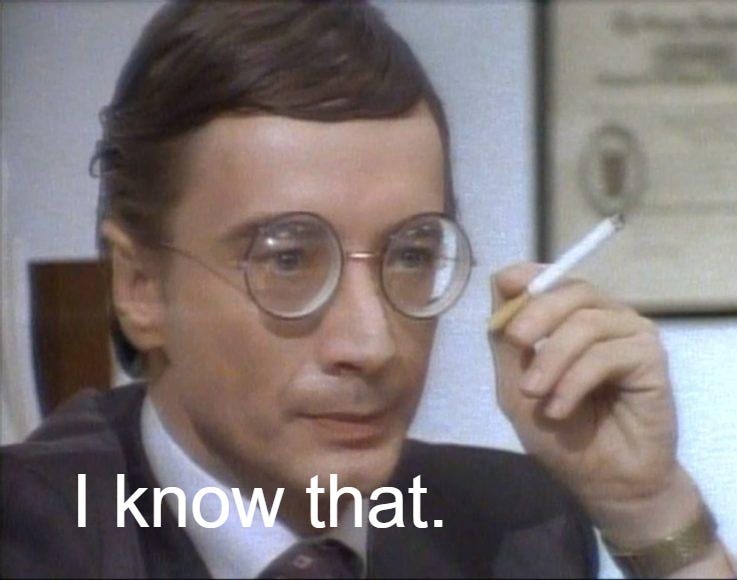
My policy when faced with this question is simple. I tell the truth and let the chips fall where they may. “I’m a geoscientist in the oil and gas business.”
“Oohh. What does that mean, exactly?”
“Well, I help to find oil and gas reservoirs, and then work on the efficient extraction of the product, whether it’s crude oil, natural gas, or both.”
“Oh, so you could work for a company like Chevron, then.”
“Yes. I used to work for a company that Chevron acquired. I work for a much smaller company now, but Chevron employs hundreds or thousands of people like me.”
As I finished my sentence, I glanced up and down the line to see if anyone was reacting to our conversation. Most of the people were looking at their phones. No one looked up or turned around.
“How is the oil business these days?” she continued.
“Well, at the moment it’s quite good. Crude oil prices are elevated because of the Iran situation, so if you have oil to produce, the money’s good right now.” While I was answering the question, I thought, Oh great, now we’re getting into Trumpian foreign policy. If the oil and gas thing didn’t trigger somebody, surely this will.
She took it in a different direction. “What about the future?”
“Well, as much as you might read or hear about the necessity or inevitability of an energy transition away from hydrocarbon fuels, the truth is that the share of total world energy supplied by those fuels — coal, oil, and natural gas — has barely changed in 50 years. The share might be a few percentage points lower than it was in 1980, but it’s still over 80 percent. The world’s economies can’t give it up. It’s too important. So I think the business is going to be around for a long time yet.”
At this point, I must acknowledge my debt to Substack. Through the research I’ve done to inform my own writing on energy topics, and the invaluable essays by other Substack authors like environMENTAL, Doomberg, Roger Pielke Jr., and Robert Bryce, I can now knock out three or four-sentence descriptions of world energy scenarios with ease and confidence.
The line moved slowly. In the store, the ordering procedure reminded me of the Soup Nazi episode from Seinfeld. Once inside, a sign instructed patrons to wait until a salesperson invited them to the counter. The sales staff did seem to have more patience than the Soup Nazi. Looking through the windows, I observed a fair amount of finger-pointing and discussion as beautiful, cream-colored boxes were filled with sweet and savory treats. Once the selections were complete, the boxes were slid down the counter and around the corner to the cashier, who also took coffee and drinks orders.
Meanwhile, my friend and I kept talking. From here on, I’ll call her Mitra, since it is the name of the Hindu god of friendship. With oil and gas and geopolitics behind us, we discussed other bakeries in the neighborhood. She told me of two others — Jane and La Boulangerie — that she felt were of similar quality to b. Patisserie. Both were within half a mile. Then we talked about our children, and the demographic and economic forces that are forcing independent universities like the University of New Orleans to seek financial security under the umbrella of large public institutions like Louisiana State University. The university conversation contained an immigration element, which again raised the specter of federal politics, but the patrons around us kept their thoughts, if they had them, quiet.
Finally, we were inside the door. Mitra waited by the sign. I was on deck behind her. A salesgirl called for her to come forward. Before she went to the counter, she said, “It was so nice talking to you. I hope you have a great weekend in the city.”
“It was my pleasure,” I answered. “I hope you have a great day.”
As she walked to the counter and I waited for my turn, the man behind me spoke up. He was tall and barrel-chested. His torso and biceps stretched the seams of a t-shirt that read “My favorite people call me Grandpa.” A straw hat with a small, porkpie brim covered a big, balding head, and a gray beard tapered to a point beneath his chin. His eyes twinkled when he spoke.
“Listening to the two of you talk,” he started, “I thought you were old friends. That was really nice. Especially since I figured out that you’re not.”
“Thanks,” I replied. A girl behind the counter called me forward. “Have a great day,” I said. Mounds of croissant and kouign amann rested on plates behind the glass. The aromas were divine.
The West Coast is criticized for its left/liberal policies on energy, gender, the environment, law enforcement, and more. The Southern states are criticized for their right/conservative policies on the same things. In my last essay, Waffle House Diplomacy, I used a Waffle House experience to demonstrate that the deep South is not a simmering hotbed of racism, though some still imagine that it is. In a similar vein, my conversations with Mitra and with others at the ceremony and party we attended the same weekend made it clear that the congeniality and kindness we experienced in the Lobdell Waffle House are not exclusive to southern hospitality. In that Waffle House Essay, part of the narrative was an explanation of two visions of humankind, constrained and unconstrained. The concepts come from Thomas Sowell’s book, “A Conflict of Visions.” In the constrained vision, which rings truer to me, the nature of man is flawed and immutable. There are no “solutions” to the fact that people sometimes do bad things to each other, only incentives and trade-offs that make the cost of doing bad things higher than the gain. That sounds like a gloomy, pessimistic view of humanity—the only thing keeping us from plundering our neighbor’s wine cellar is the fact that we might get caught and go to jail. But if demons are part of human nature, then so are angels. And they are everywhere.
If you find yourself in Lobdell, Louisiana, go to the Waffle House. The pecan waffle is excellent. If you’re in the Pacific Heights neighborhood in San Francisco, go to b. Pâtisserie, Jane, or La Boulangerie. Talk to someone. It might make your day. The pastries will be delicious.
Kouign (or King) for a day if you like (🖤) this essay.
Before you go:
Please click the 🖤 button, comment, share, and subscribe!
Great stuff, enjoyed hearing of the nice people and conversations. It’s highly possible you were in line with a large percentage of realists. Most of the developed world is realistic about the absolute necessity of coal, oil, gas and its derivatives, the politicians and others that make radical claims get the fringe believers and coverage. Absolutely right about those writers having taught their readers to articulate the necessity and benefits of hydrocarbons to the misinformed. I’d add Alex Epstein to that list, it was his first book The moral case for fossil fuels, that opened my eyes to the lunacy of net zero and “cheap green energy” Those pastries sound delicious how do they stack up with a Kolache? Congrats to the grad as well!
Thank you for this Trevor. I couldn't agree more.