
Koda

My first dog memory is a traumatic one. It happened at my grandparents farm when I was about three years old. The buildings of the farm—house, granaries, barn, workshops—are draped over a broad hill with the house at the apex. East of the house, beyond the garden at the base of the hill, was a dugout pond. It was surrounded by a barb wire fence. On the day in question I was walking to the pond with my father and grandfather. Accompanying us was my grandfather’s dog, a black lab named Bilco. As we approached the pond Bilco was ranging in front of us and when he encountered the fence he gathered himself and leapt over the top strand of barb wire. He almost made it.
One of the barbs was pointing upward and its sharp point caught Bilco just behind the rib cage. It made a clean, six inch incision in his abdomen that a surgeon would be proud of. It cut through the skin and the parietal peritoneum like a scalpel. There was only a little blood, but you could see the folds of the small intestine trying to peek out. After the sting of the cut, Bilco was calm. I was not. The injury seemed devastating, life-threatening to me. I remember my father and grandfather comforting me and telling me that he would be okay, that he would heal, but I was having none of it. To me, he was a goner, and I had witnessed the event up close and in color.
As promised, Bilco healed. He actually came to live with us for a while and so he is the first pet that I remember as part of our family. Several came after. The first were a pair of Chesapeake Bay Retriever siblings, a male and a female. My parents unwittingly named them Yankee and Dixie, and the names could not have been more appropriate. As they grew toward maturity they began to get into fights that gradually became so serious that my parents had to give one of them away. Most of the battles went Dixie’s way. I suspect that Yankee’s wealth and industrial might would have triumphed in the end, but Dixie went to a new home, largely undefeated, before that had a chance to play out.
Yankee grew into a trim, muscled, 80 pound specimen. He could run 30 miles per hour in the snow beside a snowmobile. He could pull a sled like the strongest Huskie. Like Nana the St. Bernard in “Peter Pan” he was unerringly kind and gentle to humans, but his disposition toward other large male dogs was quite different. One of my uncles had a German Shorthaired Pointer named Sherlock. Yankee was already a few years old when Sherlock was born, and Yankee met him as a puppy. If Sherlock had stayed a puppy their relationship would have been fine, but Sherlock grew into a large male dog. Once that happened, Yankee bristled up and challenged him, and Sherlock did not back down. From that moment on, those two dogs could never be together. They hated each other with a white-hot passion. We often stayed at my grandparents farmhouse and my uncle built a house in the same yard. We would call the other dwelling. “Is Sherlock out? No? Okay we’re going to let Yankee out for a little while. We’ll call back when he’s inside.”
There was no failsafe in the messaging protocol so mistakes inevitably occurred. And when that happened, they fought. Every time. Yankee had the advantage of his sparring lessons from Dixie, and probably a 20 pound weight advantage, but Sherlock was young and lithe and strong, and his teeth were white and sharp. Left unchecked the two of them would have fought until one either yielded and ran away, or was dead.
Cleo came to us as a pup when Yankee was about four years old. She was a poodle/terrier cross, off-white, about 15 pounds. She had a sweet nature, and her best trick was her ability to walk around on two legs. With a treat, we would ask her to dance, and she would pop up on her hind legs and twirl and walk for as long as you liked. The pair of them, Yankee and Cleo, along with an orange, male tabby cat named Minou, are the pets I most associate with growing up.
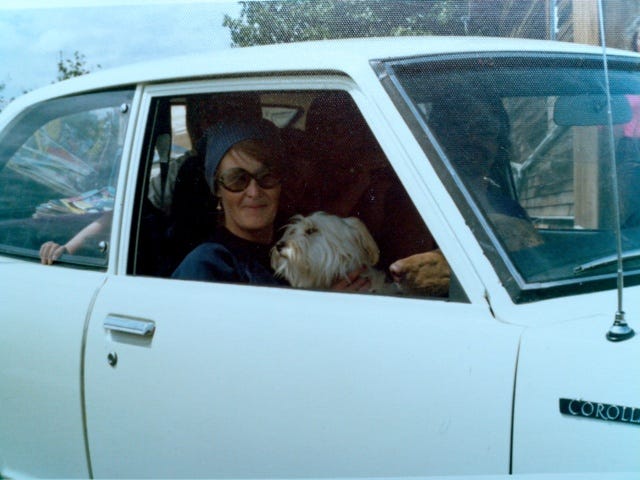
How the Casper family traveled in 1974: Two adults, three kids, and two dogs in a two-door 1973 Toyota Corolla. Yankee’s big brown head is half-hidden by the windshield pillar, Cleo is in my mother’s lap.
When Irene and I started our own family we naturally wanted to replicate some of the positive aspects of our own childhoods. She also had fond memories of their family pets. We didn’t jump right in. We knew that even if we were getting a dog “for the boys”, that we would be the primary caregivers. We waited until we were sure it was something they wanted, and until caring for the two of them no longer required constant attention.
In late fall, 2008, Thomas was about to turn six. He had always been kind to animals and seemed to have a natural affinity for them. For years we thought he would be a natural as a veterinarian. He told us that he wanted to have a dog, and name it Bandit. Without saying yes or no, we started looking. Irene had two requirements. Number one, the dog had to come from a rescue agency. Number two, she wanted a young, but mature dog that wouldn’t have to go through all the puppy phases of potty training and chewing furniture. We started watching the Facebook pages of the local rescue organizations. As Christmas approached she showed me photos of a young dog that seemed to fit the bill. He was about a year old, house-trained, good with children and other dogs. He was medium-sized, about 35 or 40 pounds, and looked like a small German Shepherd. I’m sure he had a name, but I don’t recall it. Irene was excited.
“What do you think?” she asked.
“He looks good,” I answered. “Where can we meet him?”
The rescue agency sponsoring his adoption was holding an event at one of the local pet stores that weekend. The dog would be there. We made plans to go.
The adoption event started at 11 in the morning. We walked in at 11:15. As we made our way toward the back of the store an older couple passed us walking the other direction. At the end of a lead walked a trim, medium-sized dog that looked like a small German Shepherd. As soon as they passed Irene looked at me with alarm. “That’s the dog,” she hissed. I shrugged my shoulders. What could we do?
As it turns out, nothing. We were late to the party and the other couple adopted the dog. “Now what?” Irene asked. We milled around at the back of the store and tried to think of plan B. The rescue agency that gave away our dog had a table with a small kennel on top of it. There were three puppies in the kennel and they brought loads of admirers to the table. Two of the puppies were blond and female. The third was a male, and he had a tri-color coat that was much more interesting. His head and back were black, but he had tan markings on his face, a white stingray pattern on his chest, and legs that transitioned from black to tan. The tops of his feet were white. I thought he was far more handsome than the other two.
“What about a pup?” she asked. We thought about it, but decided we weren’t ready to abandon our plan of finding a dog that was already house-trained. One week later, with zero success finding a replacement for the dog who wouldn’t be, and Christmas approaching, Irene asked again. “What about that tri-color pup?”
I was up for the challenge, but I was certain the pup was gone as well. “Did you see how many people were swarming those pups at the pet store? There’s no way that pup hasn’t already been adopted. He was the cutest by far.”
“It can’t hurt to check,” she said.
When I got home from work she took me aside so the boys couldn’t hear. “The pup is still available. All we have to do is fill out the paperwork. They’ll do a little home visit to make sure we’re not lying about having a fenced yard, and since we’re not, that should be all we have to do.”
On December 24th, in the evening, we were relaxing in the den with the boys. They were excited for Christmas morning. There was a knock at the front door, and Irene answered it. The boys looked up at the knock, but went back to watching “A Christmas Story” as Irene went to the door. When she returned she was accompanied by an older lady. The tri-color pup was in her arms. “Look Thomas,” I said. He looked up, wide-eyed and shy, as realization dawned.
The rescue lady explained that she had been calling the pup Koda, but since his training hadn’t really started, that Thomas could give him any name he liked, Bandit, for instance. “See the mask on his face?” she said. He nodded, but after she left, when we said for the second time that he could choose any name he liked, he said no. Since the pup was used to being called Koda, he would call him Koda.
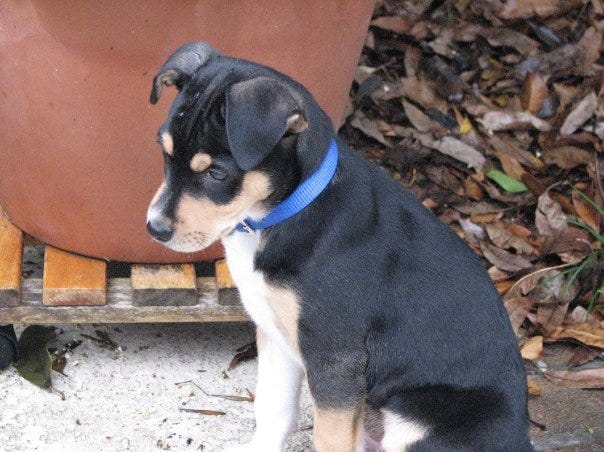
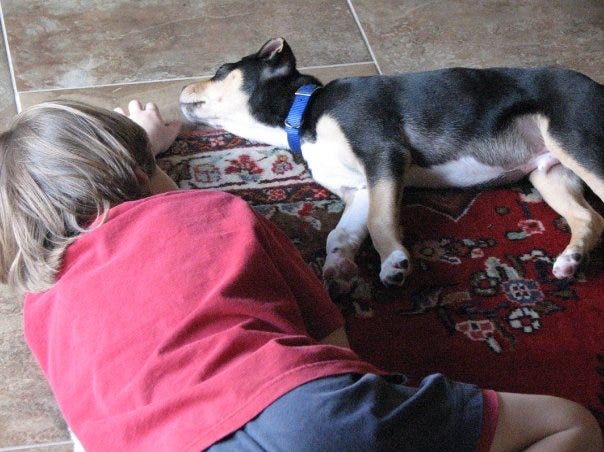
Young Koda (and Thomas) just after he joined our family
Koda was four months old, and seven or eight pounds when he came to our house. My best guess at his birthday is September 1st, 2008. When we asked, the rescue agency suggested he was a small to medium-sized terrier mix, and that he would weigh 15 or 20 pounds as an adult. In his first few months with us, the pace of his growth suggested otherwise. His legs grew long. His chunky, round puppy body grew deep at the chest, and tucked at the waist. For a while, he had some difficulty coordinating the movements of his long limbs, and when he played with Odie, the feisty Yorkshire Terrier next door, he often tripped over his own feet and went sprawling.
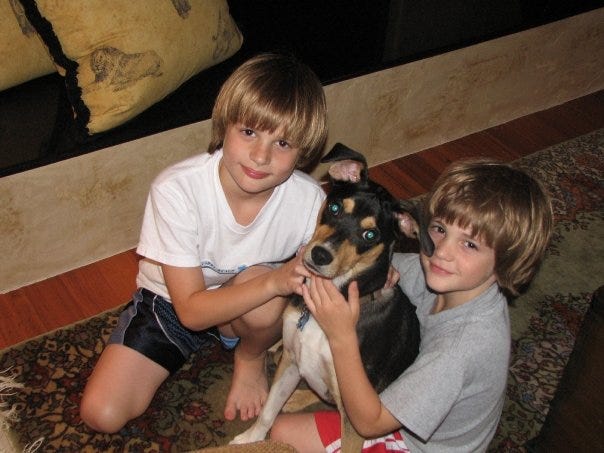
Koda in the spring of 2009
Gradually, as his muscles, and his muscle memory grew, his movements and capabilities evolved from clumsy, to agile, to highly athletic. He stopped growing when he was 37 or 38 pounds. Clearly, he was not just a small to medium-sized terrier mix. I looked at his shape—slender head and neck, flexible curved spine, deep chest, tucked waist, long well-muscled legs—and wondered what combination of breeds led to the handsome specimen that was now a part of our family.
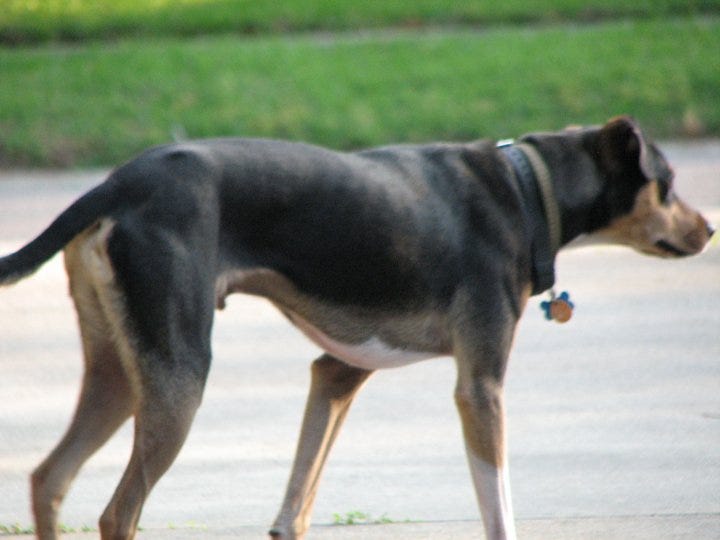
Koda approaching peak fitness—almost two years old
The puppy phase wasn’t a big issue. He slept in a kennel at first, and when he cried Irene or I would get up and let him outside to do his business. I don’t remember many accidents in the house. He added some scratches to the wood floors, and he gnawed on a door, and a rug. And that’s about it. A couple of months after he joined our family Irene was talking on the telephone to her sister. “How’s Koda?” she asked.
“He’s good,” Irene answered. “Growing fast.”
“Is he still sleeping in the kennel?”
“Not exactly.”
One night, after the boys were asleep, Irene and I were sitting up in bed watching a sitcom. Koda jumped on the bed while we watched, and he turned and pawed a blanket up into a loose pile. He collapsed onto it, curled tightly, and tucked his nose under his tail. When we turned the television off a half-hour later Irene asked if I wanted to take him to his kennel. “Nah,” I answered. “He can stay.” And he did, for the next dozen years, until the act of jumping on and off the bed began to prove too difficult for a senior dog.
Koda’s athleticism impressed me to no end. He did so many things that made us, or other onlookers, say wow. When he was about a year old we took him to a dog park for some socializing and play time. He was mature but not as fully muscled as he would be a year or two later. It was a nice fall day—warm and dry. The main park for bigger dogs was hosting a very diverse crowd. There were labs, huskies, shepherds, dobermans, mixed breeds, skinny dogs, and fat dogs. We let Koda off his lead and he ventured warily into the fray. There was a lot of intimate sniffing, and Koda endured the too-close attention of a multitude of dogs. Most were larger than him. The hackles on his back were up, but he didn’t snarl or snap. Then one of the dogs decided he was pretty, and climbed on his back. That was too much.
Koda tucked his tail and took off. A pack of dogs, at least half a dozen, began to chase. It really wasn’t fair. It was like watching prime Barry Sanders run against a middling high school football team. In tight quarters he made them all miss, and when he gained the open field he just ran away from them. It went on for a while—great fun to watch—and when he finally got tired he dove under a picnic table and sheltered between the legs of the folks who were seated. We rescued him from under the table, tongue lolling from the effort, and took him home for a big meal.
When we moved into our house there was an elaborate gazebo in the backyard. It was nestled among hickory and sugarberry trees and lots of spiky, variegated ginger. A back railing in the gazebo was just a few feet from our back fence. Our fence is of simple construction—posts, two-by-four cross-members, and upright cedar fence boards. Our yard backs up to a large, wooded property, host to barred owls and squirrels and other wildlife, and the fence around that yard is more elaborate. It’s fallen into a bit of disrepair, but its initial construction included a flat, four inch cap to give it a more finished look. As dusk settled one evening after dinner, I called Koda to the back door.
“Look,” I hissed. There was a squirrel on the floor of the gazebo. “Do you see him?”
He did. He immediately started to whine, and he bounced on his front paws waiting for the door to open. When I opened the door, he exploded. He was so quick across the yard that I remember the sound more than the sight. Gravel flew up between the paving stones as he snatched at the earth for purchase. Then it was claws ripping on the wood floor of the gazebo, and then it was quiet, and he was … gone. “Koda!” I yelled. I walked out, and when I got to the gazebo I understood. On the sprint through the gazebo he followed the exact path of the squirrel—floor, railing, fence-top, tree. Koda went as far as the fence top. How he managed to leap, while running as fast as he could, to the gazebo railing and then to the top of the neighbor’s fence, without just catapulting himself right into the other yard, is beyond me. When I arrived on the scene he was balancing on the fence cap, eyes wild from the chase, not sure how to get down. I had to stand on the railing and lift him off the top of the fence.
In the evenings we often walked to the playground at the nearby middle school. There is a chain link fence around the whole property with a couple of latched gates. Once inside the gate Koda was free to roam as he wished. One of the long sides of the playground is quite close to a busy residential street. Lawn care companies towing big noisy trailers are often on the road. For some reason, the noise of the trailers excited Koda, and if he heard one he would peel out of whatever he was doing, accelerate to full speed, and race the truck/trailer to the stop sign. The fence kept it perfectly safe so I never discouraged it, and the sight of him at full stretch was amazing. Sometimes the drivers would see him coming and accelerate to see if he could keep up. He would pull up at the end of the yard and come trotting back with a satisfied grin. Won again.
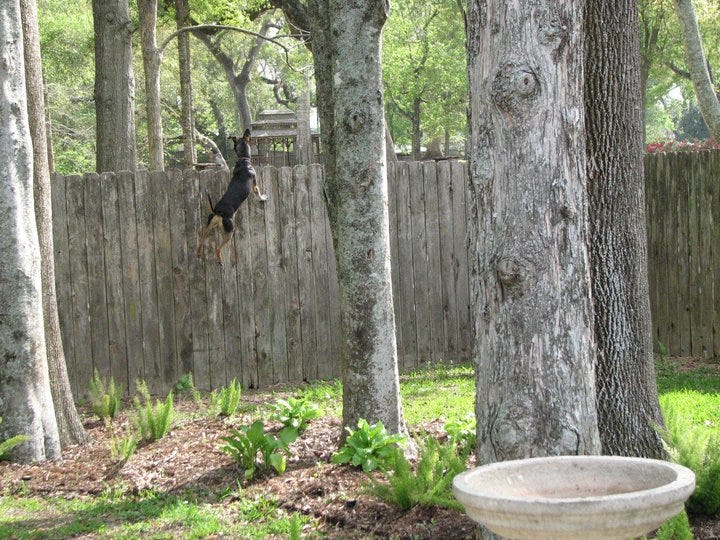
Koda was fully capable of going over the fence even without the gazebo. Here he’s checking on squirrels in the next yard.
I continued to search for evidence of what kind of dog ancestors he had. One day it hit me. He’s part whippet, I thought. Now, in my opinion a purebred whippet or greyhound almost looks like a cartoon dog. They’re beautiful, but almost over-stylized for speed. Koda looked like someone took a whippet, which can come in any color or pattern under the sun, and just toned everything down a notch. Head and neck and tail not quite so slender and pointed, spine not quite as curved and flexy looking, hind-quarters not quite as freakishly muscled, tummy not quite as high. Still, all of those tendencies were there, and he could certainly run like one.
We made sure he got a lot of exercise. Daily walks and jogs, trips to the middle-school playground, play sessions with Odie the yorkie next door. But now that I had the idea of him being at least part-whippet, I searched the American Kennel Club (AKC) website to see if there were any organized sports or games for sighthounds. In short order I discovered lure coursing. At lure coursing trials, purebred sighthounds—whippets, greyhounds, salukis, etc.—chase a lure, typically a couple of white rags, that is dragged through an open field. The lure is dragged by a continuous line powered by an electric motor. The courses are 600 to 800 yards in length and they go up hill and down dale and around corners just like a speedy rabbit would. The dogs are judged on their speed, agility, endurance, and how well they follow the lure. When I first discovered the sport, only purebred sighthounds could take part in the trials, but most events held “fun runs” after the trials were over, and any dog could run the course. Later, the AKC developed additional events like the “coursing ability test” (CAT), which is individual lure coursing for all dogs, and “FAST CAT” which is timed, straight-away sprint racing on a short, 100 yard course.
I searched for events near us and discovered that a whippet breeder near Covington, LA hosted AKC lure coursing events. In order for Koda to participate he had to be registered with the AKC, so we submitted his information and soon had documents declaring him to be “Casper’s Koda, All American Dog”. At the next event, Koda, Irene, and I drove the two hours to Covington. We arrived early so we could watch the main events and hopefully get Koda interested in the proceedings. We parked, put Koda on a lead, and wandered out to the field. It was an impressive spectacle. In the trials, the sighthounds wear bright singlets and run in groups of three or four. The feet of the big greyhounds smacked the earth so hard it sounded like rolling thunder as they approached, tongues out, white eyes wild with the chase. Koda was uninterested. He sniffed around, peed on things, and when I encouraged him to watch and learn and hopefully get excited, he glanced out at the field, then turned away.
“This may not go well,” I told Irene.
When the trials ended the field marshall announced that all fun run participants should gather near the starting area. By the time we got there we were number four or five in line. There was really only one rule. The dogs would run “naked”, which simply meant no collars. As our turn approached, something in Koda changed. When we made our way to the start he pulled at the lead and whined at the white lure that lay on the ground about twenty feet in front of us. The marshall asked if Koda had ever chased a lure before.
“Nope,” I answered.
“All right. We may have to work with him a bit. I’ll drag the lure away and we’ll see if he gives chase. If he does, great, I’ll keep it going. If he doesn’t, I’ll stop it and we can pull it back and see if we can get him interested.”
“Sounds good.”
I slipped Koda’s collar off his neck. I knelt behind him and wrapped my arms around the front of him. The lure hadn’t moved an inch, but he strained against my arms trying to get to it.
“Is your hound ready?” the marshall boomed.
“Yeah,” I answered. I wasn’t sure I could hold him much longer.
“Tally-ho!”
The lure shot away. Koda tore through my hands as I released him. There was no need for the marshall to teach him or guide him. Koda ran flat out, never flagging, never losing focus on the lure, until the course was finished. As the lure came to a stop Koda threw himself on it and gave it a few good, rat-killing shakes.
“Wow,” the marshall said, as I put the collar back on his neck. “You’d think he’d done that before. He’s a natural.”
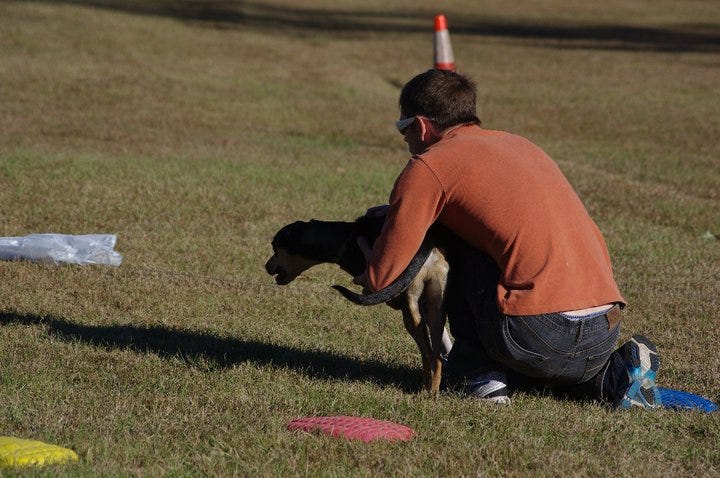
First time lure coursing. Trying to hold him back before the start
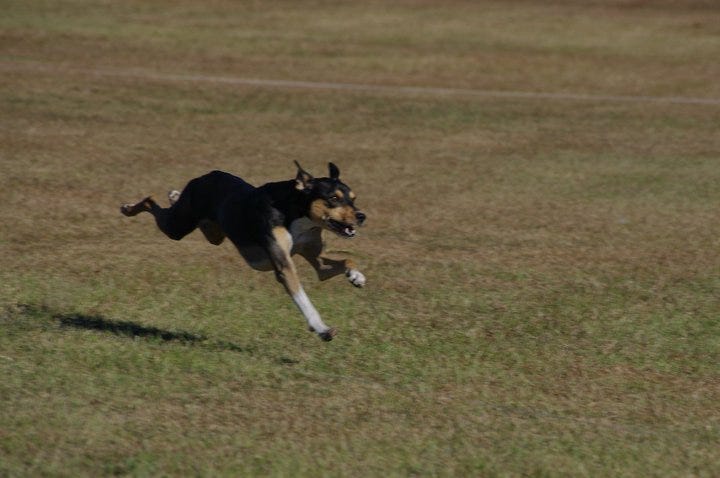
Flying.
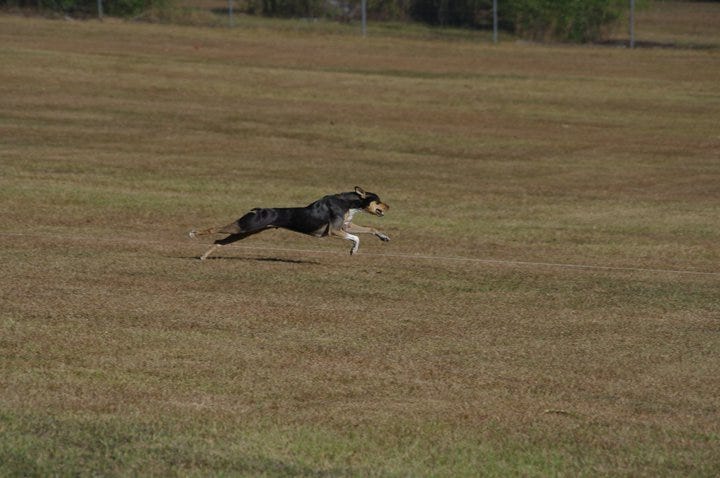
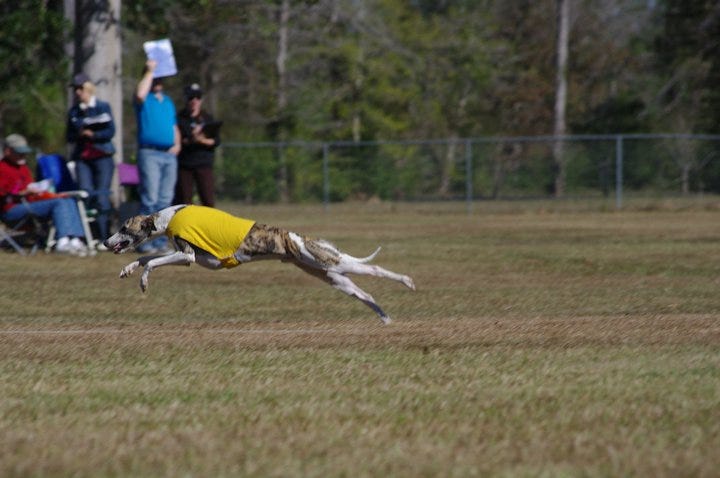
Compare Koda’s extension (above) with that of a big male whippet (below). Pretty similar. In both photos the lure is just out of the frame, but you can see the white cord it is attached to.
From that day forward Koda was nuts for lure coursing. We would drive up to an event and he would start such a racket—crying, yipping, barking—all of it loud and so high pitched it sounded like he was in distress. I guess he was. He absolutely loved running after a lure and he didn’t want to wait for it. Several times, as we stood waiting our turn at a CAT event (interesting name, right), the people in front of us would wave us through because he was so animated. “My dog likes to run,” they would say, “but he won’t mind waiting a bit. Y’all go first.”
He was very good at coursing. His combination of speed, effort, and focus often netted him the fastest overall times at coursing ability tests, even against purebred sighthounds. After a few years of this I decided I had to know what sort of parents and ancestors he had. We bought a DNA kit, swabbed his mouth, and sent it off for analysis. The result was surprising. Koda is 50% Chihuahua, and 50% hodgepodge. When we first examined the report it seemed fantastic. Koda weighed almost 40 pounds. Upon closer examination, the report suggested that the adult dog would weigh between 25 and 40 pounds. He was at the upper end of that range, but definitely in it. On the hodgepodge side, there was too much mixing of breeds to definitively identify Koda’s dog ancestors. There was one exception, and it was interesting. The one breed mentioned in the hodgepodge was Manchester Terrier. I looked them up.
Manchester Terriers were bred in England as a cross between a whippet and a black and tan terrier in order to combine the speed of the whippet with the prey drive and aggression of the black and tan, which was a valued ratter. The AKC describes them this way:
Manchesters are spirited, bright, and athletic. They combine the streamlined grace of a coursing hound and the instincts of a fearless rat terrier.
Manchesters can motor, running with good reach in front and propulsive rear drive powered by a muscular caboose.
A male Manchester is smaller than Koda, typically around 20 pounds, but their proportions look just like him. As for the Chihuahua side, the only thing I’ve noticed over the years is a very slight bulginess to his eyes. So somehow, a Chihuahua and a larger dog got together, and their one male offspring happened to exhibit an almost perfect resemblance, except for size and a bit of white fur, to an ancestor descended, at least partly, from a whippet. I knew it was in there.
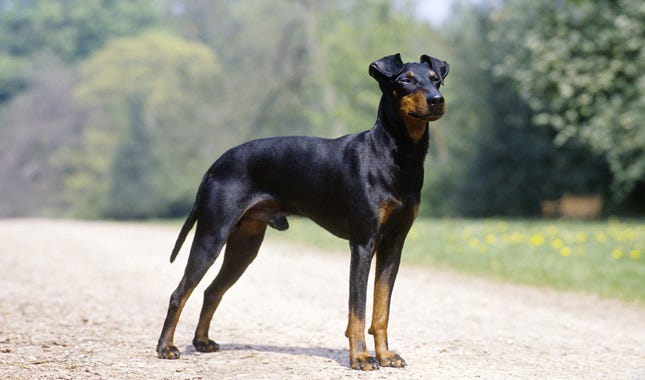
A male Manchester Terrier
Koda has another defining characteristic in addition to his athleticism. He is a gentleman. Like all of us, he had to learn a few lessons along the way, but his nature is kind and sunny and tolerant, unless you are a rodent, a rabbit, or an opossum (very Manchester like). He’s tolerant with little children, and if they are too loud or too rough with their petting he just walks away and tries to be someplace they’re not. Our next door neighbors have a very young, very energetic Golden Doodle and when she sees Koda in the yard she smothers him with face licks. You can almost see him roll his eyes as she charges toward him. He endures it stoically, and she has to be quite over the top before he’ll offer any sort of correction.
When Koda was about 7 years old we found a three-legged calico kitten behind our fence. We took her in and Koda adapted seamlessly to the new addition. Two years later a young cat, probably a year old, showed up at our camp on the Labor Day weekend. She was skinny and a little dingy from some rough living. At the end of the weekend Irene could not countenance the prospect of leaving her behind. The land around the camp is host to an occasional alligator, and other threats. Once again, Koda took the new addition in stride. He’s outnumbered now, and the cats do rude cat things like swipe at him when he walks by. Mostly he ignores them.
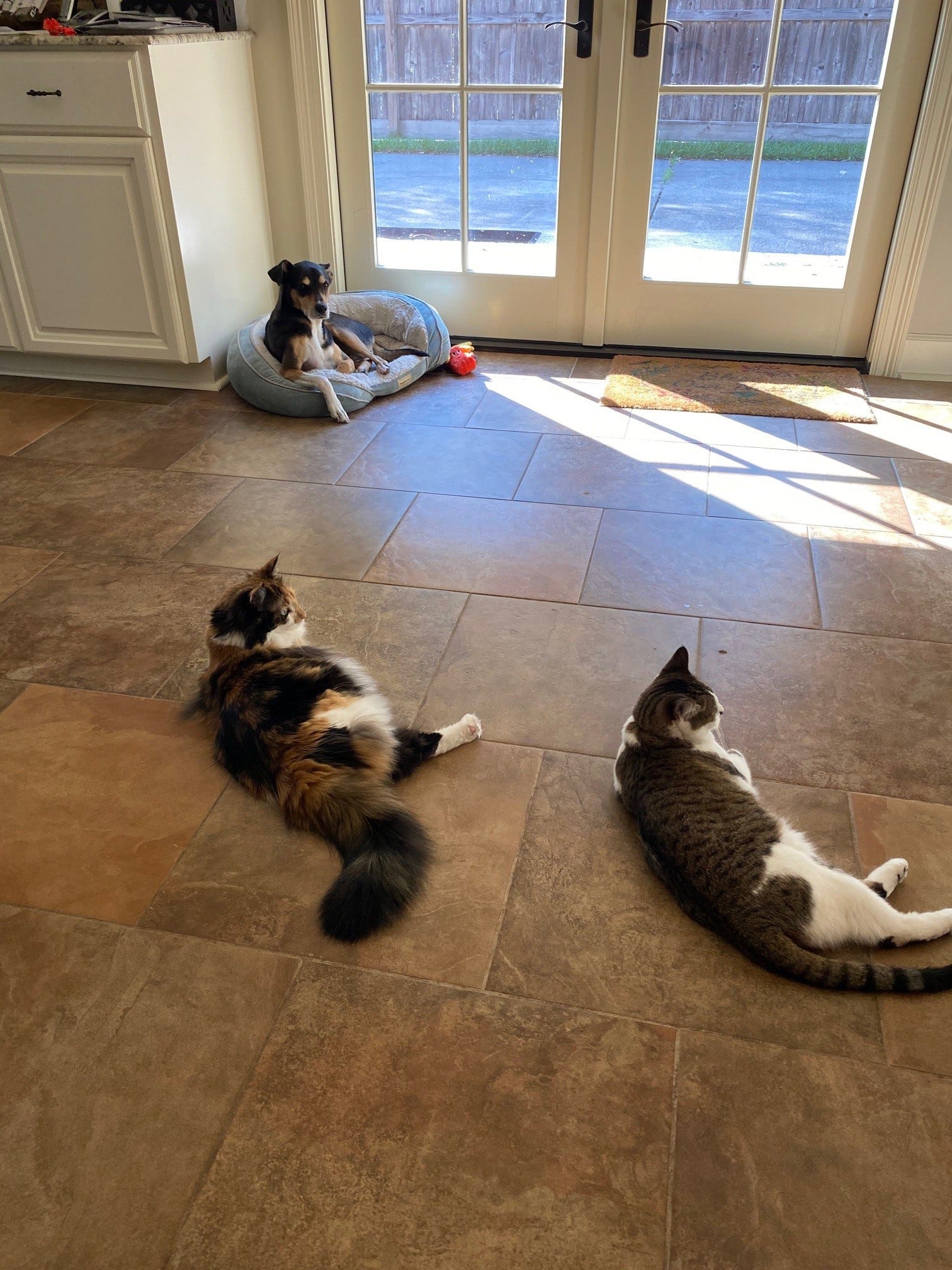
Koda, Fiona (calico), and Lola
One of the best examples of his gentlemanly nature happened when Fiona was about a year old. We have always kept a dog bed in the den so Koda can relax with us while we watch television or read. Fiona enjoyed relaxing in the den as well, and soon determined that the prime spot for a nap was curled up next to a warm dog. Perhaps Koda was recalling the time he chased a cat and ended up with two bloody stripes across his black nose, but he was never comfortable with this arrangement. Fiona would climb into his bed, arrange herself, and Koda would lift his head and look our way. The meaning of his gaze was unmistakable. It said, “PLEASE make her leave.” If we didn’t follow through, he would stand and plod to one of his other beds in another room.
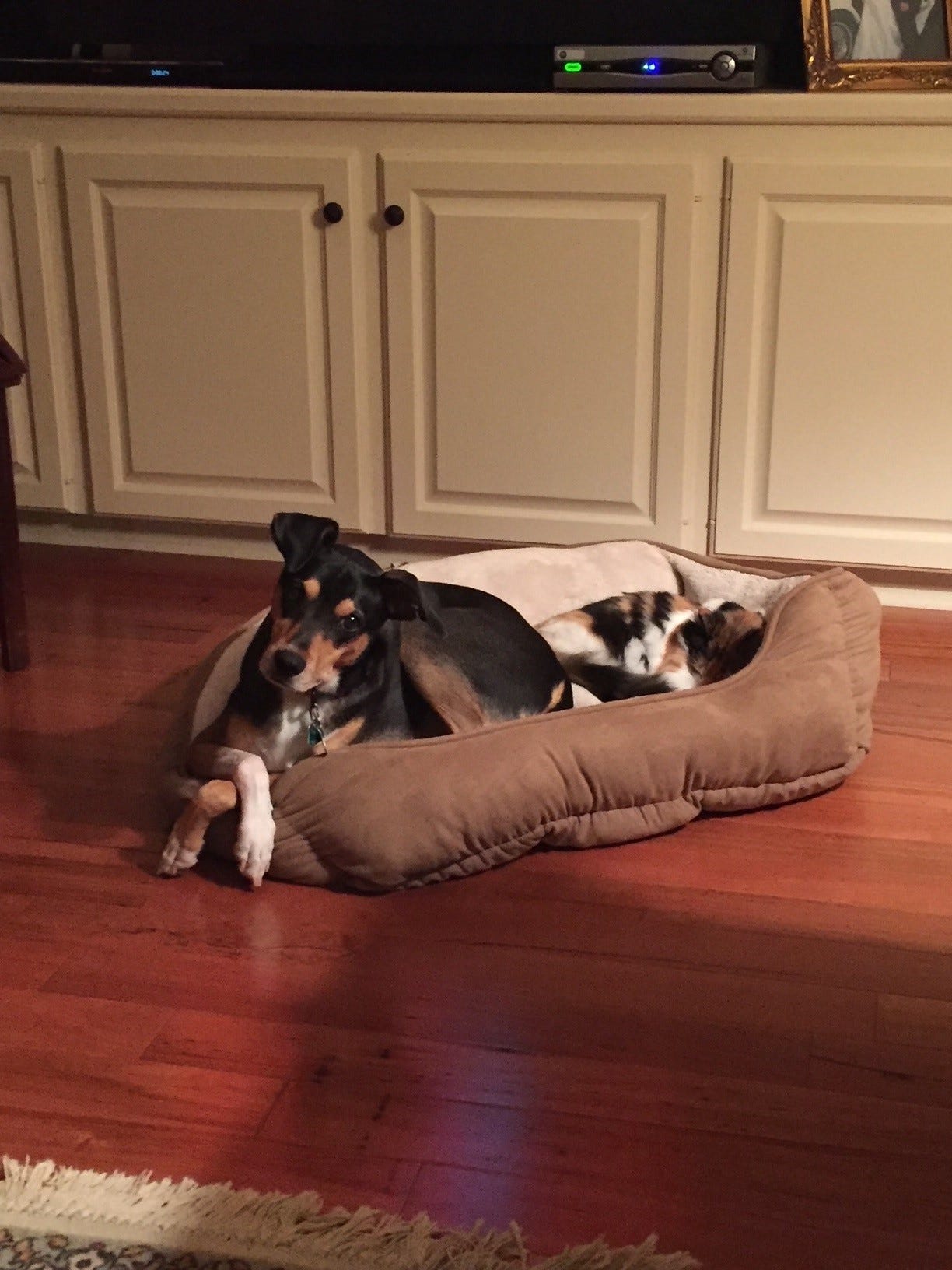
Please make her leave!
The obvious solution was a bed for Fiona. We procured one with appropriate, cat-sized dimensions. What was not so clear, to Fiona at least, was that the small bed was for her. She continued to prefer the large bed, with or without Koda. The end result was often comical. Rather than make a scene and disturb the cat, Koda simply made the best of the situation.
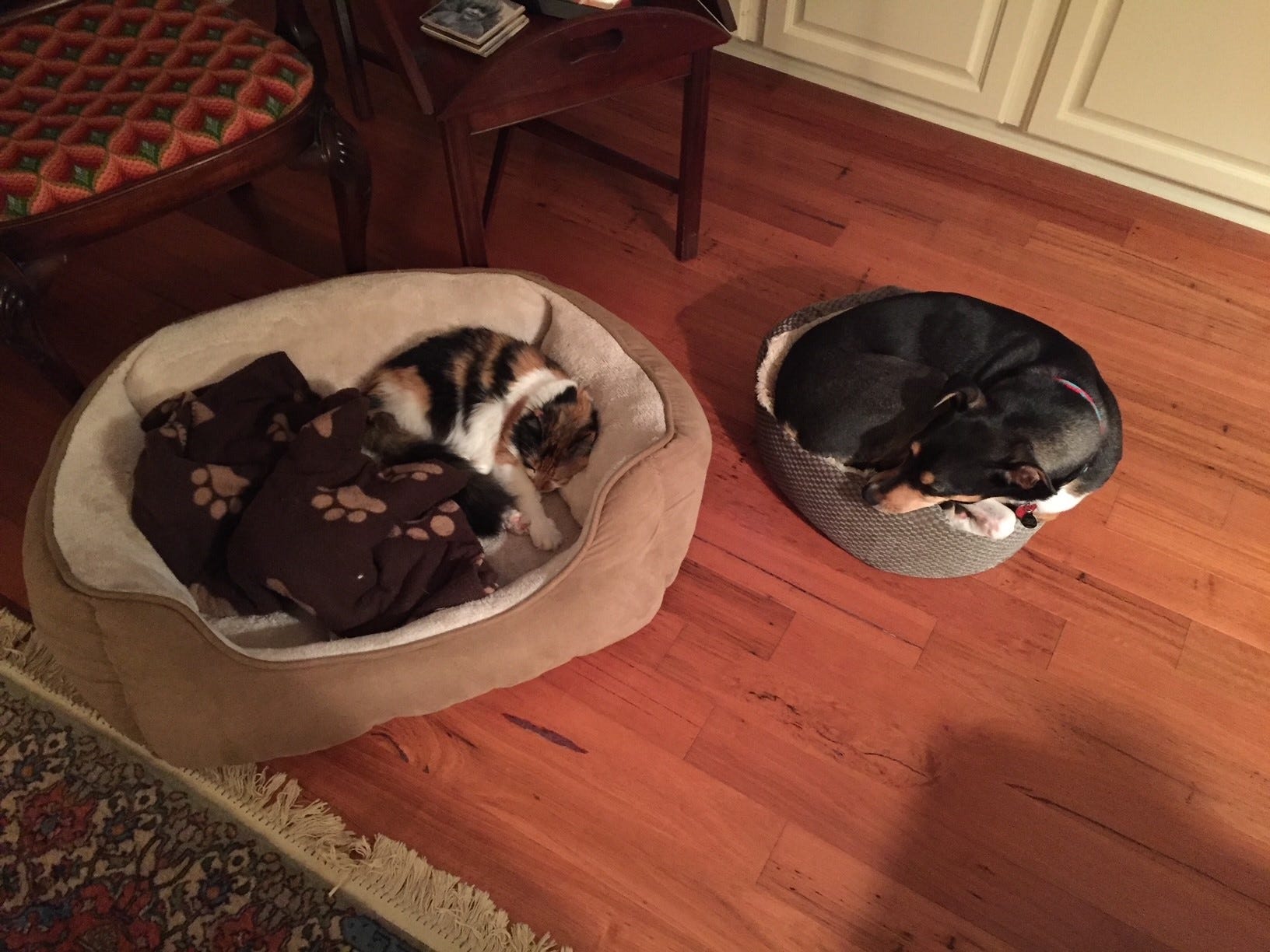
Mismatch.
Today, Koda is a few months shy of 15 years old. He’s not the supple athlete he once was, but he’s still trim, and he wakes up early every morning for a walk. He has developed a few, silly affectations in his elder years—he won’t eat his food unless the cats are watching him. I don’t understand this, but it works to keep him fed, so we oblige. The cats usually do as well.
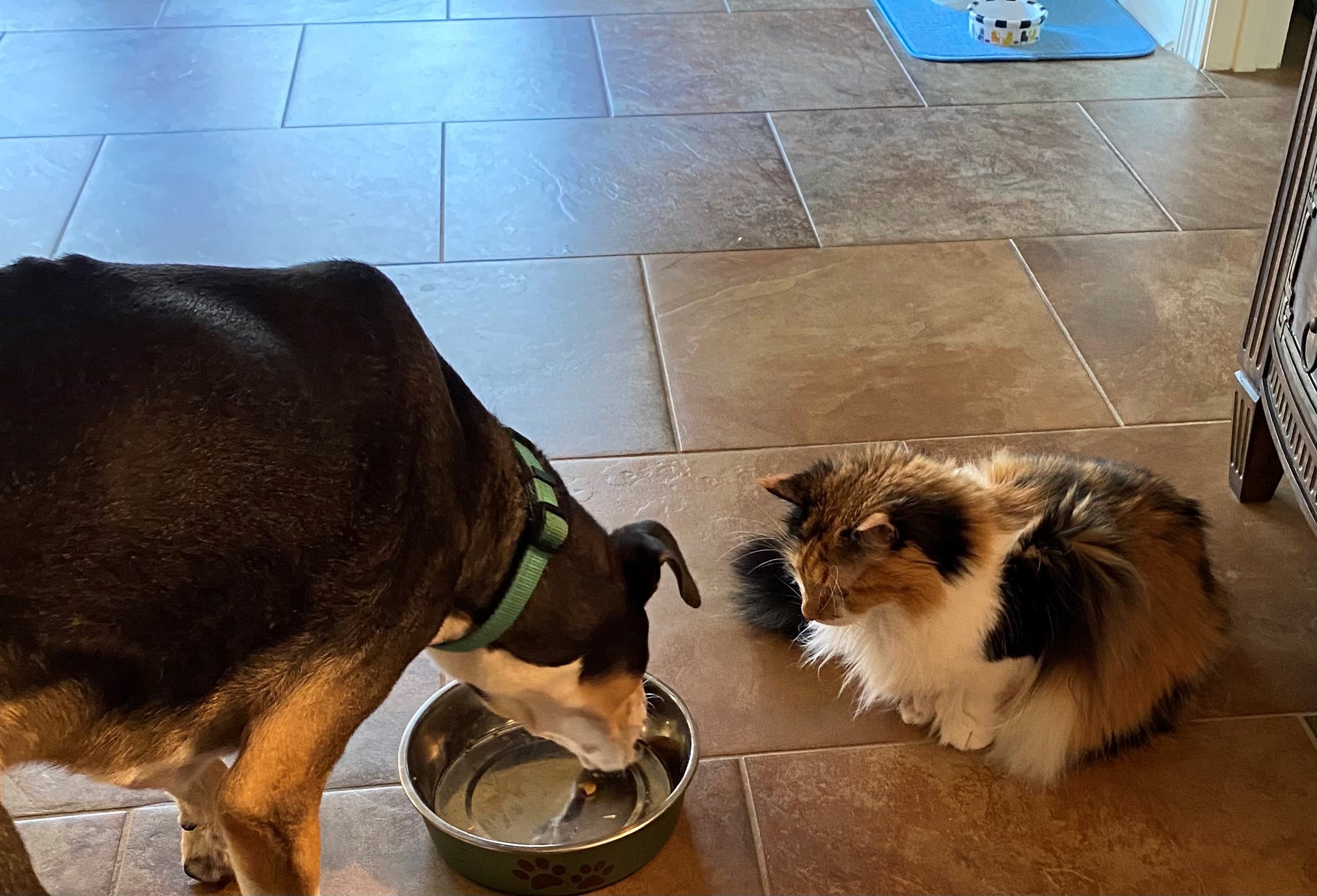
I’m not really that hungry, but I’m sure not letting YOU have it.
Koda is a great dog, one that you remember forever, one that you write about. His contribution to our lives has been immeasurable. We love him desperately, as we love each other. Thank you for everything, you big beautiful Chihuahua.
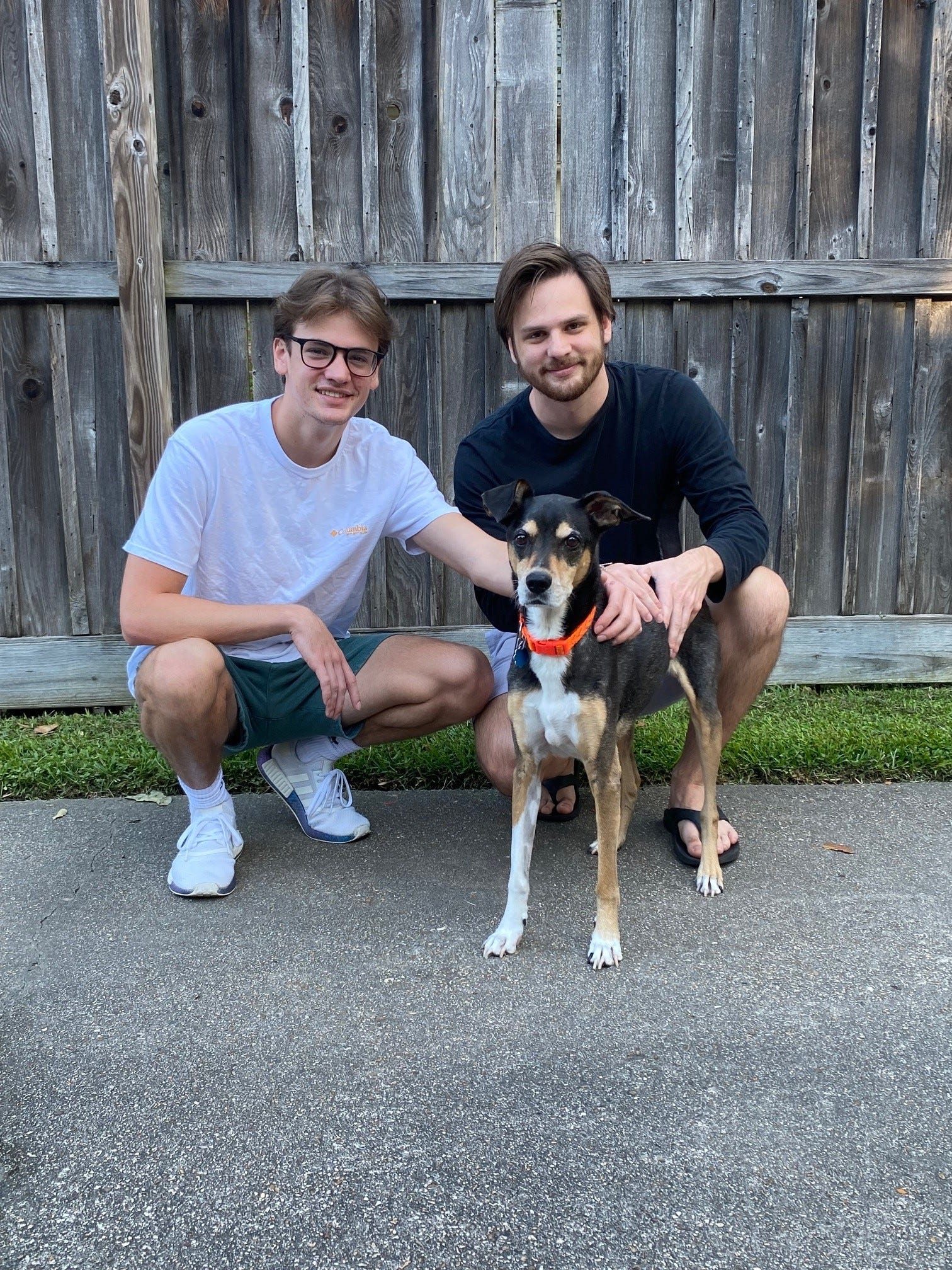
Koda and the boys in 2021
Oh my. What a beautiful story. Well written, highly emotional, and true to the last word. This reminds me of the books that I used to read as a youngster: Lassie, Bob , Son of Battle( set in Scotland), and the song- Ole Shep.
I enjoyed the read. I bet watching Koda run was exciting!