
It's Always Fire Weather

As though it had been but a brittle shell, to break at the least rough usage, the thin veneer of his civilization fell from him. From the novel Tarzan, by Edgar Rice Burroughs.
Classics Read Aloud is a Substack space devoted to, well, reading the classics, aloud. Its founder, Ruby Love, curates from a long list of wonderful short stories, fairy tales, and novels that languish on dusty shelves in private and municipal libraries, to our great detriment. Each recording begins with a brief synopsis to set the stage. Her voice is soft but authoritative. I get the feeling she would not suffer many interruptions. It is the kind of voice best listened to in a warm space, preferably by a fire, while sipping a cup of coffee or a dram of good whiskey.
I recognize most of the titles she has featured, though there are many I haven’t read. One that I know well, that also turns out to be her most popular reading to date, is Jack London’s classic short story from 1908, “To Build a Fire.” We studied it in a high school English class. If you haven’t read or listened to the story, it is set in the Yukon Territory during the Klondike Gold Rush of the 1890s. An unidentified man embarks on a one-day journey to rendezvous with his friends at a remote camp. It is bitterly cold, and the man sets out despite warnings of the dangers of traveling alone. His only companion is a dog, a husky, whose instincts are a more reliable barometer of danger than the man’s intellect. London describes the man as unimaginative, and it is this inability to imagine the consequences of traveling in -75 degree weather that leads to doom. For me, the story’s most memorable characteristic is a gathering feeling of menace. Ruby’s recitation of this familiar classic brought to mind a story of my own, one that involves bitter cold and a fire. Menace, thankfully, is not a part of it.
The cold described in Jack London’s story sounds unbelievable. Spittle crackles and freezes before it hits the ground. Minus 75 degrees without a windchill factor sounds impossible, and I’ve lived at latitudes substantially further north than the setting of “To Build a Fire.” I did some checking to see if London was engaging in some hyperbole. He was not.
The coldest temperature ever recorded in the Yukon Territory of Canada was measured in 1947 at the now-abandoned village of Snag, by the White River. Snag is south of Dawson City, not far from the locale of London’s short story. In the middle of the twentieth century, Snag was home to a military airfield, which explains the presence of high-quality meteorological equipment. The recorded temperature was minus 63 degrees Celsius, which is equivalent to minus 81.4 degrees Fahrenheit. On the Fahrenheit scale, London’s temperature estimate was extreme, but plausible.
In the boreal forest of northern Saskatchewan, where I grew up, a temperature of negative 40 degrees is considered a benchmark for extreme cold. There’s no doubt that the weather begins to be dangerous for humans at lesser extremes; you can freeze to death just fine at minus 25 if you don’t have adequate clothing or shelter, but in parts of the world where most people are prepared when they venture outdoors in the winter, negative 40 degrees is the temperature at which people begin to make different decisions. I was planning to travel to Saskatoon tomorrow for a dental appointment, but I’m going to reschedule because I don’t want a car to break down when it’s forty below.
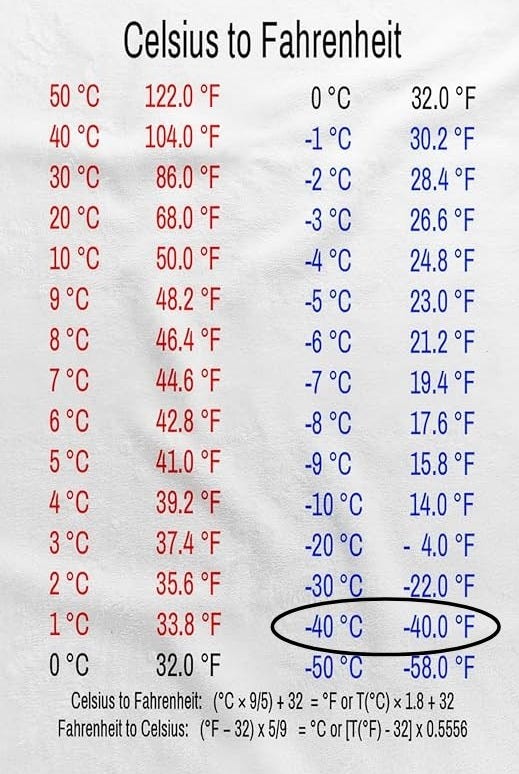
The founders of the two temperature scales used by humans to describe their meteorological surroundings, Daniel Fahrenheit and Anders Celsius, were contemporaries. Fahrenheit founded his scale, which placed the freezing and boiling points of water at 32 and 212 degrees, respectively, in 1724. Celsius published his scale, which originally placed the boiling point of water at 0°C and the freezing point at 100°C, in 1742. In 1744, shortly after his death, the Celsius scale was reversed to its modern form, which has the freezing point at 0°C and the boiling point at 100°C. Though the Fahrenheit scale is more finely sampled than the Celsius scale—a change of 1°C equals a change of 1.8°F—I wonder if the two inventors discussed the importance of a common value to represent extreme cold. They were both from cold climates, after all. Fahrenheit was German, but born in Poland. Celsius was Swedish.
As indicated above, the two scales use different values for common benchmarks like the freezing and boiling points of water, but they intersect at the -40 value. That is to say that 0°C and 0°F are different temperatures, but -40°C and -40°F are the same.
Canada switched from the Imperial measurement system to the metric system in the mid to late 1970s. In 1975, all the meteorological forecasting changed from Fahrenheit temperature to Celsius. A warm day on the prairies switched from 80°F to 27°C, but 40 below was still 40 below. Concurrent with the changing of the scales was a subtle change in our language, likely influenced by the weather forecasters. In the Fahrenheit days, the common way to describe cold temperatures was to say “32 below,” or “41 below.” After the switch, perhaps because it took a little bit of thinking to understand what we were saying, we followed the forecasters’ lead and used their more formal phrasing. “Forty below” became “minus 40 degrees.”
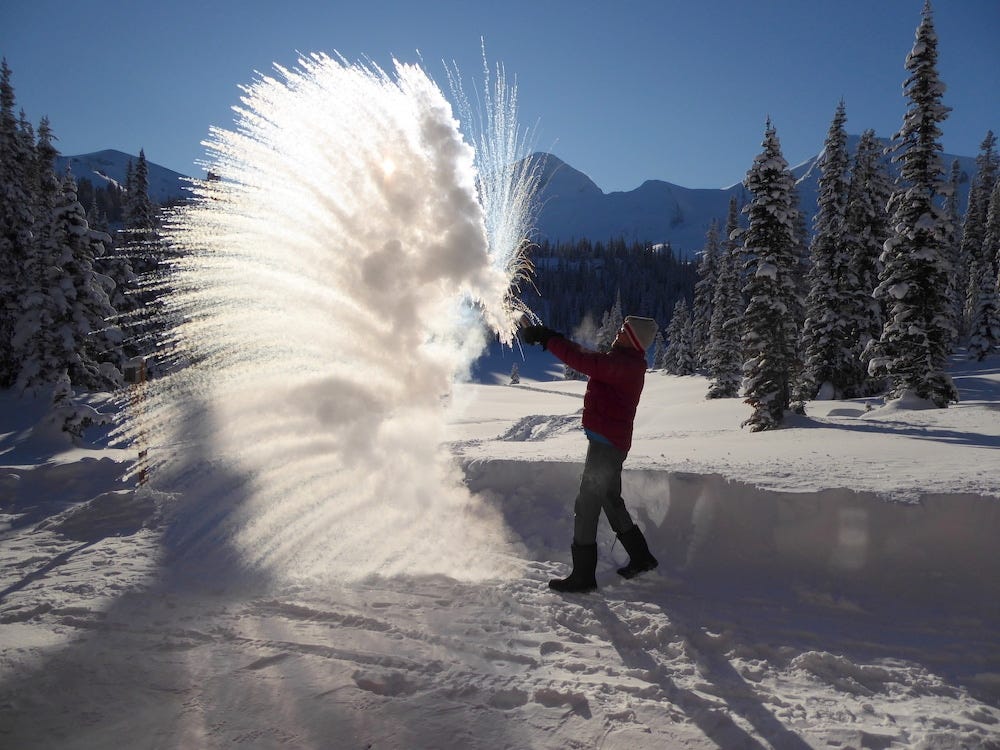
Just how cold is -40? While I don’t think that spittle will freeze solid before it hits the ground, as London describes in his short story, it’s cold enough to freeze exposed flesh in minutes. We used to cross-country ski to a friend’s house after school in temperatures far milder than that, and there were a few sections of the trail that crossed Lac La Ronge. It was frozen, of course. When we were out on the ice, we were exposed to the wind for about five minutes. Once back in the shelter of the forest, we would stop and check our faces for frostbite, which was easily identified as patches of pure white skin. The tips of noses, sharp cheekbones, and earlobes were the most vulnerable. If we spied bits of frozen skin, which happened with some regularity, we covered them with a mitten and exhaled warm breath into our palm until the spot turned pink again.
Engines don’t start very well when it’s -40. The engine oil used to lubricate crankshafts and pistons becomes much more viscous, making it difficult to turn the engine. Batteries become less effective as well. Just ask the cold-climate owners of EVs. Lower battery voltage equals fewer cranking amps trying to turn cold machinery and move a stiff fluid. First-time visitors to cold climates often ask why car owners have electric plugs hanging out of their engine bays. They’re there to provide power to electric block heaters and battery blankets that keep the engine oil movable and the battery operating at full power.
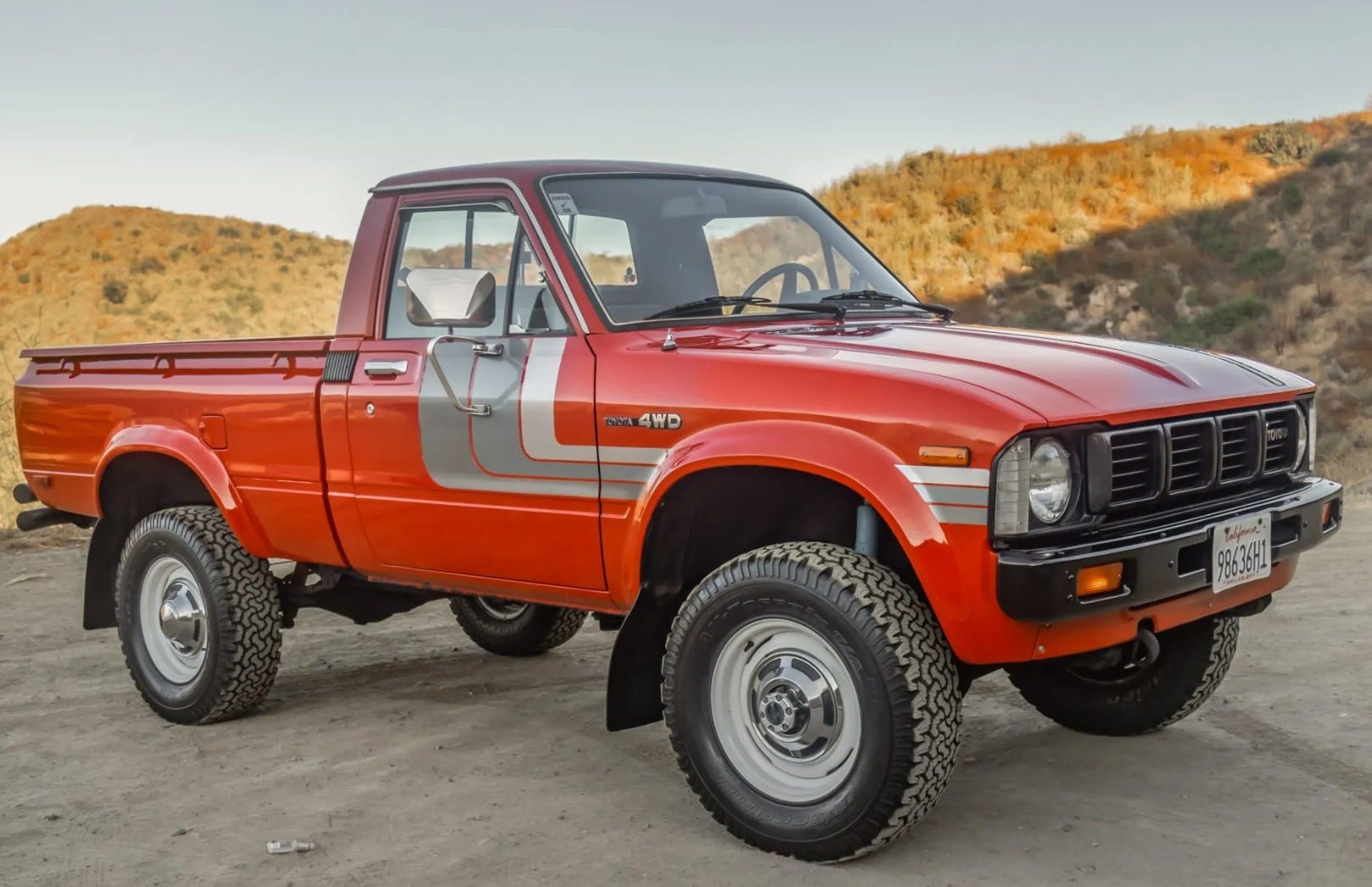
Our story of cold and fire dates back to the early 1980s. My father owned a red Toyota pickup truck with four-wheel drive. I loved that little truck. It could go anywhere, and the extra ground clearance associated with four-wheel drive gave it a nice stance that distinguished it from other small pickups. My parents drove it to school almost every day, and on cold mornings, they sometimes asked me to go out and start the truck so it had time to warm up before they left for work. When the cold was extreme, the bench seat was hard as a board, and the engine vibration made everything shake until it built a little heat for the parts and the oil to move smoothly.
I have written more than once in this column about the cabins built by my family and our friends. They were all located in the area of Lac La Ronge known as Nut Bay, near the town of La Ronge. We used our cabin extensively in the summer, but hardly at all in the winter. It had a wood stove that could keep the interior cozy and warm, even in extreme cold, but it took a long time to knock the chill out of the exterior walls, and there were no extended winter vacations like the two months of summer. We usually limited our winter excursions to day trips on snowmobiles; we would ride from cabin to cabin and inspect them to make sure they were not vandalized.
On rare occasions, we went to the trouble of building a fire, warming the interior, and spending the night. And, since the little red truck could go anywhere, there were times we drove the truck instead of riding snowmobiles. Driving cars and trucks across a frozen lake may sound dangerous to some, but here is an anecdote to indicate the safety margins we were dealing with. During the years we built the cabins, we hauled the bulk of the material to the sites across the frozen lake. You can haul a lot more material with a truck and trailer than you can in the small boats we used on the lake in the summer months. And if you use a diesel hauler and a flatbed, of the sort you might see transporting oilfield equipment down an interstate highway, you can move it all in one load. Yes, we hauled building materials across the lake with an eighteen-wheeler. Twenty or thirty inches of hard blue ice will support a very heavy weight.
In the spring, the snow on the ice surface begins to melt long before the ice beneath it is compromised. The resulting surface has a frosted, pebbled texture that provides decent traction for car and truck tires. I remember a spring day when my father and I were cruising across the lake in the Toyota, the ride as smooth as a highway. We were going 50 or 60 miles an hour, and the interior was as warm as a living room. The sky was clear, but the palest blue, like the ice beneath us. But for dark islands in the distance, the frozen lake was flat white as far as we could see. I commented to my father that there were probably a lot of people in the world who would have a hard time comprehending our surroundings.
In the dead of winter, when the snow was deep, some contractors plowed roads across the ice, but that wasn’t strictly necessary with the Toyota. With four-wheel drive, we could go where we wanted, and on a cold weekend, we drove it to the cabin with the intention of spending the night. The snow wasn’t too deep, so we were able to drive the truck up the island's slope right to the front door. We parked outside just as we would have done at our house. And “we” were my mother, father, and myself. I can’t recall why my younger siblings weren’t along, but they weren’t. There’s no way the five of us would have fit in the tiny cab of the truck.
I don’t remember if there was a larger purpose for our overnight excursion. All I know is we drove to the cabin, started a fire in the stove to warm the place up (it took a while; we tramped around in our parkas for a couple of hours), made some dinner, stoked the fire before bed, and went to sleep. I slept on a pull-out couch in the living area, near the wood stove, and when I crawled under the covers, the fire burned silently behind a thick pane of glass in the stove door. Heated air rolled off the stove in waves, and I shrugged off a blanket or two to keep from sweating.
When I woke a few hours later, the cabin was as dark as a tomb. If I looked closely, I could still spy a few orange coals glowing dully in the woodstove, but the dim light did nothing to illuminate my surroundings. The room was still warm, but not heated like it had been when I crawled into bed. I pulled all the blankets up over my shoulders. Though I shut my eyes tightly and tried to will myself back to sleep, I felt the need to pee. The prospect was daunting. The cabin had no indoor plumbing.
After ten uncomfortable minutes, I threw off the covers and sat up. My jeans were draped over the arm of the couch, and I sat on the edge of the bed and slipped them on. The floor was cold on the soles of my feet. When I looked away from the fireplace, I could make out other shapes around me—walls, the dining table, a hint of shine from the picture window across the room. I walked slowly toward the door, careful to remember the locations of coffee and end tables so I didn’t smash my toes or shins. At the door, I lifted a parka from a hook and put it on over my bare torso, and felt around for some winter boots, either mine or my father’s, to put on my bare feet. The door latch clacked loudly when I lifted it.
The world outside the cabin was as dark as the interior. The air was very cold, very dry. My first breath felt like an icy stab, and it stopped suddenly, as if my body rejected the frigid air. Slower breathing allowed it to warm before I drew it into my lungs. I paused to let my eyes adjust, but nothing changed. The jackpine and black spruce that surrounded the cabin were like wraiths, just a little darker than dark. The forest floor was covered with snow, but white is black in the absence of all light. If I looked straight up, I could see a few stars, faint pinpricks of light between the tree wraiths, just enough to see the snow as a charcoal carpet instead of an abyss. When I grabbed the exterior latch to go back inside, the freezing metal stung my fingers like a brand.
After waking in the middle of the night, my last act should have been to add a few more logs to the fire, but I didn’t. The cabin was still comfortable, and I was anxious to burrow into my cocoon of blankets. The next time I woke, the frosted picture window was the same gray as the coals in the fireplace. I was warm under the covers, but I could feel a chill on my face, and my breath plumed into white clouds whenever I exhaled. Once again, I tramped outside to relieve myself—the trees and snow and the little red truck reconstituted by dim, morning light. Back inside, I opened the door of the woodstove and stirred the coals with a stick. I blew on them softly, and a few glowed orange from the extra oxygen. I added some kindling and blew some more until the sticks were crackling with new flame, then fed in larger pieces of firewood. By the time my parents were up, the cabin was beginning to warm.
My father had a surprised look on his face when he returned from his potty break.
“Damn,” he said. “It is cold out there. I bet it’s close to forty below.
My mother, who was busy using a Coleman stove to melt snow for coffee, reminded him there was an outdoor thermometer mounted just outside the kitchen window. He walked over to the window and peered through the frosted glass.
“Hmmm,” he mused. “It’s a little hard to read through the frost, but it looks like minus 42 Fahrenheit, minus 41 Celsius. In other words, damn cold. We might have a problem getting the truck started.”
We had listened to the forecast before leaving for the cabin the day before. “I thought it wasn’t supposed to get really cold until tomorrow.”
My father snorted with derision. “That’s what they told us. Looks like they’re a bit off.”
“No sense worrying about it now,” my mother replied. “The coffee’s almost ready. Let the sun come up a while.”
When we stepped outside after breakfast, the sun’s rays were slanting through the trees. The air was opaque with tiny ice crystals that scattered the sunlight in a thousand directions. With each step, the snow beneath my boots gave a dry squeak, like sneakers in a gymnasium. The whole truck—paint, glass, everything—was covered with a hard, white frost. The door hinges protested loudly as I tugged and forced it open.
I was able to fumble the key into the ignition without removing my mitten, then pressed the clutch and shifted the transmission into neutral. Both the clutch pedal and the shifter felt like I was pushing them through thick mud. Neither one wanted to move. When I turned the key, the truck made a brief sound, “rrrr,” then nothing. I turned the key back, then tried again. “Rrr.”
My dad was standing in the snow next to me, and he shook his head. “We’re going to have to warm it,” he said.
“How are we going to do that?” I asked. “If we had a generator out here, we could use it to plug in the block heater, but it’s at the house.”
His head was nodding, brow furrowed, as he considered the problem. “We’ve only got one source of heat out here.”
“Yeah,” I said. “Fire.”
“Exactly. Let’s let that firewood in the stove burn down a bit, and then we’ll shovel some of the hot coals underneath the oil pan. Dig out a little hole beneath the engine so they’re not too close to the pan, or any of the belts or hoses.”
The plan sounded a bit dangerous. The combination of heat and gasoline vapor can be explosive. I made sure to dig all the snow out from under the oil pan, but there was no going beyond that. The ground was frozen as hard as the lake ice. I was happy for the extra ground clearance offered by the four-wheel drive.
When the fire in the cabin was reduced to glowing embers, we used a shovel to transfer a small pile of coals to the cavity beneath the truck.
“Be sure to spread them out a bit,” Dad cautioned. “We don’t want a breeze to whip them into open flame.” Kneeling in the snow, I separated them as he asked.
I stood, and he said, “Now we wait. I could use another cup of coffee.”
After thirty minutes, we put our boots and parkas back on and went outside. There were a few patches on the truck’s hood and fenders where the white frost had melted. Rivulets of water ran from them, but froze before they could drip to the ground.
“Looks like we’ve done some good,” said Dad. “Give it a try.”
When I twisted the key, the engine turned slowly. “Rrr, rrr, rrr.” When the engine fired, the cab shook like the cockpit of an old airplane. I glanced at the rearview mirror and could see nothing but a blur of white frost.
In these pages, and in many essays authored by other Substack writers I follow, it is often emphasized that energy is life. The quote below is from my essay Climate Fabians.
Energy is all. The economy, which people think of as money changing hands in exchange for goods and services, is a call on energy. Every good, every service, uses energy.
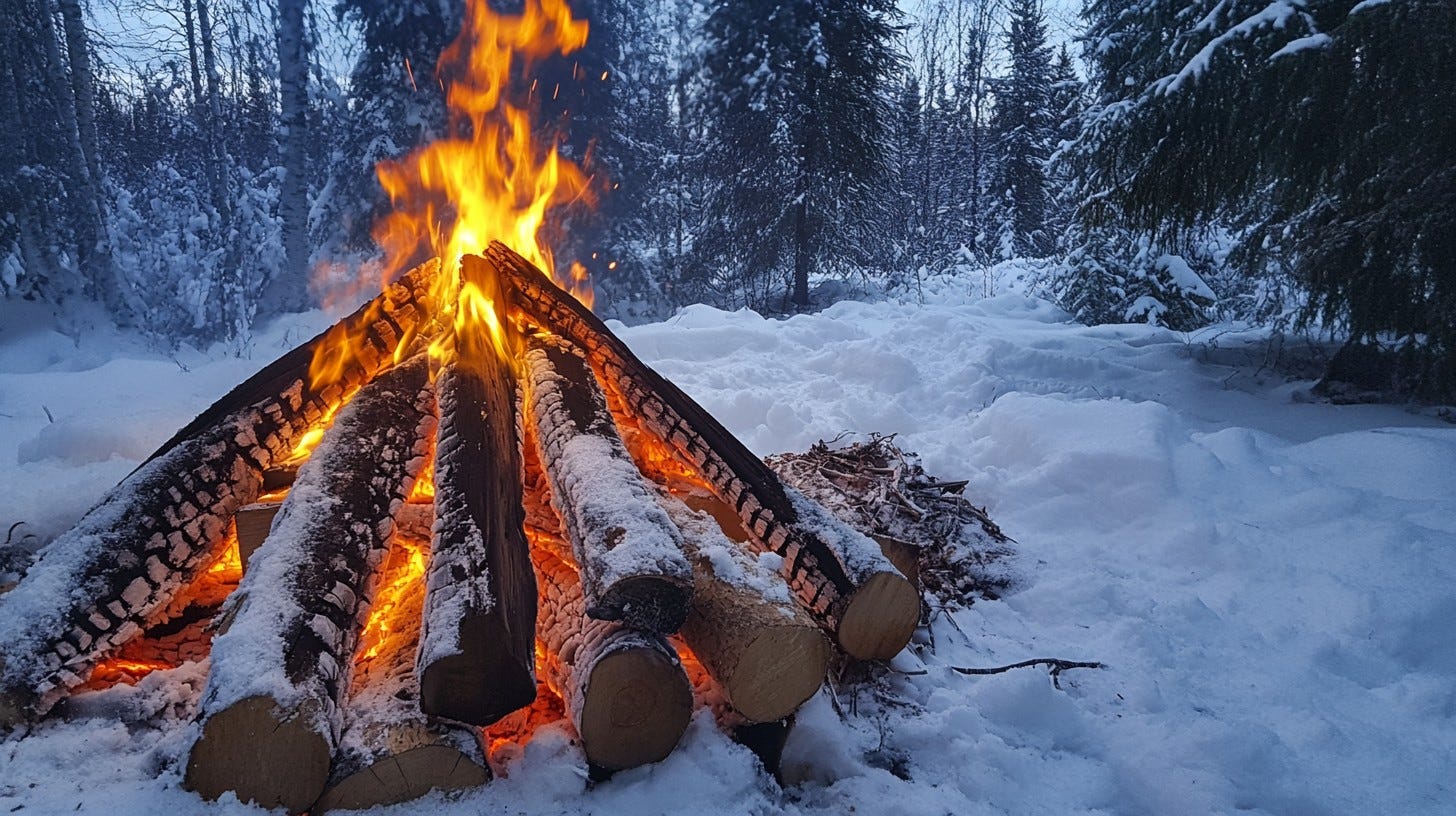
Because hydrocarbon fuels—methane, crude oil, coal—are responsible for 80 percent of the energy content that powers the modern world, we sometimes forget that without combustion, without fire, those invaluable fuels are potential energy. It is fire that transforms them, releasing heat that can be harnessed to do useful work.
The earliest evidence of fire use by human ancestors like Homo Erectus dates back one to two million years. The earliest evidence of fire mastery, the ability to carry equipment that allowed users to start fires at will, is from a Neanderthal site in eastern England that is 400,000 years old. Fire has transformed the lives of humanity and humanity’s ancestors since the beginning of time. In the earliest days, fire provided safety from predators, warmth, and, with the ability to cook food, a more varied diet. Perhaps most importantly, the light and warmth extended the waking hours, allowing its users to socialize, develop language, and expand their intellects. In Jack London’s time, and even today, fire can save us from the elements. Steel, cement, and ammonia-based fertilizers are foundational materials of the modern world. None of them would exist without industrial heat—fire, usually. And without them, we wouldn’t exist, at least not in the ways or numbers that we do. Artificial Intelligence, AI, humanity’s newest invention, which is either salvation or damnation, depending on who you talk to, depends on electrical power, lots of it. Most of it will derive from the combustion of natural gas, aka fire.
In Alchemy, the fire element is the most important. It is the element of transformation. Had he been able to keep his fire going, Jack London’s doomed protagonist could have transformed his circumstances from deadly to threatening. Numerous quotes describe civilization as a thin veneer over a dark ocean of chaos and barbarism. That veneer is forged by fire. Keep it burning.
Like “🖤” this post, and be transformed.
Before you go:
Please click the 🖤 button, comment, share, and subscribe!
Driving on a frozen lake and -40 degrees are a few things I’ll never forget. Your writing is very descriptive, having experienced many of these things myself, I feel like I’m right there watching in person. 👊 great stuff!
You had me going (once again....as always...).
Was expecting you guys to have be rescued by 2 or 3 snow machines, leave the truck there until the weather got to a balmy -10C, or bring another 4X4 back with a small gas generator to plug the Toyota's block heater into (if they even had them in that model).
Still see a few of those 1980 models around, many with 350,000+ miles on 'em. The South American grandchild of that thing (the 4WD Hilux) is the most amazing 4WD truck I've ever seen (though the rural Argentines swear by the pre-2016 versions due to electronics, emissions, and other junk).
Great story, as usual, Trevor.