
Coming Attractions

What you are about to read is an essay in its own right, but its main purpose is to introduce ideas and material I will write about more extensively in the near future.
For the last fifteen or sixteen years, my mother has lived independently in a house in Saskatoon. The house is in a small, gated neighborhood where each separate structure contains two dwellings. The structures are not organized in the classic manner of a duplex, where the two sides are mirror images of each other, and the effect is such that each house feels like a standalone structure, even though it is not. My uncles, Del and Doug, encouraged her to buy the house, and her initial reports to them after moving in were not positive. She had her heart set on a ranch house on its own lot, and the gated neighborhood on Berini Drive was not that. The years proved the wisdom of their counsel, as the small community supplied friendship, assistance, and meaning to my mother’s life. She volunteered for the neighborhood association, participated in the governance of her church, and taught English, the career she loved, to foreign language students at a nearby high school. More recently, as her health made daily tasks like preparing meals and going to doctors’ appointments more difficult, her neighbors delivered food and drove her around the city.
When my wife and I traveled to visit my mother in June, we discussed whether it was time for her to move to a place that offered regular meals and other services. “I’ll think about it,” she answered.
A month ago, Mom moved into a senior apartment building in downtown Saskatoon. There is a nice cafeteria that provides three meals a day, regular exercise classes, and other amenities. So far, Mom is thrilled with the food and is gradually moving in the furniture, books, plants, pictures, and wall hangings that transform a bland apartment into a home. Since her move coincided quite neatly with the Canadian Thanksgiving Holiday, I made the lengthy trek back to Saskatoon to see how she was feeling about the move and to help with some picture hanging and any other customization that was highest on her list.
It is a long-standing tradition in our family to spend the Thanksgiving weekend at the farm where my mother grew up. Changes on the farm over the last few years have reduced the number of beds available to traveling relatives, but Uncle Dwight and Auntie Mary said they had space for us and invited us down. I wasn’t sure Mom was up for a three-hour car trip, but she was enthusiastic about a weekend at the farm, and we left Saskatoon at mid-afternoon on the Thanksgiving Friday. I needn’t have worried.
At the end of last year, I published an essay titled “A Thanksgiving Tale.” Among other things, I described my childhood memories of our annual Thanksgiving road trip to the farm described above. Thanksgiving travel in Canada is not on the same scale as in the United States. Still, I remember busy highways and long lines of taillights stretching into the distance as we journeyed through the fall darkness. As my mother and I departed Saskatoon, I wondered if we would see the steady streams of traffic I remembered, but we didn’t. It didn’t seem like the beginning of a holiday weekend. Perhaps our three pm departure put us ahead of everyone who had to finish a day’s work before hitting the road.
We arrived in Rosetown after an hour and stopped for a restroom break. I purchased a cup of coffee to go, and we continued southwest toward Kindersley. I drove for a while, and neither of us said much. The afternoon shadows began to lengthen, and the radio signal faded. To pass the time, I asked Mom to retell one of the stories from the days she attended the one-room schoolhouse in Portreeve, which was the tiny prairie village closest to the farm. In particular, I asked about the story concerning an older classmate named Jackie. She has told the story before, and I am always struck by the grace, courage, and understanding that the main characters exhibit. Here’s the outline: a teenager is sent from his home in Ontario to live with an Uncle and Aunt on the prairie. The reason for Jackie’s move is his wild and unlawful behavior. The hope is that the hard work, discipline, conservative Christian mores, clean air, and isolation of a prairie farm will influence Jackie to change his ways. As we all know, things rarely work out exactly as we hope. As we ticked off miles and she talked, I asked more questions than I usually do, as an idea took shape in my mind.

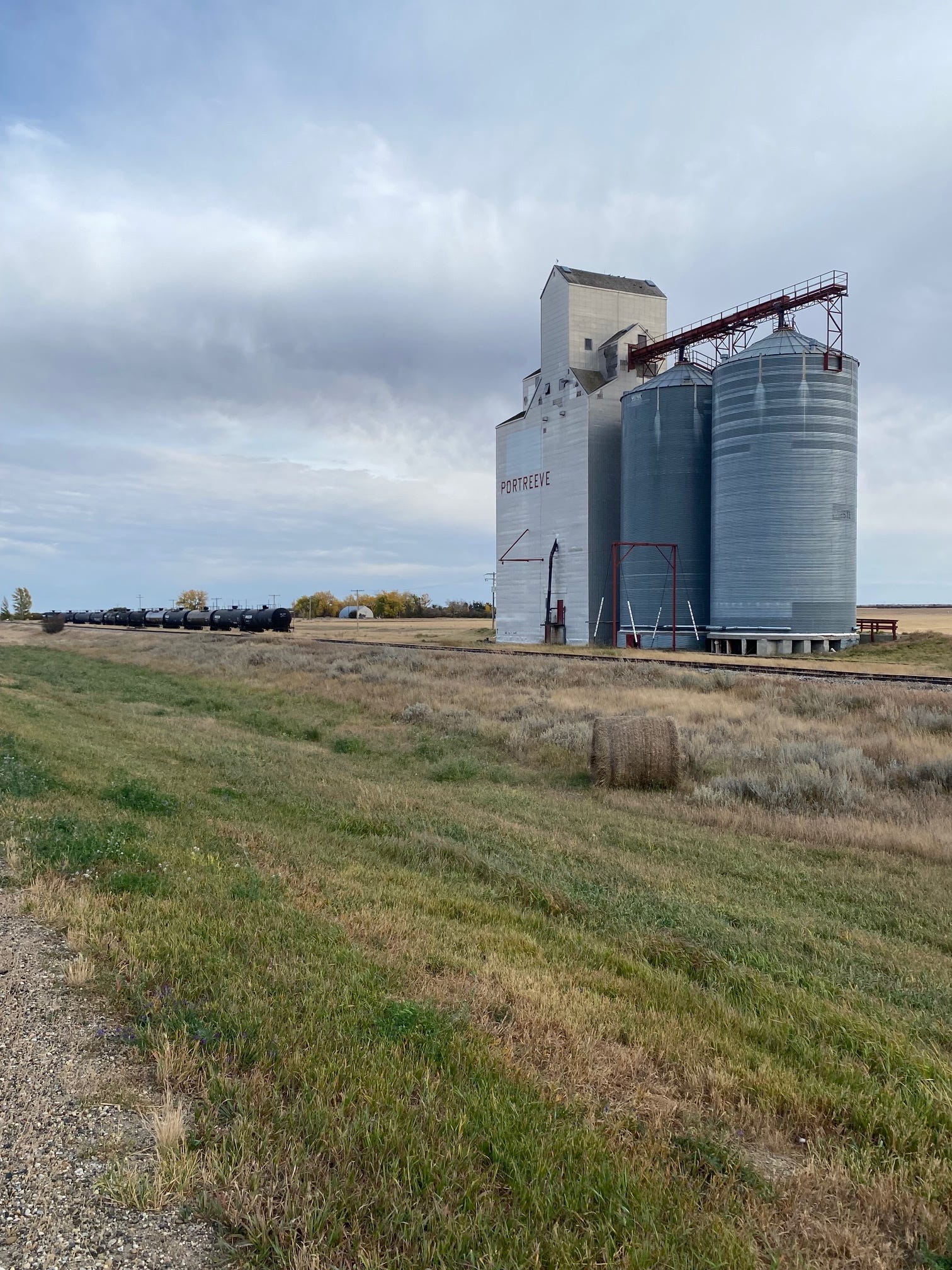
It is this. I will write a series of stories, fictionalized to some extent, based on the childhood remembrances of my mother, my uncles, and myself. All will be set in the Portreeve area. I can think of three good examples at the moment. The Jackie story is one of them. I’ll start a separate folder on my Substack page and keep them there. “Portreeve Stories” is the working title for the folder. Stay tuned!
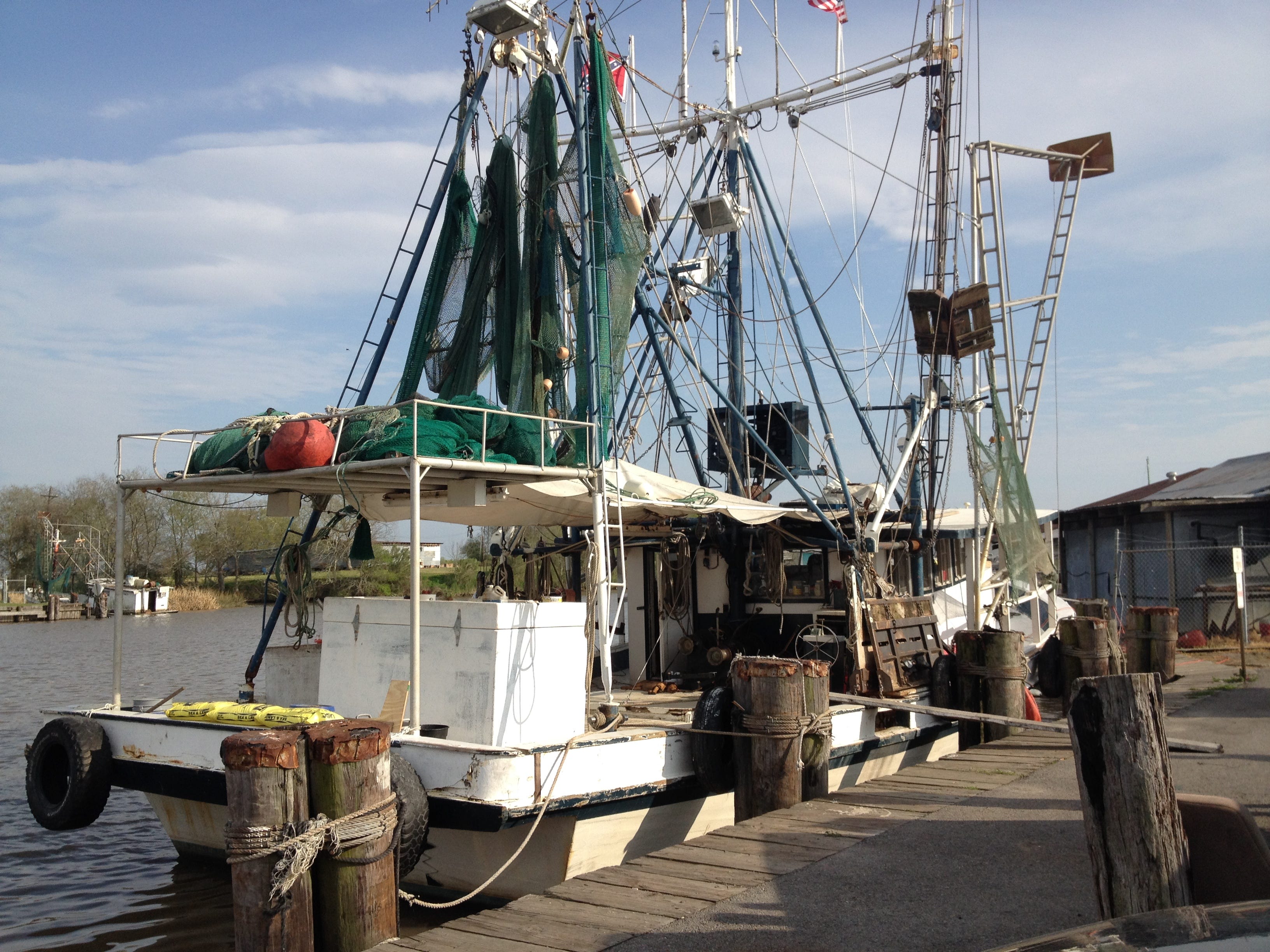
The book “Bayou Farewell,” by Mike Tidwell, is a beautiful eulogy for an ecology and a way of life that is completely unknown to millions of Americans. Published in 2003, the book is the result of a Washington Post editor instructing Tidwell to go to Louisiana and “write about whatever you want.” Tidwell decides that hitchhiking will be part of his story, but not your regular roadside hitchhiking. Instead, he hitches rides on shrimp boats.
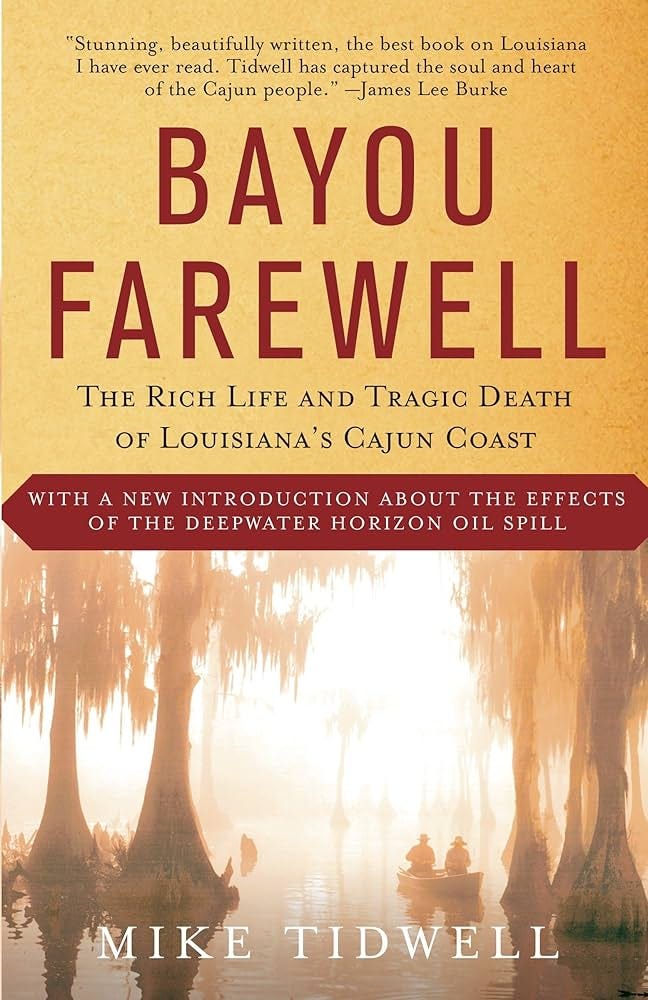
What he learns along the way is that the Louisiana coast, vast stretches of grass and brackish water partitioned by bayous whose natural levees are the only firm bits of dry ground, is at once sinking, which is a natural phenomenon that occurs after fine-grained sediments are deposited in fluvial/deltaic/shallow marine environments, and eroding, which is a consequence of thousands of canals and waterways dredged through the marsh to allow access for the drilling rigs and production equipment used and installed by the oil and gas business throughout the 20th century. Compounding the problem are the levees that fence in the Mississippi River and direct the millions of tons of sediment it carries to the edge of the continental shelf, where it descends, uselessly, into a thousand feet of water. Before the building of the modern levee system, the Mississippi River would regularly flood its banks and deposit much of its sediment load into low-lying marshes and bays that flanked the main channel, thus replenishing and building new marsh to counter the inevitable process of natural subsidence.
One criticism. The “new introduction about the effects of the Deepwater Horizon oil spill” is alarmist rubbish, which is not to downplay the deadly nature of the incident or its aftermath. Throughout the spring and early summer of 2010, as the Macondo well flowed oil, unconstrained, into the Gulf, I prayed for it all to end. Tidwell, however, uses the disaster to raise unfounded fears about the offshore oil and gas industry as a whole. He describes a Shell deepwater platform named “Mars”, much farther offshore and in deeper water than Macondo, in language that shades toward the sinister. At the time he wrote this description, the Mars platform had been safely producing oil for fifteen years. When shrimpers go offshore to help corral and disperse the floating oil, he calls it “the ripping apart of entire families.” And he touts the future benefits of offshore wind, which is probably the worst of the modern ways to harness energy. In some ways, this introduction is a continuation of the final chapter of the book, where Tidwell hitches a ride on an offshore supply boat instead of a shrimp boat. He is so shocked by the proliferation of oil and gas infrastructure that he credits it with changing his life.
What I saw over the next ten hours, described in the concluding pages, changed my life forever. It shocked me so completely that I later altered my career, becoming a clean-energy activist in the fight against oil dependency and global warming.
I’m not sure why the fact that oil comes from somewhere was more shocking than the 70 million barrels per day that the world used in 2003. Or the 100 million barrels per day we’ll use in 2025. You’d think he stumbled on a Congo cobalt mine being worked by hundreds of child laborers.
If you’re interested in reading the book, which I do recommend, try to find one of the earlier editions without the alarmist introduction. Failing that, skip the intro, or read it and try to forget it, as the book strikes a much different tone.
Tidwell notes the incredible fecundity of the marshy coastal ecosystem. Shrimp, crabs, oysters, fish, muskrats, and a dazzling variety of bird life are supported and nurtured by the marsh. It’s a giant nursery for brown shrimp (Farfantepenaeus aztecus) and white shrimp (Litopenaeus setiferus), and Louisiana consistently leads the nation in commercial landings. Whoever authored those beautiful scientific names deserves a Nobel prize. As much as the book is about the fragile ecology of the Gulf Coast, it is more about the people who inhabit the landscape and make their living doing the same things their parents and grandparents did before them—fishing, trapping, hunting, and living self-sufficiently on the rhythm and bounty of the natural world that surrounds them. The author befriends Cajuns, Houma Indians who were pushed to the southern limits of habitable land, and Vietnamese immigrants who leveraged their familiarity with tropical climates and fishing boats to start successful fishing businesses all along the sinking coast.
There is a scene in the book when Tidwell is helping out on the shrimp boat of a Houma Indian named Papoose Plaisance. As the tide runs out in the middle of a spring night, they place his 27-foot trawler in the middle of the current that runs past his camp, which is a ramshackle structure on stilts, surrounded by water and tall marsh grass. There is no electricity, and no source of potable water besides a large cistern that collects rainwater. They carry water in buckets to flush toilets. They fish for as long as the tide runs, and the shrimp come out of the marsh in a flood, filling the nets over and over again, booms creaking and bending under the weight. “What have we here?” says Papoose. When the tide finally slackens and the catch drops off, they have 1000 pounds of shrimp in the hold, and they retire, tired but happy, to the humble camp for a shower and some sleep.
In one of the very few “tweets” I ever composed, I wrote the following. Please note that the final sentence is in jest.
There are only three professions that are truly loved—fishing, farming, and ranching. Some may dispute this, claiming passion and purpose from science, law, or medicine, but what do they turn to when their careers wind down? They buy a little farm or a fishing boat. They tend to some chickens, a few cows, maybe a horse. In short, they are drawn, irresistibly, to the ancient things — farming, fishing, and ranching. There are those who reject the old ways and turn to golf, but they are of bad character.
When I was a teenager, I wanted to be a farmer, and I would dedicate the last week or two of my summer vacation to helping my uncles as the harvest got underway. When I read the passages about Papoose Plaisance and the nights when he and the author filled the hold of his boat with shrimp and ice, it reminded me of the nights I drove a grain truck beside the combine, taking on a load of durum while the combine kept moving, its giant header shearing the golden stalks and leaving a coarse stubble in its dusty wake. As the truck bed filled with grain, I could feel the wheels sink into the earth and hear the engine work harder, just as Papoose Plaisance, nosing his trawler into the current in the middle of the night, could feel the weight of the nets as they filled with dense schools of brown shrimp.
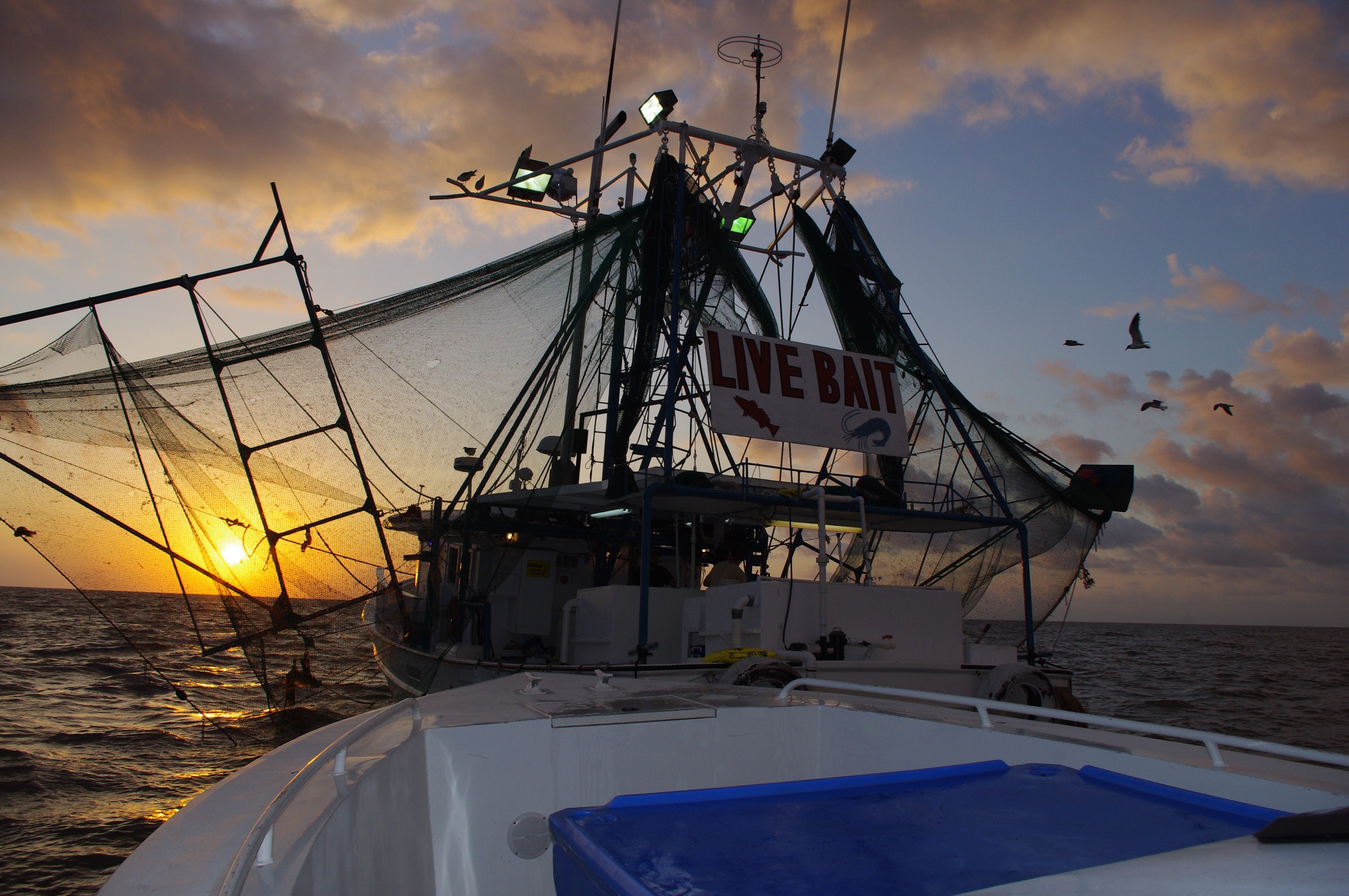
Tidwell’s narrative returns again and again to the need for Mississippi River sediment to be diverted to the marsh, not the deep waters of the Gulf. In the book, Tidwell references a plan called the Third Delta Conveyance Project, which would divert as much as 200,000 cubic feet per second (cfs) of Mississippi River water from the west bank near Donaldsonville and direct it to the upper reaches of Barataria Bay. A set of gates would determine the diversion flow rate, which would depend on the flow rate of the Mississippi itself, as sufficient water would need to be maintained in the mother stream for navigational purposes. To date, two smaller diversion projects have been completed, one at Caernarvon, just east of New Orleans, that sends 8,000 cfs of river water into the upper part of Breton Sound. A second project, located to the west of New Orleans, directs 10,650 cfs into a marshy area north of Lakes Cataouatche and Salvador, which are situated at the upper end of the Barataria Basin. A 2023 assessment of these projects by John White, associate dean of research and a professor at LSU’s Department of Oceanography and Coastal Sciences, ranged from positive in the case of Davis Pond, which was determined to have built over 1.3 square miles of new land, to neutral for Caernarvon, which had “no statistical effect on the land change.”
In the spectrum of ideas being considered to combat land loss in South Louisiana, a project the size of the Third Delta Conveyance Project would be a moonshot, the mother of all land loss strategies. Two hundred thousand cubic feet per second is almost double the discharge of the Mississippi River at St. Louis during minor flood stage. The effect would be to introduce the output of a major river into the Barataria Basin. There would be dramatic consequences for land forms, wildlife, infrastructure, commerce, and the people who live and work in the estuary. The size and impact of such an idea proved a bridge too far, as the plan that eventually made its way off the drawing board was a fraction of its size.
The state of Louisiana received approximately $8 billion in settlement money in the aftermath of the Deepwater Horizon oil spill. That money was earmarked for two main purposes: coastal restoration and economic development. On the coastal restoration side, approximately $3 billion was allocated for the Mid-Barataria Sediment Diversion (MBSD) project. The plan would divert up to 75,000 cfs of river water from the west bank of the Mississippi at mile 61 south of New Orleans and convey it and its sediment west into the middle of Barataria Bay. The project got underway towards the end of the John Bel Edwards administration, but was recently canceled by the current administration led by Governor Jeff Landry. Reasons for the cancellation include ballooning costs, unresolved lawsuits, and the suspension of the Corps of Engineers permit due to a shift in the state’s commitment to the project, plus inconsistencies and omissions in the technical analysis. Coastal conservation groups are incensed and accuse the Landry administration of putting politics ahead of science. Plaquemine Parish oystermen celebrated the cancellation, as they feared the salinity changes would decimate their livelihood. The State of Louisiana, through its Coastal Protection and Restoration Authority (CPRA), is planning to pivot to smaller diversion and coastal protection projects that are less expensive and, hopefully, less controversial.
In one or two future posts, I’ll flesh out my thoughts on Tidwell’s lovely book and the demise of the MBSD. I know people who work in coastal conservation who are disappointed in the decision, and I know a geoscientist who has done extensive work to demonstrate that the active geology of southeast Louisiana makes it unlikely that diversion plans like MBSD will have the desired land-building effects. I’ll speak with all of them and write what I find.
Like “🖤” this post to read more on these topics!
Before you go:
Please click the 🖤 button, comment, share, and subscribe!
Oh we absolutely can't wait for the Portreeve Stories!
Before retirement, had several environmental engineering clients who worked on mid-Barataria sediment diversion projects, on marsh benches/tiers/terraces in South LA, others who did extensive water and sediment sampling in the wake of the Macondo blowout.
The bait boat down in Lake Pelto. Selling shrimp obviously, but what's the other live bait he's selling ..... croakers or pogies?
As a kid growing up in Morgan City, where I saw all ranges of the oil and gas business. From land, to inland, to offshore. It all amazed me! I believe it took me to the place I am today, a Petroleum Engineer. I also have an interest in the sediment diversion of the Mississippi River. Both my Grandfather and great-grandfather worked for the Corps of Engineers. My Grandfather worked on the Old River Structure that helps keep the mighty Mississip' from moving to a different channel. My great-grandfather worked at Port Eades ,working to keep the mouth open for travel. I am looking forward to your writing.