

“How ironic it is that for Canadians the defining battle of the Great War was a glorious victory [Vimy Ridge], while its counterpart, twenty-five years later, was a bitter defeat.” Pierre Berton, Canadian Historian
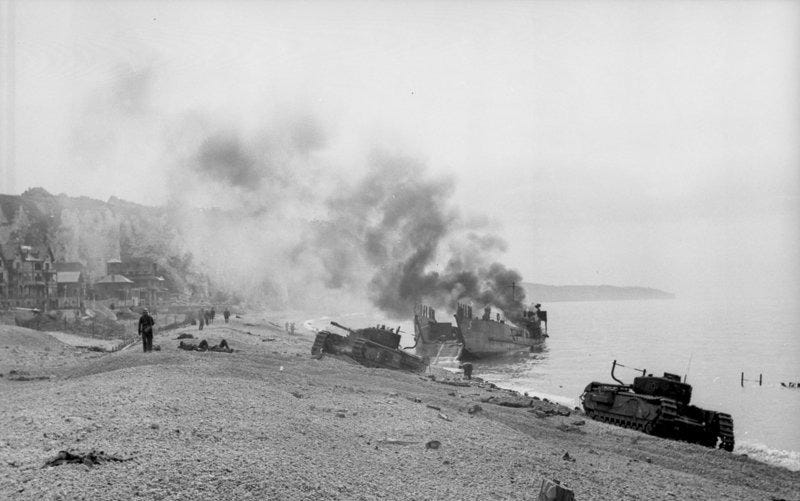
Ten years had passed, but the nightmare still came to him at least once a week. Sometimes it was the beach at Pourville-sur-Mer, just west of Dieppe, the pebbles like marbles a yard deep beneath their boots, loose gravel that slowed men and tanks alike. They ran to the boats, something wrong with his leg, sharp pains that stabbed through him like lightning bolts, other men dragging him by the shoulders of his jacket, Mountbatten’s biggest raid a shambles, while the Germans rained bullets, mortars, and artillery from their redoubts on the cliffs and high ground that flanked the narrow crescent in front of the seawall. That was when he was most scared, worse even than the bridge, which he crossed twice. Though all of it was a shattering violation, of men, of machines, of buildings, of creatures large and small that startled, trembled, and fled from the noise and destruction, it was those moments on the beach, in that neverland that promised safety and annihilation both, as they scrambled and crawled up the ramp of the landing craft, that the fear tore through him as viciously as the bullets and shrapnel that whizzed and clanged all around.
If asked to use one word to describe what it was like to be a young girl, and then a young woman in a tiny town on the Saskatchewan prairie in the 1940s and 1950s, I would choose the word freedom. Although I believe it to be accurate, it could also be misleading. Freedom is a subjective concept. Under similar circumstances, one person may feel free, while another suffocates. So, to be clear, my friends and I were not free of social and societal conventions, which did not decree, but certainly guided us toward hobbies, interests, and careers that fit the parameters of traditions and expectations that changed slowly, if at all. We were not free to travel far and wide, as the infrastructure and machines that are now ubiquitous were just beginning to expand in reach and scope. We were not free to dine in restaurants or attend a matinee showing of the latest movie because our community had no movie theater and no restaurants. And, for good and for bad, we were not free of the burdens, disappointments, triumphs, and fears of our parents. They shaped us, whether we liked it or not, and it’s often the work of a lifetime to discover what part of that shape we want to keep, and what we need to shed.
Our most visible freedom was the freedom to go outside, roam, explore, and play. In the summer, when school was out, we moved to the farm that was five miles north of town. There, I could saddle my horse Donnie and ride across the prairie alone, with nothing but the sounds of the wind, western meadowlarks, and grasshoppers to keep me company. Donnie loved to chase coyotes, and when we saw one, I could feel her muscles tense, and she would turn her head left and right, the whites of her eyes flashing as she tried to get my attention. “You see that, right?” she was asking. And then I would touch her sides and lean close to her neck, reins loose, and we were off, the poor coyote running flat out, Donnie too, until we thudded up beside the panicked canine, its tongue lolling. Donnie would linger for a few seconds, as if to say, “You think you can run?” Then she would peel off and slow to a proud, bouncy trot.
We lived in town from September to May, but there wasn’t much difference in our access to the world around us. Outside the doors of our houses, there was discovery and adventure at all points of the compass. In minutes, we could be holding a secret meeting in a treehouse, or lying in the tall grass on the bank of a dugout pond while butterflies flitted above us and northern leopard frogs croaked and growled along the reedy waterline. We rode bicycles to the general store and paid dimes and quarters for cold bottles of pop and ice cream treats that melted onto our hands as soon as we left the cool darkness of the store. In winter, we slung skates over our shoulders and hiked to the big, wooden skating rink on the east side of town. There was good sledding in the river hills to the north, but that was a ten-mile drive, so it wasn’t a part of our unsupervised escapades. There was, however, a local alternative.
In winter, the sport of curling was an integral part of prairie social life. Most communities, no matter how small, had at least one sheet of ice, and Portreeve was no exception. The curling rink was next to the skating rink on the east side of town. The building was long and narrow, just wide enough for one sheet of ice, and just long enough for that same sheet plus a warming and spectators' room at one end. It had a classic, gambrel roof—steep at the sides, shallower at the top—that made it look like an elongated barn. Since the roof design provided lots of overhead space, the side walls were short, and the overhangs were low. In the winter, the snow sometimes drifted against the side of the building and filled the gap from the roof to the ground. The drifted snow was packed and firm, and we could walk up the drifts, then climb the roof to its peak. From the top, we could slide on our bottoms or on pieces of cardboard, slowly at first, then picking up speed when the roof turned steep. The tall drifts extended the ride all the way to ground level. The rink was used regularly, so there was almost always a cheery fire burning in the woodstove. Whenever our fingers or toes got too cold, we tramped into the little warming room. We sat as close to the stove as we could bear, and steam rose from our winter garb as snow and ice melted in the shimmering heat. The grown-ups, usually men, tolerated us for short periods of time, tempering their language and taking quick, discreet sips from their small flasks of whiskey.
When he woke from his beach dreams at Pourville-sur-Mer, it always felt like the instant that the bullet or piece of shrapnel was about to play its cruel joke and end his life just as he climbed onto the boat that would take him back to England and safety. The skin at the small of his back was damp with sweat. His breathing slowed as his eyes discovered the familiar shapes of the small, dark bedroom. His wife would reach over and touch his arm. “It’s okay,” she would say. “I’m here.”
The other dream, the one from the bridge, was more disturbing and more frequent. It wasn’t usually a part of the dream, but after he woke, sometimes with a cry, he remembered what led to it.
He was nervous in the boat on the way to the beach, listening to the marine diesel change pitch, higher and lower, as they rode up and down the gentle swells of the English Channel. A few of the men smoked in the dark cavity of the hull, and the glowing tips and acrid smoke of cigarettes calmed him, though he never smoked himself. The South Saskatchewan Regiment was one of the few raiding parties that hit their mark on time. The steel hull of the LCM scraped the sand at 4:50 am. When the ramp dropped, the eastern sky was pink, but the headlands that flanked the narrow beach were still cloaked in darkness.
They mustered behind the seawall. They could hear machine gun and mortar fire to their east, at Dieppe or beyond, but their landing, so far, was unopposed. Their mission was to eliminate radar and gun installations in the headlands to their east, then link up with the Royal Hamilton Light Infantry, who would land on the main beach in Dieppe. As they breached the wire defenses and entered the village to find the road that climbed the headlands, they discovered their mistake. The beach at Pourville was long, and in the darkness, they landed west of the river Scie. They found the road, but had to cross the Scie on a small bridge, one hundred feet long and twenty feet wide. Coils of wire hemmed the approach to the bridge. The German defenders correctly viewed the bridge as a choke point and had machine guns and mortars ranged to sweep the span with bullets and explosives. And by the time the South Saskatchewans got there, the Germans were well awake.
His dream always started the same, with the South Saskatchewans pinned down at both ends of the bridge. One small group had made it across early, but several dead soldiers were lying on the bridge, and a German pillbox in the slope to their front laid down a withering fire from a pair of MG-34s if a man so much as twitched in his hiding place. He and his best friend, Tommy, were crouched behind a stone foundation, and even though bullets from the MG-34s regularly smacked and chipped away at their defense, he began to feel relieved. Now that the Germans were fully alert, there was no possible way to cross the river and achieve their objectives. The only thing that made sense was to fall back, defend their positions at the beach, and wait for the boats so they could disembark.
Then their commander, Lt. Colonel Merritt, stood up and took off his helmet. He walked out onto the bridge while 8mm rounds from the MG-34s chipped the pavement all around him. “Come on over, boys,” he called. “There’s nothing to it.”
There was a brief pause, then forty men jumped up and ran across. Most, but not all, made it over. He remained, frozen, behind the foundation. So did Tommy. When the survivors were across, Merritt, unbelievably, jogged back to the center of the bridge and called for more. This time, Tommy caught his eye and nodded. Men around them started to jump up and run, and Tommy did too. Everything in his being told him to stay put, but in warfare, the only thing worse than running into a hail of bullets was not doing it while your friends did, and the prospect of shame was enough to get him to his feet and sprint after Tommy into the firestorm. In the thirty seconds it took him to run across the bridge, he was sure he would die. Bullets passed so close to his head he could feel them split the air. Tommy angled for a ditch on the left side of the road, and he followed. With two or three steps to go, Tommy’s torso jerked, and he spilled forward. “Nooo,” he screamed, as he threw himself down beside his friend. His face was inches from Tommy’s when another round hit Tommy’s helmet. Blood and tissue from inside Tommy’s helmet splattered against his face. Hands pulled him into the ditch, still screaming, while his friend lay dead in the road beside the river Scie. When he woke, he often found his face wet with tears, with his hands scrubbing furiously at his cheeks.
Portreeve was too small a community for us to form cliques or clubs that excluded others based on gender, age, or anything that kids use to divide themselves. When I was ten, the group of us who played and adventured together contained my two best friends, Joanie Carmichael and Mary Hanson, plus a handful of other boys and girls within a year or two of our age. By convention, it was Mary, who was slight and pretty and never without a ribbon in her gorgeous dark hair, who should have resisted some of our wide-ranging explorations and activities, and encouraged us to stay inside or closer to home, but it was not. Mary looked stylish while we were catching frogs, but she always helped to catch frogs. It was a boy who regularly implored us not to venture too far lest we not make it home on time, or not use the roof of the curling rink as a winter slide, or not bring home a whole den of fox kits after their mother was killed for raiding chicken coops. Whenever we asked him why he opposed our plans, Mark Forrester always answered the same. “Because if he finds out, my dad’ll kill me.” When I pointed out that he’d been giving us the same answer for years, and that he had, in fact, crossed some of the lines he said would result in his death, he seemed not to understand. “Deanie, we have to go home now!” he would insist. “If I’m late, my dad’ll kill me.”
Again, by convention, we reckoned it should have been his mother who worried about where he was or what he was doing, but he was never concerned about that. And based on what we knew about Mrs. Forrester, her first name was Rose, he did not need to be. The Forrester house was one street over from ours, on Broadway Street, and we passed it regularly on our way to the general store, or anywhere on Railway Avenue by the tracks and Highway 32. Rose Forrester loved to garden. In the summer, her backyard was filled with rows of potatoes, peas, beets, and carrots, and the front of the house was flanked by beds of flowers that she weeded, tended, and watered almost daily. When our little tribe passed on the sidewalk, we told her hello, and she would turn, sit back on her heels, and wipe a few strands of hair from her face with the back of her hand, as her fingers and palms were usually smeared with rich, prairie soil. Then she would smile and wave.
On a few occasions, we happened by when she was finishing her work, and if Mark was with us and the gang wasn’t too large, she invited us in for a glass of milk and a chocolate chip cookie. I remember sitting at her dining table and watching her move around her kitchen with the same practiced skill she showed in her beds of flowers. She had blue eyes set wide apart, light brown hair, a straight nose, and a thin, wide mouth that opened easily into a smile. I never saw her wear makeup, and her lack of any disguise made me feel like she could never lie or be lied to. When we left her house, cookie crumbs stuck to the corners of our mouths, she tousled Mark’s hair, but never laid down the boundaries of time and space that Mark’s father apparently marked with deadly, but rhetorical threats.
Mark’s father was Glen Forrester, and he worked for a farm implement dealer in the town of Sceptre, which was twelve miles west of Portreeve. Sometimes, during the school year, especially during the short days of winter, when the work of farming consisted mostly of waiting for spring and praying for moisture, we saw him getting into his truck to start his drive to Sceptre. Since we were friends with Mark, we called out, “Good morning, Mr. Forrester.”
Mrs. Forrester was open and warm. Mr. Forrester was not. When we greeted him, he would turn quickly, as if startled. His forehead was usually creased, like he was suspicious or angry about something, and he had dark, wavy hair and dark eyes that pierced in a way that made us think Mark’s fears were not so overblown. He would grunt a reply: “Hmmph. Morning,” then climb in his truck and drive away without saying more. The only thing we really knew about him was that he had been in World War II, but we knew many people with that experience. My father was almost forty years old at the start of the war, so he did not go, but two of my uncles did. Both had been talented hockey players drafted by professional teams before the war, and lost those opportunities, but both came home.
We would never have known that fact about Mr. Forrester, but for Joanie’s observant eye. She had three older brothers who were constantly playing pranks on her. Her awareness was a matter of survival. We were sitting at the Forrester kitchen table on a weekend day in late spring. School was almost out. The days were warm and long. Later, as we strolled toward the railroad tracks, Joanie asked a question.
“Mark, was your dad a soldier in the war?”
Mark stopped short and stared at Joanie in shock. “Who told you that?”
Joanie shrugged. “Nobody. There’s a small photo in an oval frame on the mantel in your den. It’s your dad in a uniform. I could see it from where I was sitting. I just wondered.”
Mark relaxed a little, but he still looked upset. “He never told me anything, but I heard him and Mom talking one night. I asked him about it the next day, and he got mad. He said he didn’t want to talk about it ever, and that I shouldn’t ever tell anyone either. So you better not blab it, ‘cause if he finds out he’ll blame me, and then he’s gonna kill me.”
Joanie smiled and gave him a soft punch in the shoulder. “It’s okay, Mark,” she said. “We won’t tell.”
There were nights when the dreams came to him in the middle of the night, and others when they waited until the morning. Their bedroom window was at the back of the house, facing east, and he would lie in the bed while his heart and breathing slowed. If it were morning, the pink glow at the horizon reminded him of the sky over the beach at Pourville, and he thought bitterly of the old men who committed young men to their destruction. First on his list was Mountbatten, whose commando raids into Norway and France grew larger and more sophisticated with each iteration. Dieppe was 6,000 men, plus ships, landing craft, tanks, and airplanes. In early July 1942, when the raid was called off due to bad weather, the 6,000 men, fully debriefed, disembarked from the ships and dispersed back into the villages and pubs of England. Protocol said the raid, as planned, should not be remounted. The risk of discovery was too great. But Mountbatten convinced Churchill and other senior military leaders that the Germans, on the remote chance they discovered the plan, would never suspect a do-over in the same place with the same objectives.
General Harry Crerar was the commander of the 177,000 Canadian volunteers in England. General Montgomery asked Crerar if he wanted to be the main force in Mountbatten’s newest and largest endeavor. With Canadian politicians and Crerar himself anxious for his troops to prove themselves in combat, he answered, “You bet we want it.”
His feelings about Colonel Merritt were mixed. There was no doubt that Colonel Merritt’s raw courage and sense of duty were the deciding factors that allowed them to cross the bridge over the Scie, but to what end? After they made it over, with the dead, Tommy among them, piled up like sandbags at the margins of the bridge, they fought a pitched battle up the headland for two or three hours. Merritt continued to lead by example, jogging up to the pillbox with the MG-34s and lobbing a grenade through the gun slit under cover of mortar smoke. But mortars and artillery rained down on the Saskatchewans, now joined by the Camerons, and it became clear they didn’t have the numbers or firepower to take out the radar station, which was their main objective. In the end, they turned back, just as he had wanted when he and Tommy crouched behind the foundation at the bridge. But the dead numbered in the hundreds.
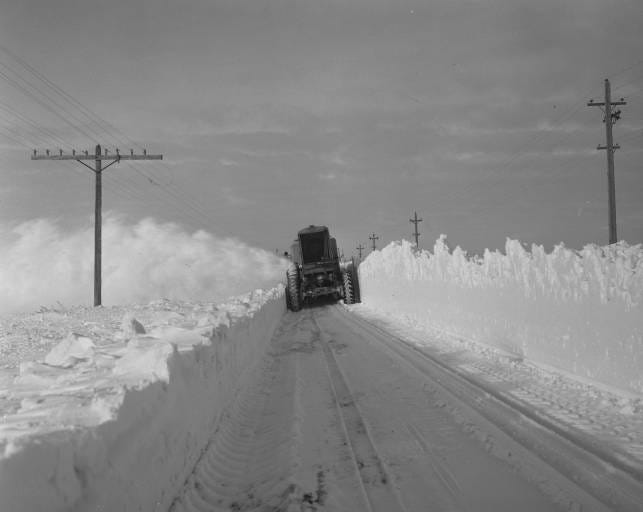
Prairie winters in the 1940s and 1950s were notable for fierce blizzards and consistent, deep snowfall. The blizzards were tough for livestock, but the deep snow, once the weather cleared, added new dimensions to our outdoor recreation. In the giant drift that piled on the lee side of the curling rink, we dug an elaborate snow cave tall enough to stand in. In the interior, we carved benches in the side walls that seated six or eight of us. Joanie took an old coyote pelt from her father’s shed, and we sat on the warm fur and burned a candle in a coffee can. Mary likely saved us from suffocation because she knew that igloos needed vents to allow smoke and poisonous gases to escape. We used the handle of a shovel to poke a hole in the roof, and were amazed at how much warmth a candle flame could provide.
The other end of the building, closer to the warming room, was where we did our sliding. Repeated climbs through the tall drift and onto the roof compressed the snow into a set of steps that let us climb onto the steep roof without difficulty. There was much less snow on the roof, in some places just a skiff. Where the snow was deeper, we packed it into shallow steps, like on the drift, but where it was thin, we scrubbed our feet until we felt the rough shingles beneath.
The only heating system in the curling rink was the woodstove in the warming room, but it had electric lights to allow for late-night matches, card games, and twenty-four-hour bonspiels. In the yard, where people parked their cars, there was a pole with a junction box and a light. A live wire ran from the junction box to the top of the pole inside a length of conduit. From there, it spanned the distance to the rink, where it connected to a small pole that stuck up above the warming room. Our pathways for climbing and sliding passed beneath the span between the yard pole and the building, but it was several feet above us, and we never worried about it.
In early March 1953, a short but vicious late-winter storm kept our school closed on Friday. I was pleased to stay home from school, but soon got bored with reading and helping my mother in the kitchen. I tried to convince her to let me go to Joanie’s house, but she wouldn’t allow it, and for good reason. The wind rattled the windows and pushed small piles of snow past the weather stripping at the base of the door. The floor of the house was cold, and the world outside was nothing but a grey-white maelstrom where you could not tell the sky from the earth.
It was still blustery on Saturday morning, but the heavy snowfall had stopped. The wind picked up the new snow and carried it down the streets in sheets and swirls. The sky was grey, and our small, squat houses looked like a flock of living things that hunkered down and were nearly buried by the passing storm. Nothing moved.
On Sunday, everything changed. The sun rose into a cloudless sky, and the wind was calm. Church services were canceled, and we all slept in later than usual. By nine am, as I sat at our round breakfast table with my parents and my two younger brothers, men and boys were shoveling walks and digging out cars. Our windows were covered with frost, and I peered through the glass and ice, trying to see if any of my friends were outside in the snow. As my brothers were just five and six years old, it fell to me to help Dad shovel snow off the steps and the walks. In truth, I did very little. I had a child’s snow shovel while he had a great, wide metal one that lifted big slabs of drifted snow from the sidewalks. He threw them over his shoulder into the yard, and my brothers had a great time trying to position themselves in the spots where the snow clouds were falling.
By noon, a neighbor with a tractor and a snowplow had cleared at least one lane down every street in town, most of the cars were dug out, and the sidewalks were mostly clear. The bare limbs of the elm trees were sheathed in frost that flashed and glinted in the bright sunshine. The caragana hedges were pure white, and the houses behind them looked cheerful and warm, all of them puffing white plumes of wood smoke or furnace exhaust into the clear, cold air. It was a winter wonderland, and my friends and I knew exactly what we wanted to do.
The woodstove at the curling rink was puffing merrily by the time we arrived. Everyone, adults included, had a bit of cabin fever, and with church canceled, many men found their way to the curling rink for curling, card games, and whiskey. Our climbing steps were filled in, but the drift was bigger than ever, and the roof was caked with new snow. I glanced upward as we started to stamp new steps into the steep snowdrift. “Hey,” I said to Joanie, who was just in front of me and first in the line of climbing kids. Her face was wrapped in an ivory-colored scarf, and when she replied, her breath turned into clouds of condensation that filtered through the scarf and lingered around her face like a halo.
“What?” she answered.
“Look up,” I said. “The wire is different.”
Joanie tilted her head and stared upwards. “You’re right,” she said. “It’s lower.” She turned her head and tracked the electrical wire from the building to the utility pole. I did the same.
Our last outing to the curling rink slide was the previous Sunday, before the savage wind and snow of the blizzard. On that day, the electrical wire was stretched tightly between the rink and the utility pole. Now, the belly of the wire hung low between the two ends. I wasn’t sure, but the utility pole seemed to have a slight tilt, like the Tower of Pisa, though not as dramatic.
“The wind must have pushed on the utility pole and tipped it a bit.”
Joanie turned her head back and forth, then paused to study the pole. “I think you’re right.”
“Do we have room to slide?” I called.
Joanie looked back at the roof. “I think so. We might have to duck a bit on the way up.”
Without thinking further about the possible dangers, I turned and relayed instructions to Mary, Mark, and the other kids behind me. “See the wire?” I said, pointing upwards. “It’s lower than it was before. The wind must have stretched it or tipped the pole or something. Just make sure you duck under it on the way up.”
Half a dozen kids looked up, saw what I was pointing at, and nodded agreement. No one expressed any trepidation about ducking under a live wire. Most of us were well-versed in various dangers associated with farm animals or farm machinery, but contact with a live wire was such an unlikely circumstance that our parents hadn’t warned us about it. Joanie put her head back down and continued to kick new steps into the firm, fresh snow.
On the roof, as before, the best way to climb was to scrub your foot back and forth until you felt the grainy surface of the underlying shingles, then push forward. When she got to the wire, Joanie shrugged her head down between her shoulders like a turtle pulling into its shell, but she didn’t have to bend over to get under it. Joanie was a couple of inches taller, but I followed her example and hunched down to make sure I was well clear of the sagging wire. As I passed under it, I felt the electrical current in the air. There was a gentle buzz or hum that I felt more than heard, and its invisibility gave it a menacing quality, like a spirit that lurked, waiting for an unsuspecting soul to stumble into its lair. I ducked a little lower.
Some of the taller kids behind me, the boys mainly, had to bend more to get under the wire, and we were all slow and careful the first time up, but once we had two or three repetitions under our belts, we were climbing and sliding with abandon. The extra snow on the roof helped us go faster than we ever had, and as soon as we stopped at the bottom, we started back up again. The men inside the building must not have been trying to do any serious curling; I’m sure our constant tromping and yells of delight would have challenged their concentration.
After thirty minutes, our steps in the snowdrift were firm and well-formed, and the path on the roof was grippy. I made so many trips up and down, I could feel beads of sweat on my forehead, and my freckled cheeks were flushed and hot inside the hood and scarf that kept my head warm. We still ducked under the wire, but it no longer felt like a threat. We passed under it so many times.
Though my face was hot, I could feel a cold tingle in my toes. I called out to Joanie to see if she wanted to go inside and sit by the stove for a few minutes.
“One more time,” she answered. “Then we’ll go in.”
Mark Forrester was standing with me at the bottom of our slide, and he echoed Joanie’s sentiment. “Let’s go up once more,” he said.
We were nearly at the top when someone yelled loudly from the bottom of the slide. Mark and I both turned our heads at the sound, and when we did, his left foot missed the bare patch of shingle we were using for grip under our boots. We were just short of the electrical wire when his foot slipped backwards. He was already leaning to counter the steep pitch of the roof, and as he started to tip forward, he instinctively windmilled his hands up and over to break his fall. Mark was tall for his age, and both hands hit the wire.
When I heard Mark’s feet scrabbling for grip, I turned back just in time to see him throw his hands into the wire. There was a hollow “pop” in the air that I could feel and hear, and Mark’s long body instantly contracted into a tight ball. His knees were sucked up to his chest, and his arms were bent and tight to his sides. His gloved hands were clenched tight on the wire, and he hung there, bouncing gently in the crystalline air, like a giant, misplaced Christmas ornament. I froze, wide-eyed, looking up at Mark hanging from the wire, and at Mary Hanson, who was looking down at him from the top of the roof. Mary screamed.
When I turned and looked down, the kids on the ground were as frozen as I was, all of them staring at the boy who hung from the wire. “Get Mr. Ellerby,” I yelled.
John Ellerby was the caretaker of the curling rink. I had seen him earlier when he opened the door and looked up at our troupe of sliders with a frown. I wondered if he was going to tell us to stop, but he went back inside without speaking. Joanie was starting to run when the door to the warming room banged open. I learned later that the men inside heard the pop as well, and that the lights went out at the same time. Mr. Ellerby was first outside. He blinked hard in the bright sun, took one look at the roof, saw Mark hanging from the wire, yelled “Hell’s acres!” and ran for the utility pole. I will remember that run for all of my life.
The warming room was cozy from the woodstove, and all the men had removed their heavy parkas to sit around in home-knit sweaters or plaid woolen shirts that buttoned in the front. Mr. Ellerby wore a plaid shirt and had loosened the ties of his winter boots in the interior warmth. At the time, we didn’t think he was old, but he was an adult, so for him to run in any fashion, as we did all the time, seemed an unusual spectacle. Thinking back, he was probably in his mid-thirties—still young enough to sprint if circumstances demanded.
His stride was long and ungainly, the sort of running you do in heavy boots that threaten to fly off with every step. He was awkward, but fast. It seemed like it took five or six steps to make the distance, though the reality was probably twenty. Fresh snow flew up with each gallumphing stride, and the frozen crystals glinted in the bright sun as he skidded to a stop at the pole. He lifted the lid of the junction box with his left hand and threw the switch with his right. There was a loud clack, and we all froze for a second time, our eyes turned toward Mark, who still hung from the electrical wire.
I was closest to him, and as I watched, his body began to unfold slowly, like the petals of a flower opening toward the sun. His feet were almost touching the roof when his hands relaxed, and he fell to the snowy shingles with a soft thump. He immediately began to slide, and at first, I tried to block him, thinking he shouldn’t be moved, but his limp body and the pitch of the roof were too much for me, and he pushed me backwards toward the ground. His face was turned upwards; it was white, expressionless. His eyes were pinched shut. A lock of dark hair had escaped the edge of his hat. It stood out like a slash of paint on a white canvas. I was sure he was dead.
I glanced over my shoulder as we slid. All the men from the rink were gathered with my friends, and I let us slide faster to get to them. Hands reached around me as we got to the bottom, and I shifted sideways to get out of the way. The men fell to their knees around Mark, and their strength quickly arranged him so he lay on his back, with his hands beside his waist. I heard one of them say, “God help him,” and another yelled for someone to get to a phone and call the doctor in Prelate. I heard more footsteps, thudding against the ground. A car started.
None of the men was versed in first-aid beyond staunching the blood from a cut or scrape, but someone said to lift his head, and big, rough hands immediately cupped the back of his head and lifted gently, while others stuffed a jacket beneath it for a rest. And just as they settled his head on the makeshift pillow, Mark’s body jerked, and a puff of white breath plumed out of his mouth.
“C’mon son,” said Mr. Ellerby, who knelt at Mark’s side. There was another spasm, a cough, and more white breath. Mark’s eyes opened, and he blinked them repeatedly, confused why he was lying on his back with a crowd of people looking down at him. Mr. Ellerby dropped his head in relief, and all around I heard men saying “thank God,” in quiet voices. When Mr. Ellerby finally lifted his head and looked down at Mark, whose breath now streamed from his nose and mouth in regular intervals, he said something different.
“Jesus son. What in hell were ya thinkin’?”
He met Tommy at Camp Shilo in Manitoba during basic training. Like most of the South Saskatchewan Regiment, they had both grown up on farms, though Tommy’s parents were late to the homestead bonanza and chose land at the northeastern limit of the great prairies near the town of Carrot River. Tommy told firsthand stories about black bears, moose, and packs of timber wolves, creatures he knew only from books and magazines. When he thought about his own childhood on the arid prairie of the southwest, it was hard to imagine they came from the same province. They didn’t talk about it much, but their reasons for enlistment were similar: a young man’s yearning for excitement and adventure, a patriotic urge to save the world from the Nazi menace, the opportunity to acquire skills like aviation or mechanical repair, and the security of a job that provided a regular paycheck, food, and a bed. The hardships of the 1930s were still fresh in their minds.
Initially, they bonded over books. A week into training, they were gifted a rare spell of downtime. All the Saskatchewan boys knew how to shoot, and they had done well on the range that afternoon. The drill Sergeant sent them back to barracks early; they had a free hour to shower and relax before the dinner bell rang. He was walking back to his bunk, a threadbare towel wrapped around his slender waist, when he noticed Tommy lying with his head propped against the wall, reading a book. He knew the cover well. It was Jack London’s “White Fang,” and he stopped at the end of Tommy’s bed.
“I’ve read all his books,” he said. Tommy raised his eyes and looked at the young man who stood by his bed.
“So have I,” Tommy answered. “I’m just re-reading this one because it’s all I have.”
“The short stories too?” he asked.
“Some of them. ‘To Build a Fire’ is my favorite.”
He nodded. “It’s a good one. Hey listen. I managed to buy “For Whom The Bell Tolls,” in a bus station on the way here. I just finished it. We could trade when you’re done with “White Fang.”
Tommy nodded. “Sure. But you said you’ve already read it.”
“Yeah. But I’ll read it again. Say, what’s your name?”
“Tommy. Tommy Cernovic.”
“Glen Forrester,” he said, placing his hand on his chest. “Let me know when you’re finished, Tommy, and we can swap.”
From that moment on, the two of them were always on the hunt for new books. They knew they’d have many hours to pass on the ocean passage to England, so they stocked up with whatever they could find from the American greats like Fitzgerald, Hemingway, Faulkner, and Steinbeck. When they got to England, they discovered Conrad, Huxley, and the science fiction of H.G. Wells.
Though the Luftwaffe bombed the major cities and ports almost nightly, well into 1941, the tens of thousands of Canadian troops that arrived in England were mostly billeted in villages and camps along the south coast, where they could drill and train. On a weekend trip to London, they found their way to pubs and restaurants through a blacked-out city and witnessed the rubble of bombed-out buildings firsthand. At night, in the coastal towns where they lived and trained, they could hear the drone of heavy bombers high overhead, their holds filled with explosives destined for strategic targets.
But if not for the blackouts and the newspapers, the war seemed as distant as it had at Camp Shilo. Tommy called it ‘book club with guns.’ It was only when they began to train on the Isle of Wight in the spring of 1942, beach landings and the like, that the prospect of actual fighting became real. As they tromped up the ramp for the first, aborted attempt on Dieppe, Tommy grabbed Glen’s shoulder and gave him a little shake. “We’ve got each other’s backs, right?”
He frowned, looking back at Tommy, wondering why he asked a silly question. “Of course,” he answered.
I answered Mr. Ellerby’s question. “He didn’t mean it,” I said. “We were ducking underneath the wire every time, being careful, but someone yelled on the ground, and he turned his head and didn’t watch where he stepped. Then he slipped, and his hands just flew out when he started to fall forward.”
Mark had a panicked look on his face, and he struggled to sit up. Mr. Ellerby pushed him back gently. “There, son. Let’s rest for a minute. We sent someone to get your parents. It seems like you’re all right, but they might want you to see the doctor and make sure.”
Mark let out a snuffling sort of breath, and I saw tears form in the corners of his eyes and spill down the sides of his face. “N’not my Dad,” he said. “He’ll kill me.”
Mr. Ellerby smiled, and when I looked across Mark’s body to Joanie, who stood on the other side of him, I saw a hint of a smile on her face, too.
“Oh, I don’t think you have to worry about that,” said Mr. Ellerby. “Besides, you made a pretty good run at it yourself. I don’t think he’ll be makin’ your day any worse than it’s already been.”
Again, Mark twisted his torso to sit up, and this time Mr. Ellerby helped him. The path of his tears left wet lines down Mark’s dry, red cheeks.
“What do you think, son? Can you stand?”
Mark nodded, and Mr. Ellerby slid a pair of strong hands under one of Mark’s arms to help him up. When he was upright, it took Mark a few seconds to find his balance, and then he narrowed his eyes, as if he was thinking or confused. Slowly, he tilted his head forward until he was staring at the ground by his feet. “Oh man,” he cried. “I peed my pants. Now my dad is really going to kill me.” I looked where he was looking and saw drops of urine coloring the snow as it dripped past the cuffs of his pants. The snuffling and tears started again, and I tried my best to make him feel better.
“It doesn’t matter, Mark. It wasn’t you. The electricity did it.”
“It m’matters,” he answered. “He’s gonna kill me.”
“Let’s get you home,” said Mr. Ellerby. He signaled one of the other men to grab his coat and gloves from inside the curling rink. “Your parents will be worried when they hear.”
We were a sad procession. Mr. Ellerby walked slowly with his arm cupping Mark’s shoulder and pulling him close. The rest of us—me, Joanie, Mary, and all the kids who were sliding on the roof followed close behind. While we walked, Mark would occasionally sob and then say, “He’s gonna kill me. Oh man, he’s gonna kill me.” We had gone a block when a man dressed like Mr. Ellerby had been, plaid shirt, no jacket, boots undone, came sprinting around the corner from Broadway Street. He raced toward us, and the fresh snow flew up behind him. From our vantage point, it looked like a man running inside a sparkling shroud.
We knew it was Mr. Forrester as soon as we saw him, and we stopped at the side of the road while he closed the distance between us. He slowed as he approached. He stopped a few feet away. His forehead was creased with fear and confusion, and his dark hair hung in lank clumps across his brow. He stared at Mark, breathing heavily, and we wondered if he was angry in the way Mark expected. When he spoke, the words came in short bursts while he tried to catch his breath.
“Are you? He stopped to breathe, then started again. “Are you okay?
Mark looked at his father as if he didn’t expect that question. There was a pause, and then he nodded.
“You’re not hurt?”
The cold and the stress were making his nose run, and Mark took a small, huffing breath to make it stop. “I don’t think so.”
Mr. Ellerby was beginning to explain when Mr. Forrester fell to his knees in front of his son. He grabbed Mark and pulled him tight to his chest. I was standing behind Mark as Mr. Forrester buried his face against his son’s shoulder. All I could see were his eyes. They were pinched shut—in prayer, in gratitude, in something.
The leg wound suffered when they ran to the boats at Pourville—broken bones and soft tissue damage—was enough to get him sent home. Some of the other South Saskatchewans said he was lucky because he was hurt badly enough to be sent home, but not so badly that he wouldn’t recover and live a normal life. That was not how he felt. He felt guilty. He felt ashamed. Of the 5,000 Canadian soldiers who hit the beaches at Dieppe, a thousand died under the German guns, and two thousand were taken prisoner, destined to spend the next three years in German POW camps. Their brave commander, Lt. Col. Merritt, was one of them. After the decision to return to the beach, Merritt led a force in a fierce rearguard action that allowed the boats to return and get men off the beaches. Eventually, Merritt and his men ran out of ammunition and were captured.
He met Rose at a convalescent hospital a month after he returned to Canada. She was part of a volunteer service that brought books to recovering servicemen. When the cast came off, and he started walking again, he asked her out. They were married two months later, and on a trip to meet his parents, the owner of the implement dealer in Sceptre offered him a job.
The baby was born a year hence, at the hospital in Leader. When the nurse brought the infant to the waiting room, she beamed at the anxious father, who stood up from his chair and rubbed his hands together nervously. “It’s a boy,” she said, and held the tiny bundle toward him.
He took the baby and held it close to his face. The eyes were shut tightly, and tiny hands opened and clenched near the chin. It smelled earthy and warm. For some reason, he was reminded of truffles, though he knew of them only from books he had read. With his eyes closed, he vowed silently to do for the child what he failed to do for his friend Tommy. He would have his back. He would protect him, always.
When I asked my father what happened to Mark when he touched the wire, he did his best to explain. We were sitting at the kitchen table, and he grabbed the edge of a plate and tilted it.
“You know, in the spring, when the snow melts, and there are little streams of water that run this way and that?”
I nodded.
“Imagine this plate is a little hillside, and there’s a tiny stream of water running down it. Does the water run straight? Or does it curve back and forth?”
“It usually curves back and forth,” I answered.
“Right. Why?”
“I don’t know.”
“Because the water is always trying to find the easiest path. But to where?”
“The ditch?”
“Well, yes. But beyond that, where is it trying to go?”
“The sea?”
He clapped his big hands. “Right,” he said with a smile. “That little stream is trying to get to the sea. That’s as low as it can go. An electrical current is just like that little stream. It’s always trying to find the easiest path, and it’s always trying to get low, not to the sea, but to the ground.”
“When Mark touched that wire, he was touching the curling rink, which is connected to the ground. So the current immediately took the chance to shoot through him to get to ground. Now here’s the part that saved him, because if he had continued to touch the rink and the wire at the same time, he would be dead.” His face turned serious, and he leaned toward me with no small amount of warning and menace. His blue eyes were fierce. “And if you had touched him to try and help, you, Deanie, would be dead too.”
I shuddered, thinking how close I was to Mark when he fell into the power line.
“The initial shock made all his muscles contract at the same time, which lifted Mark away from the roof. You know how birds can sit on power lines?”
I nodded.
“That’s because they’re only touching the power line, nothing else, and since it’s easier for the current to flow through the wire than through flesh and blood, it zips past them, not through them. Mark was like one of those birds. And it’s a good thing his muscles didn’t relax before Ellerby cut the power. That young boy is very, very lucky,” he said gravely. “And I hope you learned a lesson. You stay off that roof until that line is fixed, and I say that it’s safe.”
“Yes sir,” I nodded.
The March blizzard was winter’s dying breath. In the weeks that followed, warm chinook winds blew from the west and melted the drift away from the curling rink long before the electrical wire was stretched to a safe height above the roof. We never climbed it again that winter, or in the following winter when the snows were not so generous, and the flanking drift never formed. By the time the heavy snows returned, some of our friends were driving, and we made sliding trips to the river hills, where prickly-pear cactus replaced electrocution as our biggest threat, though teens in charge of cars and trucks likely gave our parents some anxious moments. Mark remained a worry-wart. It was his nature, but he never again said, “If my dad finds out, he’s gonna kill me.”
I once asked my mother why Mark’s father was never very nice to us, and she stopped what she was doing to answer my question. She draped a tea towel over a slender shoulder. “Oh, I suspect he’s seen some things that he can’t forget, and you can’t understand,” she said. “You know the phrase, ‘time heals all wounds?’”
“Yes.”
“Well,” she said. “I don’t think it’s always true. Some wounds never quite heal.”
I know that many of you (my subscribers) signed up for my Substack to read the writing I have done on energy, climate, and things related. As you have probably recognized, the spectrum of topics covered in this Substack has grown wide. Memoir, athletics, at least one recipe, fiction (like this piece), and the whole thing started with a movie review of sorts. This lack of consistent focus may be off-putting to some. It’s okay. I understand. For those who keep showing up, please know that I appreciate your support. Best regards … TC
Before you go:
Please click the 🖤 button, comment, share, and subscribe!
Wow.
First, there's plenty of time and no shortage of topics on the energy and climate front.
The Portreeve Stories have a different purpose.
There are plenty of other superheroes in your industry who can turn drill bits 90 degrees 10,000 feet under the ground.
But your fiction combining Burton's recounting of the landing at Dieppe, the Saskatchewan volunteer soldiers, and the tie back to Mom's upbringing on Hwy 32 in SW SK? Show me the petroleum geo in North America who can do THAT!
Off-putting? Please.......
A fantastic story. And, from a philosophical perspective, this is one of the most profound things you've written on Substack, IMO:
"....and it’s often the work of a lifetime to discover what part of that shape we want to keep, and what we need to shed."
Well done, Trevor. Really great.
Don’t change a thing! A diverse array of articles about energy and life are perfect. Oh can I relate to those winter stories with the exception of Curling. It was a different lifestyle and I would not wanted to have grown up anywhere else. The igloo and candle and using a shovel handle to make a chimney, your stories were just great!