
250

“a mixed rabble of Scotch, Irish and foreign vagabonds, [the] descendants of convicts, ungrateful rebels, &c.”
“[the] lowest of Mankind, and almost a different Species from the English”
“fit only to be snubb’d, curb’d, shackled and plundered.” all from papers and letters of Benjamin Franklin, describing how the English viewed the American colonists in the years leading up to the Declaration of Independence
In the Canadian History classes I took in middle and high school, the Battle of the Plains of Abraham was described as a seminal moment in the struggle between the British and French empires for control of colonies and land in eastern North America. The 1759 victory by General James Wolfe, a rising star of the British army who had distinguished himself in battles at Dettingen (1743) and Culloden (1746) while still a teenager, over Louis Joseph de Montcalm on the flat plateau above the St. Lawrence River and the old city of Quebec, was one of a string of British victories that led to their triumph in the French and Indian, or Seven Years’ War. Both Wolfe and Montcalm were killed in the battle, and Montcalm was buried at the Ursuline chapel in Quebec City in the crater of a British bomb. Later, when the tomb was disturbed, Montcalm’s skull was displayed by the nuns in a little box. It became a curiosity that attracted tourists and history buffs. Finally, in 2001, Montcalm’s remains were moved to a mausoleum in a Quebec cemetery that hosts many other combatants of the Seven Years’ War in unmarked graves. Stuart McLean, the Canadian storyteller famous for his Vinyl Cafe series, uses Montcalm’s skull as a plot device in a lovely story titled “A Trip to Quebec.”
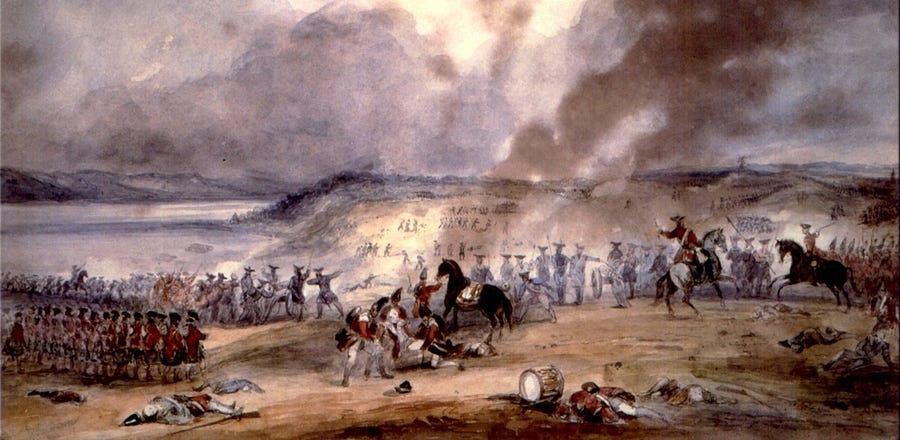
Though it was not emphasized in our classrooms, the famous battle between Wolfe and Montcalm (could the generals have been named any better?) is as important to American history as it is to Canadian. In early 1763, a few years after the clash on the Plains of Abraham, England, France, and Spain signed the Treaty of Paris, which ceded to England all of Canada and all the land east of the Mississippi River. The victory did not come cheaply.
After the war, the British national debt was nearly doubled. Servicing the debt consumed more than 60 percent of the national budget. Parliament also needed £360,000 a year to protect its new holdings. Already taxed more than the French and Spanish, the British public demanded that Parliament raise new revenue from the colonies. Taxes and duties rankled the colonists, but so also did the tight leash that Parliament tried to keep on western expansion.
With fertile land and navigable rivers beckoning from beyond the Appalachian mountains, settlers pushed west into Indian country in Ohio and Kentucky. A Royal Proclamation in October 1763 prohibited settlers from moving west of the Appalachians, but British authority was spread too thin to enforce it or protect the remote farms and villages already established. Conflict between settlers and the Indian tribes was inevitable, and the western frontier was soon host to vicious clashes that left behind burnt, smoking cabins and mutilated bodies from both sides. The frontier anarchy was another source of grievance colonists felt toward Britain. Colonists had helped defeat the French in Canada and expected Britain to help them dispossess the Indian tribes in the West. A century later, with the western frontier now represented by the plains and mountain states and territories west of the Mississippi River, the heated conflict between Indian tribes and white settlers would resume. In this second round of frontier warfare, the power of the United States government, unlike that of Parliament in the 1760s, settled firmly on the side of the settlers. Guided by Jefferson’s vision of an “empire of liberty,” and expansionist doctrine like “Manifest Destiny,” the government sent wave after wave of “Bluecoats” to rout proud nations of Apache, Comanche, Cheyenne, Kiowa, Nez Perce, Navajo, and Sioux to clear the land for settlers and gold miners.
In 1776, the Declaration of Independence signaled the official beginning of the revolutionary process, though there had been skirmishes for years. Sadly, the soaring language of the document—We hold these truths to be self-evident, that all men are created equal, that they are endowed by their Creator with certain unalienable Rights, that among these are Life, Liberty and the pursuit of Happiness.—was not extended to everyone. The most obvious hypocrisy was the enslavement of African people, but the dispossession and debasement of the Indian tribes were abuses of similar magnitude. The irony was not lost on critics. The British writer Samuel Johnson wrote: How is it that we hear the loudest yelps for liberty among the drivers of negroes?
Even after the ratification of the Constitution and the Bill of Rights (1790 and 1791, respectively), the contradictions remained. Wealthy planters had no intention of burdening their valuable businesses with expensive labor, and the southern states were a powerful bloc in the Federal government. In the decades following the revolution, as the voices condemning slavery became louder and more numerous, new “scientific” reasons were invented to preserve the practice. In a dizzying bit of circular logic, the reality of enslavement supposedly proved that Blacks were too cowardly and passive to qualify for the same freedom declared by Whites, even though slave resistance was ruthlessly suppressed.
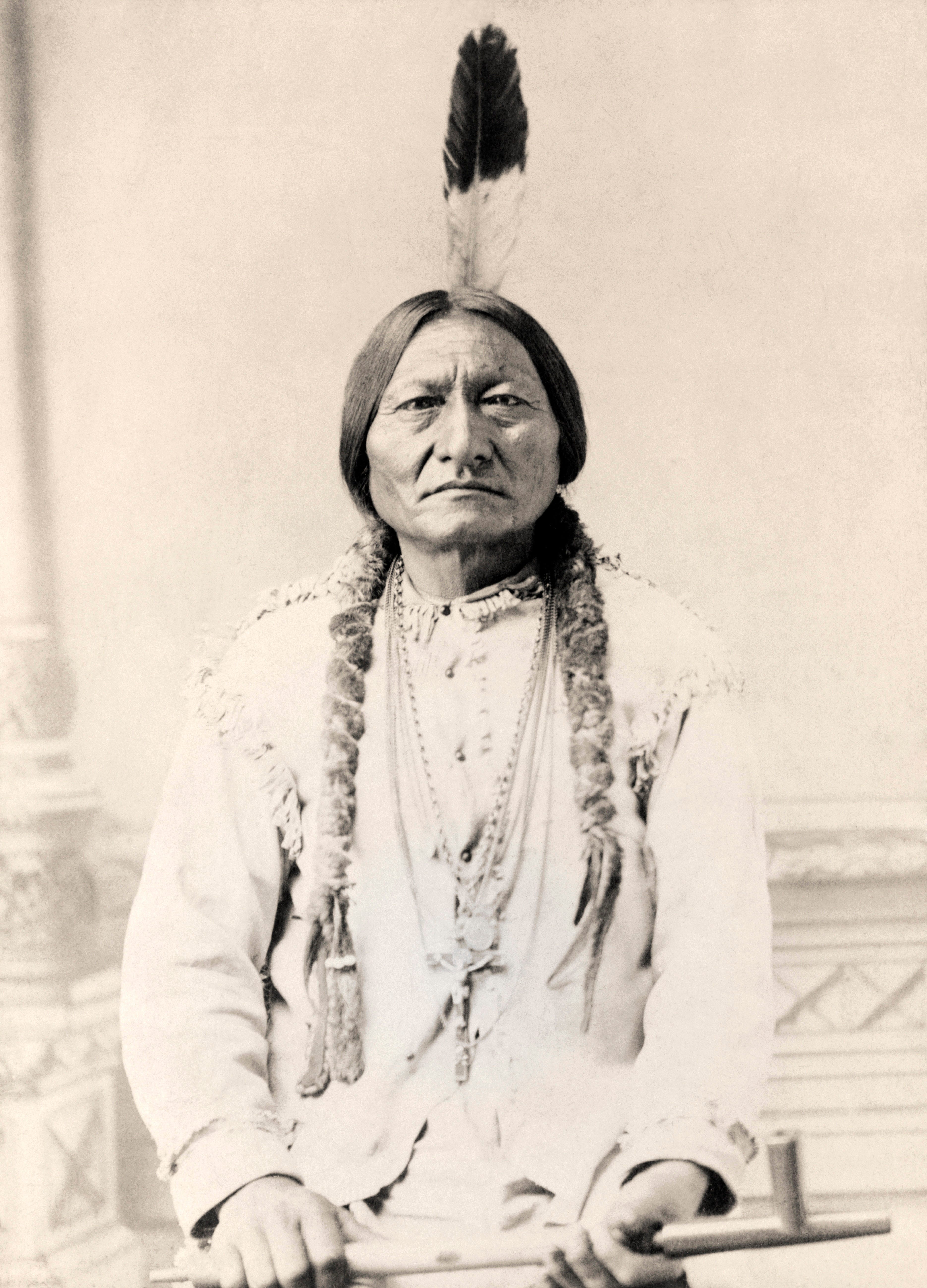
The treatment of the native Indian tribes was no better. It wasn’t until after the Civil War, but in 1868, the 14th Amendment to the Constitution was passed by 28 of the 37 states and became part of the supreme law of the land. A major provision of the Amendment was that citizenship be granted to “All persons born or naturalized in the United States,” thus giving citizenship to all former slaves. It would take another century for enfranchisement to be fully realized, but the groundwork was laid. In contrast, at the time of the Amendment, the Great Plains and Mountain tribes of the West were fighting to avoid the same fate their Eastern brothers had suffered a century earlier. The Indian tribes were considered to be separate, sovereign nations, and weren’t included in the Amendment. The payback for their attempts to preserve their lands and ways of life was war, death, flight, and starvation. In 1868, the Comanche chief Tosawi brought his band to Fort Cobb to surrender to General Phil Sheridan, the famous Union commander. Tosawi knew a few words of English, and when presented to Sheridan, spoke a few words to indicate his intentions. “Tosawi, good Indian.”
Sheridan growled his famous response. “The only good Indians I ever saw were dead.” Such was the attitude of many. It was not until 1924 that all native Americans were granted full citizenship when President Calvin Coolidge signed the Indian Citizenship Act.
From the Declaration to the Emancipation Proclamation, from the 14th Amendment to women’s suffrage, from the Indian Citizenship Act to the Civil Rights era, and onto the modern struggles of today, one of the essential questions in American politics remains whether we have redeemed the Declaration's aspirational language or defaulted on it. As with many things, it depends on who you talk to. We all have our opinions, and the political party that is not ascendant in Washington can be counted on to rue the miserable state of things, but perhaps we’re all too invested in our own struggles and outcomes to be impartial judges. It would be helpful if we could recruit some outsiders to give us perspective on the state of our union as it approaches its 250th birthday. Oh, wait, is there a big soccer tournament going on? Have tens of thousands of people from around the world traveled to the U.S. to watch games and experience an American summer? Are they armed with cell phones and social media accounts to record and broadcast their experiences?
Like Benjamin Franklin’s notes that preceded the body of this essay, the United States is typically treated quite harshly by pundits in other parts of the world. This is most noticeable during Republican administrations like the current one, as the emphasis on free markets, the Second Amendment, freedom of speech, industrial might, military power and readiness, and the preservation of traditional institutions tends to exacerbate the ideological and political differences between America and the rest of the world. America is variously portrayed as violent, unhealthy, unfair, gluttonous, meddling, and backwards in comparison to more enlightened countries like Canada, Australia, New Zealand, and those in Europe. There are plenty of locals who join in the bashing as well.
Freddy the German is probably the most widely known of all the World Cup tourists recording their impressions of America. He and his friends have been traveling back roads, listening to country music, trying to spot “mooses” in Vermont, visiting Amish country, eating fast food, checking out small towns, touring NASA, and stopping at Buc-ees and Bass Pro Shops. Country star Ella Langley and football legend J.J. Watt have hosted Freddy in Oklahoma and Texas. To preserve his anonymity and add to the mystique, he always covers his face in the photographs he posts on X.
(update: Freddy has canceled his account on X. He explained that “too many people seem to have a problem with us having a genuinely good time in this country, and this is ruining the fun a bit for us because we really just wanted to document our road trip and never expected that people would have a problem with it.” Sad. His Instagram account “freddyla7” is still active, but there’s not as much content on it.)
As Freddy and his small entourage journeyed south toward the Gulf Coast, CNN’s Christine Brennan commented on the German tourist and his reception in the USA. She said:
“I saw some conversation, Wolf and Pamela, about how the rest of the world is looking at the United States and feeling that we are—it’s a foreboding image and that we are inhospitable…But how wonderful again, that sports can bring people here and show people that the United States and you know, the South is welcoming a German tourist in a way we would never have anticipated.”
“Never have anticipated?” What “South” is she even talking about? Who is “we”? In 1993, my parents traveled from western Canada to visit my new home in south Louisiana. It was Easter time, late March or early April, prime crawfish season. When they got here, they asked if they should rent a car. I told them no. I would be working at least some of the days they were here, and as long as one of them dropped me off at work, they could use my car. They had both grown up on farms in Saskatchewan, so they spent one afternoon driving through the countryside around Lafayette, observing various forms of agriculture and aquaculture. On a flooded field southwest of the city, they stopped to watch a crawfish farmer pulling crawfish traps. After ten or fifteen minutes, the farmer was curious why a couple in a red sports car stopped to watch him work. He brought his boat up to the bank where they were standing.
“Hey there,” he said. “How y’all doin’?”
“We’re fine. How about you?”
“Not bad. Not bad.” The farmer paused and looked past them for a moment. “Can I help y’all with sometin’?”
“Oh no. We’re just visiting from Canada. Our son moved here a few months ago, and we came down to see him. We like to see the countryside in new places, and we saw you working, so we just stopped to watch for a while.”
“Hmmph. Y’all just stopped cause y’all are interested?”
“Well, yes. I hope that’s okay.”
“Oh sure, sure. Pullin’ crawfish traps isn’t all that interesting to me, but I guess if you're from someplace else … do y’all have any questions?” he asked. His question precipitated a ten or fifteen-minute discussion about how the fields are flooded, seeded, and harvested.
When my parents tried to excuse themselves so he could continue his work, he told them to wait a few minutes, if they could. “I want to give y’all sometin’,” he said.
With that, he went back out into the pond and hurriedly pulled and emptied a few more traps full of crawfish. When he returned, he stepped out of his boat and handed my father a bulging sack of crawfish.
“This is for y’all,” he said.
“Oh, no. We couldn’t possibly.”
“Sure, you can. Y’all took the time to show an interest in my work, so this is my gift to y’all. Look, I’ve got a spare styrofoam ice chest in my truck. You can put them in there so they don’t mess up your car. And you tell your son if he needs any crawfish to give me a call.”
When I got home from work, they handed me a business card and a sack of crawfish. We made a trip to Walmart for the biggest stockpot that would fit on the electric stove in my apartment. We boiled fifteen pounds of crawfish in the tiny galley kitchen, and I still tell the story today. That’s the South that anyone with a smile and an open, curious mind, like Freddy the German, is most likely to encounter.
And that is the America that World Cup tourists are discovering all over the country. In addition to the kindness and hospitality, the visitors are marveling at the gleaming stadiums, the scale of Buc-ees, Costco, and Walmart, the prosperous suburbs, free refills of soda and coffee, and Texas barbecue. Tens of thousands of first-time travelers, who were cautioned about soulless stadiums and a lack of culture, are finding that the United States is brimming with energy, beauty, and wealth.
Perhaps the oldest prejudice leveled at America and Americans is the notion that we are uncultured in comparison to our more sophisticated European counterparts. But this presumes that culture only derives from age and history. French cooking, Italian sculpture, German engineering, and English football stadiums are considered superior to the efforts of their upstart cousins across the pond. In America, you can’t find any 11th or 12th-century Norman churches of the sort that dot the landscape of the Cotswolds like they’re convenience stores, but the dictionary definition of “culture” is “the shared set of beliefs, values, customs, behaviors, and artifacts that characterize a group or society.” Artifacts, like ancient churches, statues, soccer stadiums, and croissants, are only one piece of the puzzle. Also important are the shared beliefs, values, customs, and behaviors. Are we not rich in those?
America is incredibly diverse in both its physical and human geography, but as of this 250th birthday, there are still many things that are quintessentially American. The Declaration, the Constitution, and the Bill of Rights. Thanksgiving, the 4th of July, the work ethic, and the relentless innovation that turned the country into a superpower. Rock and roll, country music, jazz, drive-in restaurants, cowboys, football, baseball, and NASCAR. Free markets, freedom of speech, and the right to bear arms. All this is culture, not just bland whiteness, and the delighted reactions of visiting fans illustrate that American culture has turned the United States into a great place to live.
Another reason that fans, especially those from Europe, are delighted to be here is the air conditioning. With the heat wave in Europe, I have seen several essays (read this one, by Roger Pielke Jr.) contrasting the prevalence of air conditioning in America with its scarcity across the Atlantic. Most of Europe is temperate, heavily moderated by the warm waters of the Gulf Stream—not too hot in the summer, not too cold in the winter. Despite the pleasant temperatures that persist most of the time, heat waves have always been a feature of the European climate. In France, much has been made of the current high temperatures, and similar weather in 2025, 2019, and 2003, but a heatwave in 1911 persisted for 70 days and killed an estimated 41,000 people. The U.K. also endured two months of hot weather in 1911.
The first air conditioner was designed by Willis Carrier in 1902. He installed it in a Brooklyn print shop to lower the humidity, presumably to dry the ink and keep it from running. After World War II, inexpensive window units became widely available, and people in the United States began to cool their homes with them. In hotter parts of the country, central air conditioning systems became a common feature in new homes beginning in the 1960s. Today, estimates of the share of homes and apartments in the U.S. that have A/C range from 75% to 90%. In France, 25% of homes have air conditioning. In England, that number is 5%.
The relative scarcity of air conditioning in Europe is not just a matter of discomfort. People die when it gets hot. Despite their wealth, European countries have the highest per capita heat-death rates on the planet. In 2022, heat deaths across Europe totaled more than 60,000. Most of those who die are elderly or infirm. Air conditioning has been around for more than a century. The fact that they’re choosing not to use it may be the unhappy result of a perfect storm of circumstances.
Circumstance number one is a relatively recent increase in the number of heat-stress days. Since 1980, the number of heat-stress days has been trending upwards. At the same time, the association of hydrocarbon combustion with a warming climate began to influence policy discussions around the world. In Europe, and even in France, where 70% of the country’s electricity comes from nuclear plants that emit nothing more than water vapor, the use of energy to improve the human condition transitioned from a virtue to a vice. Historically, the lack of air conditioning might have reflected the relative rarity of heat-stress weather. Today, it is a choice made by politicians and bureaucrats who prevent landlords from installing A/C in apartment buildings and require documents like certificates of medical necessity when people want to install A/C systems in their homes.
In the face of hostile weather, two approaches can be taken—adaptation or mitigation. In Europe, mitigation is the chosen path—net-zero emissions, degrowth, the use of energy cast as a moral failing. No one knows if the mitigation efforts, even if successful, will reduce the frequency and intensity of heat waves. The Mayor of Paris, Emmanuel Gregoire, noting U.S. criticism of Euro attitudes toward air conditioning, was quick to double down. She stated that “individual air conditioning is a scourge,” and insisted that “public authorities must act quickly” to prevent a flurry of home A/C installations. The delight that World Cup visitors feel when they walk across an asphalt parking lot in Texas and through the sliding doors of a giant, air-conditioned Costco shows they might be down for the freedom to augment bureaucratic mitigation with some individual adaptation.
The federalist model that the founders cobbled together started as a loose federation of thirteen mostly sovereign states. In the 1780s, the Federal Constitution was drafted and ratified in response to diplomatic futility and turmoil within and between the states. Far from resolving those conflicts, the Constitution gave them a new, national focus, as nationalists battled states’ rights advocates in Washington. Constitutional crises flared regularly until 1860/1861, when the secession of eleven southern states initiated the bloody conflict that would decide the nation’s future course. The aftermath—reconstruction, the Great Depression, two World Wars, the Cold War—was difficult, but it saw America expand onto the world stage as a superpower without equal. Today, 35 years after the collapse of the Soviet Union signaled the official end of the Cold War, you can’t swing a cat without hitting someone sure that America is in a state of decline. Washington is dysfunctional, the federal debt is out of control, socialists are on the rise, identity politics affects business and government at every level, and partisan sniping is worse than ever. Against this backdrop of despair, a Substack essay written by Inverteum Capital is titled “America Will Keep Succeeding.” Why the optimism?
According to the essay, it’s the structure.
The federal government is both interchangeable and limited in power, as much of the governance is executed at the state level. Because control of the White House and Congress shifts every four to eight years, no single administration can durably alter the nation’s economic trajectory.
Each state, by contrast, can be a lasting one-party regime. California has been blue and Texas red for generations, giving each decades of uninterrupted policy continuity.
That continuity lets each state compound a flywheel: Texas builds energy abundance, California builds the world’s richest pool of technical talent. These advantages accumulate precisely because no election cycle resets them.
The states then trade with and offset each other’s weaknesses, giving America a diversified portfolio of fifty compounding economies whose prosperity can continue into the future.
The essay lists the top 50 economies in the world. Instead of ranking the United States as a whole, the rankings include the 50 states. Of the top 50 economies in the world, 19 are U.S. states, beginning with California at number 4, and ending with Indiana at number 50. Two states make the top ten: California and Texas. Wealth isn’t everything, but it’s easier to be happy when you can pay the bills, no?
250 years after the Declaration, the redemption of its language and principles remains an ongoing project. All is not roses. But our structure, culture, prosperity, and, from the independent views of World Cup tourists, our kindness and generosity, leave us well-positioned to continue the work. Thousands of soccer fans agree; we’re pretty cool. Happy Birthday, America.
Like (🖤) this post, and you are free to eat all the hot dogs you want.
Before you go:
Please click the 🖤 button, comment, share, and subscribe!
"The delight that World Cup visitors feel when they walk across an asphalt parking lot in Texas and through the sliding doors of a giant, air-conditioned Costco shows they might be down for the freedom to augment bureaucratic mitigation with some individual adaptation."
Surely you're not obliquely advocating for our visitors to return home and, having seen something different than portrayed, tell their countries' leaders and the EUrocrats Brussels where to shove their green virtues! ;)
This annual essay thing you have going with the 4th of July and America is something I really hope you'll continue.
The essence of the things you're capturing with these beautiful essays is providing badly needed perspective, Trevor.
👍👍👏💪
A reflection of progress, very well written. It was common practice to conquer land and expand a country. In some places in the world it’s still happening. It took time but the people spoke and eventually policies reflected the views of the vast majority of citizens. And the story of your parents rings true all over more rural areas of the country. It happened to me too. Curiosity got me during peanut harvesting some years ago. I stopped to watch and before you know it I was riding with the farm owner getting a first class tour and education about how they are picked, moved, hauled and where they were headed. Found out that day that peanut oil is so valuable they extract it and when they make peanut butter they mix it back with less expensive oils like corn, cottonseed, or vegetable oils. In 1997 I met a guy at a bird dog field trial. He invited me to his house on July 4th. He was from Lake Charles Louisiana. I had no idea what to expect. He lived in our current hometown, but at that time I was a few hours away NE of Atlanta. I showed up with a cooler of beers and some fresh sweet corn. He and his family welcomed me like family, around the back patio was a massive pot of boiling water. He looked at me and said “ you ever eat mud bugs” or have a low country boil? I was a bit lost for words, I saw these big bags of crawfish and was able to put the lingo together. I had eaten crawfish while on a canoe trip in the boundary waters once when we were low on food and the fish didn’t want to bite. I didn’t recall them being good or bad, we were hungry and they did the trick. Anyway, I watched in awe as he built this massive meal and as more and more people arrived I was sure they all must have been experts on eating these critters. There must have been 40-50 people there by the time it was ready to serve. He and his family gave a lesson on how to properly eat a crawfish 🦞. Most people had never tried them either, by the end of the afternoon it was like a giant family reunion, but none of us were related! Happy birthday America 🇺🇸 thanks for putting this out Trevor! You all be safe, I spent a July 4th weekend fishing out of Grand Isle in 2022. That was the wildest party I’ve ever witnessed! Bottle rockets and grenade type fireworks filled the sky on every night I was there, it was highly entertaining 🎆🇺🇸🤠🧨